🧠 Hallucinations and delusions usually start in a person's teens or twenties. When they arrive for the first time after 40, medicine has had almost no way to see what is driving them. A Japanese team has now scanned the brains of 37 such patients and found that roughly two-thirds were carrying tau, the protein behind Alzheimer's disease and several other dementias. The result was published in Molecular Psychiatry on August 3, 2026.
The psychosis that shows up late
Psychosis is the umbrella term for hallucinations and delusions, and it covers conditions like schizophrenia and delusional disorder. The textbook picture is a young person: symptoms surface in adolescence or early adulthood, and treatment plans are built around decades of illness ahead.
But a substantial group of people first develop these symptoms in their fifties, sixties or later, and they don't fit the textbook. An international consensus published in 2000 split them into two categories, late-onset schizophrenia for symptoms beginning between 40 and 60, and very-late-onset schizophrenia-like psychosis for onset after 60. Compared with younger patients, they tend to have vivid persecutory beliefs (that neighbors are coming through the walls, that someone is interfering with their home) and far less of the flattened emotion and disorganized thinking that characterize early-onset schizophrenia.
Two lines of evidence have long hinted that something else might be going on. A Swedish national registry study following more than 15,000 people with very-late-onset psychosis found an elevated rate of dementia diagnosis in the two decades after their psychiatric symptoms began. And autopsy studies of similar patients kept turning up neurodegenerative changes: argyrophilic grain disease, Lewy body pathology, corticobasal degeneration.
The problem was that autopsies arrive too late to help anyone, and registry data cannot tell you what is happening inside a particular brain. The affected population keeps growing. Japan's population aged 65 and over reached 36.19 million as of September 15, 2025, or 29.4% of the country, the highest share among the 38 nations with populations over 40 million. According to the Institute of Science Tokyo's announcement of the study, only about a quarter of people who develop psychosis in later life are actually receiving treatment for it.
Even the name is unsettled. The Japanese rendering of "psychosis" was long seishinbyō, literally "mental illness," a word that carried heavy stigma. The academically preferred alternative seishinshō was formally adopted as the official Japanese translation in a January 2026 government notice implementing ICD-11.
Scanning 37 brains
The team was led by Manabu Kubota, now at Kyoto University's Graduate School of Medicine and based at the National Institutes for Quantum Science and Technology (QST) when the work was done, with Shin Kurose of Keio University as co-first author. They recruited 37 patients whose psychosis began after age 40, alongside 47 healthy older adults. Recruitment ran from July 2017 to October 2023. Patients had shown no cognitive impairment or neurological disease when their symptoms first appeared, and anyone with a psychiatric history before 40 was excluded.
Each participant received two PET scans. One used 11C-PiB to map amyloid beta. The other used florzolotau (18F), a tracer developed at QST that binds to tau.
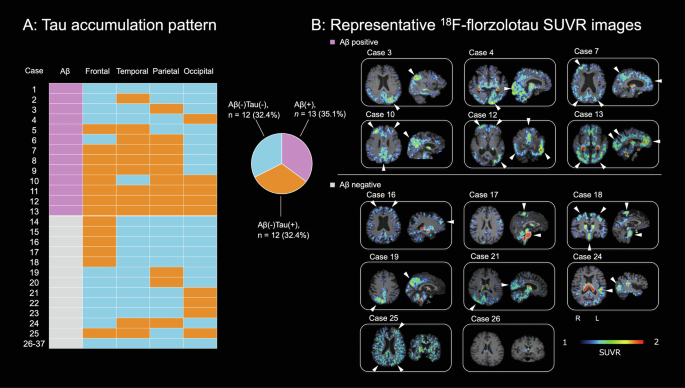
The numbers came out lopsided. Tau was detected in 24 of the 37 patients, or 64.9%, against 7 of 47 controls, or 14.9%. Amyloid showed up in 13 patients (35.1%) versus a single control (2.1%).
The patients split into three near-equal groups
Thirteen patients (35.1%) were amyloid-positive, the signature of Alzheimer's disease, and twelve of those thirteen also had tau. Every one of them had developed psychosis after 60. Another twelve (32.4%) had tau without amyloid, a pattern pointing to non-Alzheimer's tauopathies, the family that includes progressive supranuclear palsy, corticobasal degeneration and argyrophilic grain disease. The remaining twelve (32.4%) had neither.
From the outside, in the clinic, all three groups look the same.
Across the whole patient group, tau accumulated most conspicuously in the parietal cortex. Within the amyloid-negative subgroup, both the parietal and occipital regions stood out. Both sit at the back of the brain and both feed into the frontoparietal network that handles attention and top-down control, which the authors suggest may be part of how the symptoms arise.
At the individual level, the patterns were all over the map: tau concentrated in one parietal lobe but not the other, deposits in the precentral gyrus and brainstem, lopsided temporoparietal spread. Among amyloid-positive patients, more tau in the parietal cortex tracked with worse scores on the Frontal Assessment Battery, a bedside test of planning and attention (r = −0.58, P = 0.04). None of the 37 had visual hallucinations, the symptom that would usually point toward Lewy body disease.
Source: Kubota et al., Molecular Psychiatry (2026), CC BY 4.0
Why the tracer had to be this one
Tau is not one thing. It comes in isoforms, and the aggregates differ by disease: Alzheimer's involves a mix of three-repeat and four-repeat tau, while progressive supranuclear palsy and corticobasal degeneration are four-repeat diseases. A tracer tuned to one type is blind to the others.
The first tau PET tracer to reach the market, flortaucipir (sold as Tauvid), was approved by the US FDA on May 28, 2020 for evaluating patients with cognitive impairment for Alzheimer's disease. It works for what it was built for. But researchers have documented that it struggles to pick up four-repeat tau, and PET studies of progressive supranuclear palsy using it largely failed to capture the underlying pathology. The approved US labeling points at the same constraint from the other direction: Tauvid is not indicated for detecting chronic traumatic encephalopathy, because the shape and spread of tau in that condition may keep the tracer from binding reliably.
Florzolotau, also known as 18F-APN-1607 or 18F-PM-PBB3, came out of Makoto Higuchi's group at QST, refined from an earlier compound called PBB3. It detects three-repeat and four-repeat aggregates as well as Alzheimer's-type tau. The precursor is supplied by APRINOIA Therapeutics, which received FDA Fast Track designation for the tracer in progressive supranuclear palsy diagnosis on May 8, 2024.
Run this same study with a first-generation tracer and the twelve amyloid-negative, tau-positive patients, a third of the cohort, would most likely have registered as normal. Higuchi and co-author Ming-Rong Zhang hold patents on related compounds, which the paper discloses.
A century-old line starts to move
For most of the twentieth century, psychiatry and neurology divided the brain between them along a rough line: neurology took the diseases you could see in tissue, psychiatry took the ones you could only infer from behavior. Late-onset psychosis was filed under psychiatry more or less by default, largely because nobody could look.
In the QST announcement, Kubota described the work as starting from "a clinical question." Patients can arrive with the same hallucinations and delusions and then follow completely different courses, responding differently to treatment. He wanted to know whether something biologically different was going on inside each patient's brain.
If a third of these patients are in the early stage of Alzheimer's, a third are developing a non-Alzheimer's tauopathy, and a third have something else entirely, then a single treatment plan cannot fit all of them.
The authors state the caveats plainly. Thirty-seven patients is a small cohort, and they call their subgroup analyses exploratory. No autopsies were performed, so the imaging has not been confirmed against tissue in these particular people. Patients had lower educational attainment than controls, which independently associates with tau burden. The main findings survived adjustment for it, but the occipital signal in amyloid-negative patients weakened to a trend. And the study does not explain the third group at all: twelve patients had neither protein, and what is behind their symptoms remains open. An association between tau and symptoms is also not proof that tau causes them.
Will there be a drug in time?
Anti-amyloid antibodies have reached patients, but tau has been harder. Johnson & Johnson discontinued its Phase 2b trial of the anti-tau antibody posdinemab in November 2025 after it failed to slow decline in more than 500 people with early Alzheimer's. Then in May 2026, Biogen and Ionis reported that their tau-targeting antisense drug diranersen had missed its primary endpoint in the 416-person Phase 2 CELIA trial. That endpoint was dose response, and higher doses did not work better. Prespecified secondary endpoints did point to a slower rate of decline, most clearly at the lowest 60 mg dose, where worsening on the CDR-SB scale was reduced by 0.54 points, or 26%, against placebo, though most of those differences reached only nominal statistical significance. Biogen presented the full data at the Alzheimer's Association International Conference in London on July 14, 2026, and as of July 2026 the company plans to move into Phase 3.
Even in the best case, though, those programs target Alzheimer's. Progressive supranuclear palsy, one of the non-Alzheimer's tauopathies that appear to account for a third of this cohort, still has no approved disease-modifying treatment, and reviews of the field describe trials there as still working out which measures are sensitive enough to track progression at all.
Which is where an aging society becomes something other than a burden. Japan had an estimated 4.43 million people aged 65 and over living with dementia in 2022, 12.3% of that age group, projected to reach 5.84 million by 2040, according to a Ministry of Health, Labour and Welfare research group led by Kyushu University's Toshiharu Ninomiya. That pressure pulls in research money: this study ran on grants from the Japan Society for the Promotion of Science, a JST Moonshot program on dementia-related disorders, and AMED. A tracer that sees the non-Alzheimer's tauopathies, and a cohort large enough to scan every patient twice, are what a country this far into aging can build.
And where you are?
Nothing changes tomorrow. Florzolotau remains an investigational agent rather than a routine clinical test, and as the research team points out, there has been very little by way of an objective, biological measure for hallucinations and delusions, even as Alzheimer's diagnosis moved steadily toward measuring proteins.
How does your country handle it when hallucinations begin late in life? Does the case land with a psychiatrist, a neurologist, a geriatrician, or nobody at all? And if a scan could tell a family that what looks like a psychiatric illness may be the opening act of dementia, would they want to know?
References
- https://www.isct.ac.jp/ja/news/5wj8ll0op2pb
- https://www.nature.com/articles/s41380-026-03749-3
- https://www.miragenews.com/brain-scans-show-tau-buildup-in-late-onset-1721467/
- https://www.accessdata.fda.gov/drugsatfda_docs/nda/2020/212123Orig1s000Approv.pdf
- https://www.accessdata.fda.gov/drugsatfda_docs/label/2020/212123s000lbl.pdf
- https://pmc.ncbi.nlm.nih.gov/articles/PMC10027831/
- https://pubmed.ncbi.nlm.nih.gov/34030750/
- https://www.biospace.com/drug-development/j-js-anti-tau-bet-falls-flat-in-mid-stage-alzheimers-trial
- https://investors.biogen.com/news-releases/news-release-details/biogen-presents-phase-2-celia-data-aaic-demonstrating-meaningful
- https://aprinoia.com/aprinoia-therapeutics-announces-fast-track-designation-granted-by-u-s-fda-to-apn-1607-florzolotau-for-the-diagnosis-of-progressive-supranuclear-palsy/
- https://pmc.ncbi.nlm.nih.gov/articles/PMC11775610/
- https://www.stat.go.jp/data/topics/pdf/topics146.pdf
- https://www.mhlw.go.jp/content/001279920.pdf








Global Discussion
4 comments