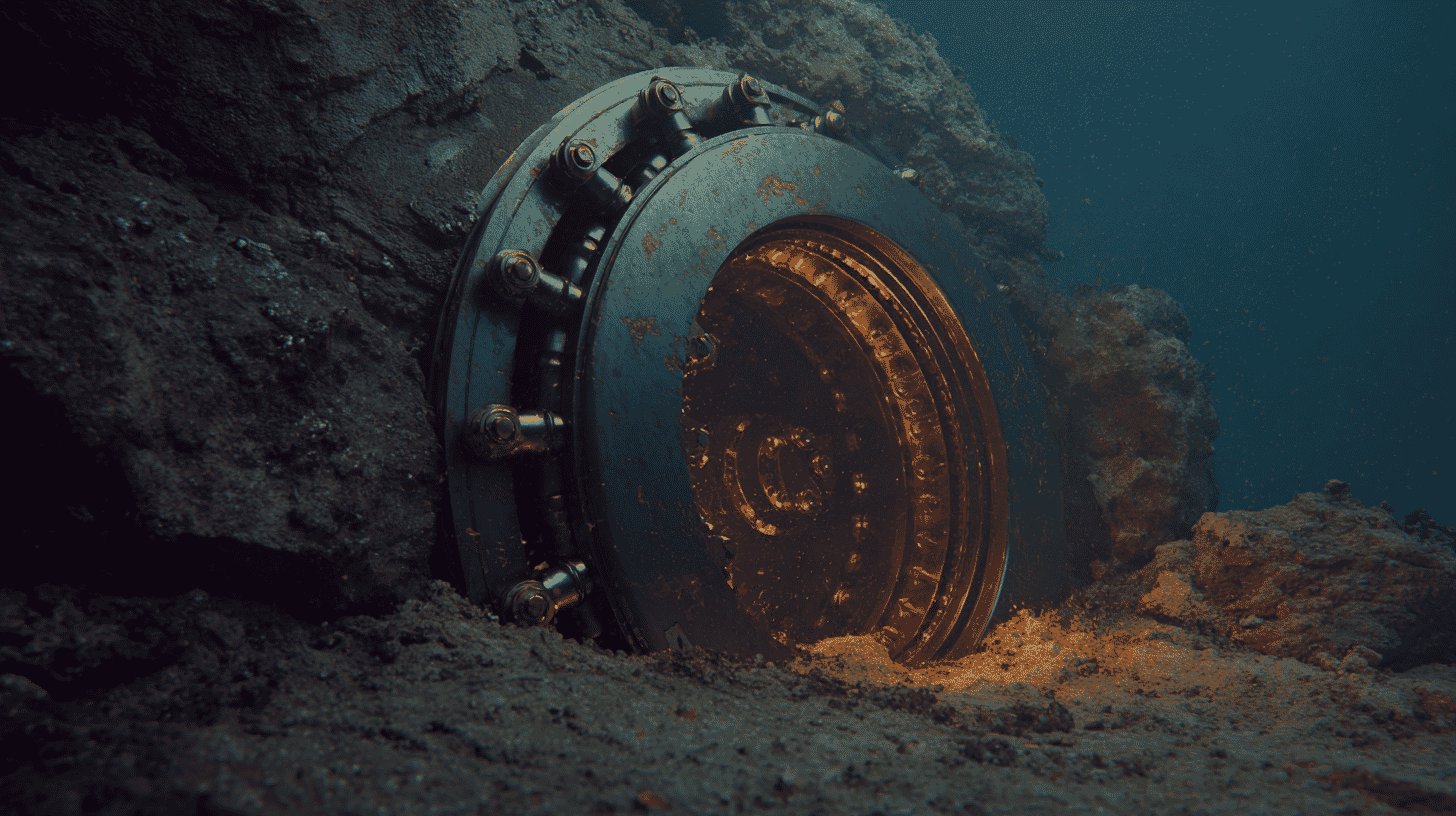
The "Rare Metal King" explains why Minami-Torishima's 16 million tons of rare earth mud is worth more sitting on the seafloor than on a cargo ship, as a silent deterrent co-held with the United States.
In February 2026, Japan pulled rare earth mud from 5,700 meters below the Pacific near Minami-Torishima (also called Marcus Island), a tiny coral outpost 1,800 km southeast of Tokyo that marks Japan's easternmost point. Politicians cheered. Headlines hailed Japan as a future "resource superpower." But Shigeo Nakamura, a trader nicknamed the "Rare Metal King" after 50 years in the business, now chairman of UMC, read the news and essentially said: great technical achievement, terrible commercial idea.
His counterintuitive thesis: don't mine it, but make sure the world knows you could. Minami-Torishima isn't a mine-in-waiting. It's a geopolitical card to be held, not played. And ideally, held jointly with Washington.
This is a story about invisible resource diplomacy, the strategic value of an option you never exercise.
Who Is Shigeo Nakamura? The 50-Year Trader Behind the "Don't Mine It" Argument
Nakamura was born in Kyoto in 1947. After backpacking through 35 countries as a graduate student, he joined Chori Corporation, a venerable Japanese general trading house, in 1974 and spent the next 30 years running its rare metals import desk. From 1977 he began buying Chinese rare earths, visiting factories across the country at a time when Beijing's refining technology was still immature. He was, in his own words, "part of the crew" that taught China the solvent-extraction method now central to rare earth separation. In other words, the roots of today's Chinese rare earth dominance were partly laid by Japanese traders like him, a fact he discusses openly and without nostalgia. He is a living witness to the supply-side history most Western analysts know only through data.
In 2004, Nakamura led a management buyout of Chori's entire rare metals division and founded Advanced Material Japan (AMJ), Japan's first specialized rare metal trading house. As its president, he grew the firm to around $500 million in annual revenue. He stepped down from AMJ in June 2022, but the outbreak of the Russia-Ukraine war sent rare metals markets into turmoil and by August 2022 he was back in business with UMC Resources, focused on mineral development in the Kyrgyz Republic and Central Asia. He currently serves as UMC's chairman. Across his career he has visited 116 countries; he was profiled on TV Tokyo's long-running documentary series Gaia no Yoake ("Dawn of Gaia"); and he is widely known by the nickname "Rare Metal King."
Nakamura repeatedly describes himself as a yama-shi (山師), literally "mountain man," a Japanese word that fuses the meanings of prospector, speculator, and fortune-hunter into a single term. For him, a yama-shi is not someone who merely digs; it is a trader who reads the people, politics, and history hidden behind the ore. His books, Rare Metal Panic, Chinese Elites Actually Like Japan, Learn from Vietnam How to Deal with China, point to a consistent intellectual stance: resource nationalism grounded in operator realism rather than ideology. He is neither pro-China nor reflexively anti-China. His operating rule is simple: buy from whoever will sell, reroute when they stop, and build enough redundancy to never depend on a single source again.
This background matters for how to read his "don't mine it" argument. The person telling Japan to leave 16 million tons of rare earth mud untouched on the seafloor is not an economic-security think-tanker or a Ministry of Economy spreadsheet jockey. He is a career trader who walked Chinese refineries in the 1970s, shook hands with workers bearing radiation-induced depigmentation, and was physically in Beijing during the 2010 rare earth export stoppage. He now writes the weekly column A Thousand and One Rare Metal Nights (launched 2025) for UMC and contributes to the monthly magazine Wedge while publicly battling stage 4 cancer. The paradox of "capable but abstaining" that this piece lays out isn't armchair strategy, it is the conclusion a 50-year operator reached from inside the trade.
The "impossible" depth that finally yielded
Minami-Torishima is a 7.6 km triangular island hosting only Japan Self-Defense Force personnel and Japan Meteorological Agency staff. Beneath the 2,500 km² of ocean to its south, at roughly 6,000 meters down, under 600 atmospheres of pressure, lies an estimated 16 million tons of rare earth elements. That's world-class: ranked third globally, containing neodymium, dysprosium, yttrium and the other 14 elements that magnetize EV motors, spin wind turbines, stealth fighters, and precision-guided munitions.
The February 2026 trial extraction was run under the Cabinet Office's Strategic Innovation Promotion Program (SIP), now in its third phase. Nakamura himself had once written that commercial extraction at this depth was "impossible even after 100 years." He congratulates the engineers, and still says Japan becoming a rare earth superpower is, in his words, a shrug.
Why the numbers don't work: three walls at 6,000 meters
Nakamura's skepticism rests on three hard walls.
The physics wall. Pressure increases by one atmosphere every 10 meters of depth. At 6,000 meters, that's 600 atmospheres, 600 kilograms of force per square centimeter. The engineering to pump viscous mud up a 6 km pipe without clogging was only demonstrated in 2022 off Ibaraki Prefecture at 2,470 meters. The 2026 Minami-Torishima trial barely cleared the 6,000-meter bar. "Feasible once" and "commercially scalable" are very different things.
The cost wall. Rare earths arrive as mixed ores and must be separated element-by-element using acids and bases. Under Japanese environmental regulation, refining costs explode. Since the 1980s, China has ignored those costs, captured the market at roughly one-tenth Western prices, and now processes about 90% of the world's rare earths. No matter how much mud Japan pumps up, it cannot beat Chinese refining on price. Not close.
The radioactive waste wall. Rare earth ores usually contain thorium-232 and uranium, producing significant radioactive waste during refining. Nakamura recalls touring Chinese plants in the 1970s where researchers greeted him with radiation-induced white patches across their hands; he walked the floors wearing a lead coat. In 1980s Malaysia, a Japanese-affiliated refinery stockpiled radioactive tailings near residential areas and was sued after leukemia cases spiked; the Japanese company withdrew. Since a 1968 revision of Japan's Atomic Energy Basic Act, yttrium producers must file nuclear-material-use declarations, adding a regulatory layer that drives most rare earth refining offshore.
In Nakamura's summary: sail to 6,000 meters, haul the mud, process it under Japanese environmental law, and the spreadsheet never competes with Beijing.
The paradox: keep going anyway
So, pointless? Here's where Nakamura gets interesting.
"The value of continuing," he argues, "isn't in the rare earths themselves. It's in building the framework of economic security."
The key is keeping the ability demonstrated. As long as the world knows Japan can pull rare earths from the deep ocean when it chooses to, Beijing's export-restriction card loses edge. If Japan shrugs and says "actually too hard," Chinese restrictions get sharper overnight. The successful extraction isn't the opening of a mine, it's the laying of a card on the negotiating table.
Nakamura pushes further. Japan shouldn't run Minami-Torishima alone. China has been unilaterally drilling for resources in contested East China Sea waters; Japan's Minami-Torishima EEZ could face similar pressure. Japan by itself, he argues, is too exposed.
Enter the March 2026 summit between Prime Minister Sanae Takaichi and President Donald Trump, at which the two governments signed a Memorandum of Cooperation on Deep-Sea Mineral Resource Development. Nakamura had been advocating exactly this arrangement for over a year. The memorandum's value, he says, transcends any plausible commercial yield from the site itself.
The logic is counterintuitive but standard in resource diplomacy: two allies who "could mine but don't" is more threatening to China than two allies actually mining. Mined rare earths enter the market and lose leverage. Un-mined deposits, held jointly, stay leverage.
Sitting on reserves is what countries actually do
Nakamura's "don't mine it" stance isn't a quirky outlier. It's what serious resource powers have been doing for decades.
The United States built its Strategic Petroleum Reserve after the 1973 oil shock. Its military rare metal stockpiles go back to 1939, were partially liquidated after the Cold War, and are now being rebuilt hard. In February 2026, the Trump administration announced Project Vault, a roughly $12 billion (approximately 1.86 trillion yen) critical minerals reserve, financed by a $10 billion Export-Import Bank loan plus $2 billion in private capital. In 2025, the Pentagon's Defense Logistics Agency had already committed around $1 billion to critical minerals procurement. U.S.-listed rare earth miners rallied 4–11% on the Project Vault announcement.
China goes further. Open-source estimates put Chinese reserves at around 7,000 tons of cobalt and about 40,000 tons of defense-relevant rare earths, used to stabilize domestic prices and as a geopolitical cudgel. In 1991, Beijing placed all 17 rare earth elements under state management via the National Mineral Resources Protection Law. The timing of stockpile releases is itself a market-moving instrument.
The pattern is universal: a stockpile is a weapon that can be used by releasing it, or by conspicuously not releasing it. In that light, the 16 million tons under Minami-Torishima's EEZ waters is arguably one of the world's largest natural strategic reserves. The optimal move isn't to mine it; it's to keep it mineable, keep the U.S.-Japan joint operating framework in place, and let the world draw its own conclusions.
That's Nakamura's "silent deterrent."
The real shortage isn't rare earths: it's negotiating skill
Nakamura's final jab lands on Japanese diplomacy itself.
In 2010, after the Senkaku Islands fishing boat incident (when a Chinese trawler rammed Japan Coast Guard vessels near disputed territory), Beijing halted rare earth exports to Japan for roughly three months. Then–Foreign Minister Katsuya Okada of the Democratic Party of Japan government flew to Beijing and asked Premier Wen Jiabao to reconsider. Nakamura happened to be in Beijing at the time and remembers watching, deflated. His critique: "If begging worked, no one would need to work this hard. Negotiation means building leverage and cultivating the people you can actually talk to. That's what politics is supposed to do."
On the current 2026 export curbs, widely read as China's response to Takaichi's November 2025 Diet remarks suggesting a Taiwan contingency could constitute a "survival-threatening situation" (a legal trigger under Japan's 2015 security legislation allowing limited collective self-defense), Nakamura is unbothered about supply. If China exports to anyone, Japan can buy through third countries. "There are plenty of back doors," he says. The problem, he insists, isn't the rare earths. It's the negotiating capacity.
A rare earth crisis is not a shortage of elements. It's a shortage of leverage.
The Minami-Torishima mud, on his view, exists not to be mined but to be negotiated with. A resource that gains value precisely by staying asleep, that's the paradoxical conclusion the Rare Metal King reached after 50 years.
How does your country handle strategic resources? Is it a "mine and sell" economy, or a "hold and negotiate" one? Let us know in the comments.




Global Discussion
14 comments