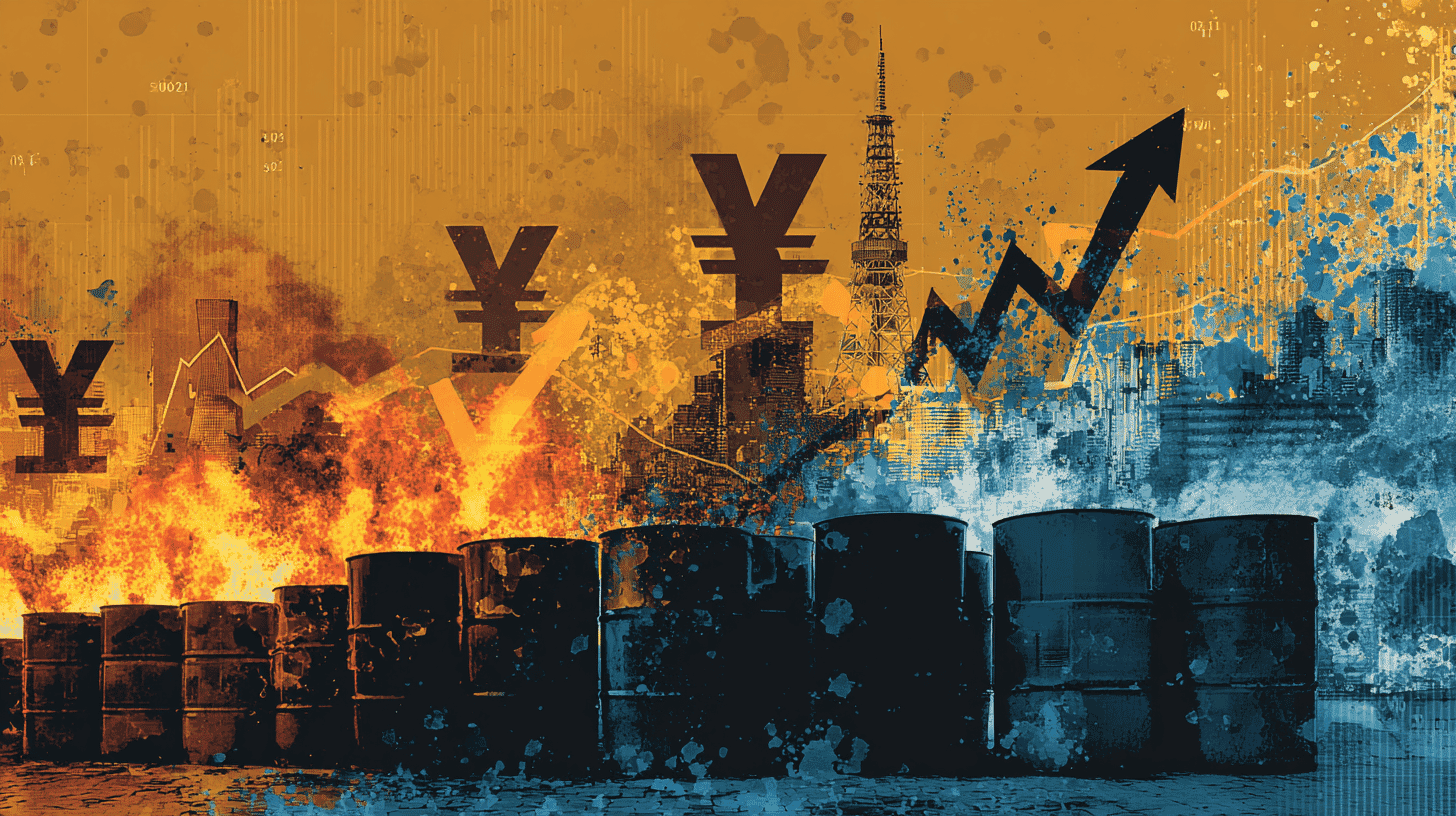
A Japanese cabinet minister just said the quiet part out loud: monetary policy that strengthens the yen "could be one option." In Japan, where government officials almost never comment on central bank policy, that is a seismic shift. With oil prices soaring from the Iran crisis, the yen hovering near 160 to the dollar, and the Bank of Japan weighing a rate decision on April 28, here's what's really going on.
What Minister Akazawa Actually Said
On April 12, 2026, Japan's Economy and Trade Minister Ryosei Akazawa appeared on an NHK television program to discuss countermeasures against rising prices driven by the Iran crisis. During the show, economist Hideo Kumano of the Dai-ichi Life Research Institute suggested that if the Bank of Japan (BOJ) used monetary policy to strengthen the yen by 10–15%, it could suppress price increases across the economy, especially for energy and food.
Akazawa responded positively, saying he thought pursuing that direction "could be possible as one option," while emphasizing the need to monitor economic impacts. He also noted that the BOJ's 2% inflation target was "quite close" to being met, and that real interest rates remained "quite low", widely interpreted as signaling room for rate hikes.
Why This Is Such a Big Deal in Japan
To understand the significance, you need to know something about Japan's political culture around monetary policy: government officials simply don't tell the central bank what to do. At least, not publicly.
Japan's central bank independence is enshrined in the revised Bank of Japan Act of 1998, which guarantees the BOJ's autonomy in setting monetary policy. The unwritten rule is even stricter, cabinet ministers are expected to defer to the BOJ on interest rates and avoid commenting on exchange rate levels, which fall under the Ministry of Finance's jurisdiction, not the Ministry of Economy, Trade and Industry (METI) that Akazawa heads.
Former Prime Minister Shigeru Ishiba repeatedly emphasized that "the government should not dictate specific monetary policy tools to the BOJ." When Akazawa himself was appointed as Economic Revitalization Minister in October 2024, he actually took the opposite stance, urging the BOJ to be "cautious about raising interest rates" and declaring "deflation exit" the top priority. The dramatic reversal in just 18 months reflects how drastically the Iran crisis has reshaped Japan's economic landscape.
The Double Squeeze: Oil Prices and Yen Weakness
Two forces are crushing Japanese households and businesses simultaneously.
The Iran Crisis and Energy Costs: The military confrontation between the U.S. and Iran has effectively shut down the Strait of Hormuz, a chokepoint through which roughly 20% of global oil supply passes. WTI crude has surged above $115 per barrel, and Japan, which imports approximately 90% of its oil from the Middle East, is feeling the impact acutely. The BOJ's March corporate price data showed import prices (yen-basis) rising 3.3% month-over-month, the largest jump since September 2022.
The Weak Yen: The USD/JPY exchange rate has been hovering around 159.7, meaning one dollar costs nearly 160 yen. The primary driver is the interest rate differential: Japan's policy rate sits at 0.75%, compared to roughly 3.5% in the U.S. This gap makes dollar-denominated assets more attractive to investors, pulling money away from the yen. For consumers, the weak yen amplifies the pain of higher oil prices, crude oil priced in dollars costs even more when converted to yen.
To put this in perspective: at 160 yen per dollar, a $115 barrel of oil costs ¥18,400. If the yen strengthened to 140, that same barrel would cost ¥16,100, a saving of about $14 per barrel without any change in the global oil price.
The BOJ's Dilemma: Rate Hike on April 28?
Financial markets are now pricing in roughly a 60% probability that the BOJ will raise interest rates at its April 27–28 policy meeting, potentially bringing the benchmark rate from 0.75% to 1.0%.
The case for hiking is compelling. At the March meeting, board member Hajime Takata dissented from the 8–1 decision to hold rates steady, arguing for an immediate hike to 1.0%. The BOJ's own Summary of Opinions noted that despite earlier rate increases, "financial conditions remain loose" and that policymakers should "adjust policy without delay if conditions hold."
But the case for caution is also strong. BOJ Deputy Governor Ryozo Himino warned on April 11 that the central bank would need to watch for stagflation, the dreaded combination of stagnant growth and rising prices. Raising rates could tame inflation but also risk tipping a fragile economy into recession, especially given Japan's staggering government debt at roughly 240% of GDP. Higher rates would sharply increase the government's debt servicing costs.
What actually happened: At its April 28 meeting the BOJ held the rate at 0.75%, its third consecutive hold. Three board members (Junko Nakagawa, Hajime Takata, and Naoki Tamura) proposed a hike to 1.0% but were outvoted, and the quarterly outlook raised the fiscal-2026 inflation forecast from 1.9% to 2.8%. The remark itself drew a rebuke: at the April 13 Council on Economic and Fiscal Policy, Prime Minister Takaichi and Finance Minister Katayama directly urged Akazawa to refrain from such comments, as Katayama disclosed on April 14.
A Shift in Japan's Currency Stance
Akazawa's remarks suggest a potential evolution in how Tokyo thinks about the yen. For decades, a weaker yen was broadly welcomed by Japan's powerful export sector, automakers, electronics firms, and manufacturers all benefit when their products become cheaper in overseas markets. The tourism boom fueled by cheap-yen travel further reinforced this view.
But the calculus has changed. When a weak yen coincides with soaring global energy prices, the import cost burden outweighs the export benefits for the broader economy. Ordinary Japanese people, paying more for gasoline, electricity, and groceries, feel the pain directly, and Prime Minister Sanae Takaichi, who won the February 2026 general election, cannot ignore rising public frustration over the cost of living.
Finance Minister Satsuki Katayama has also been vocal, warning that "financial markets have seen excessive volatility" and that interest rate spillovers from other markets are moving "much more rapidly than anticipated."
How Japan Compares: Currency Defense Across Asia
Japan's predicament mirrors challenges across Asia. The strong dollar has pressured currencies from the South Korean won to the Indonesian rupiah, and central banks throughout the region have deployed rate hikes and direct intervention to defend their currencies.
What makes Japan's situation unique is scale. The BOJ has been on a historic journey from negative interest rates (-0.1% until March 2024) to the current 0.75%, a path no other major central bank has traveled in recent memory. Japan has more room to raise rates than many Asian peers, but its massive government debt makes every rate increase a fiscal event. Each 0.25% hike adds trillions of yen to the government's annual interest bill.
Meanwhile, the U.S. under the Trump administration has been critical of currency depreciation by trading partners. Akazawa himself is Japan's lead negotiator in trade talks with Washington, having brokered the July 2025 tariff deal. His public openness to yen strengthening may also carry a diplomatic signal, showing the U.S. that Japan is not deliberately pursuing competitive devaluation.
Where This Leaves Japan
Either way, Akazawa's public statement has already moved the needle. By openly acknowledging that monetary tightening is "one option" for fighting inflation, a senior cabinet minister gave the BOJ political cover to act, and signaled that the government's longstanding tolerance for yen weakness may be reaching its limits.
In Japan, frustration over rising prices and the weak yen is growing. How does your country handle currency depreciation and inflation? Do you think governments should intervene in exchange rates? We'd love to hear your perspective.








Global Discussion
14 comments