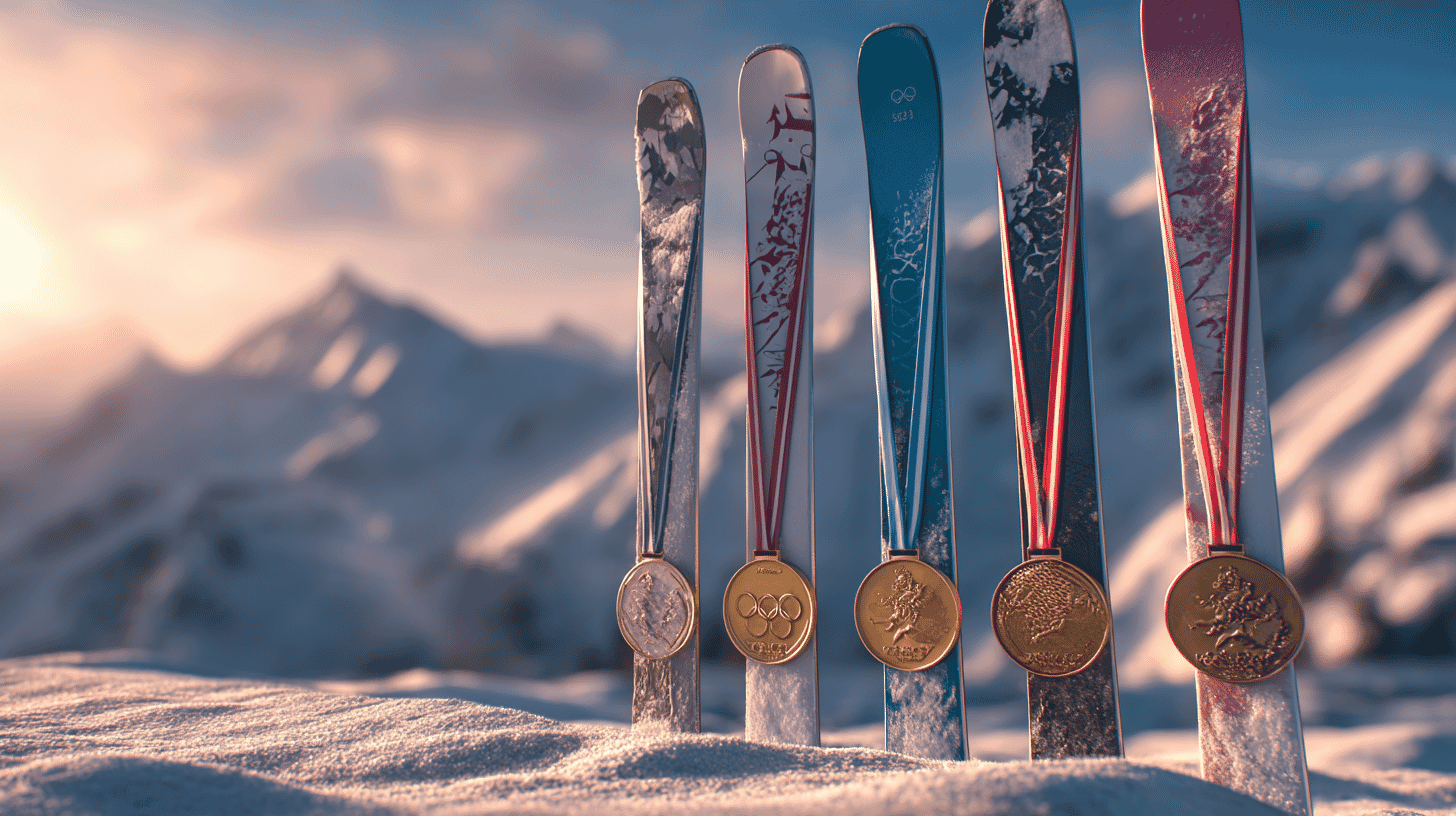
A five-employee company in Osaka just swept every Olympic moguls medal, again. At the 2026 Milano Cortina Winter Olympics, all six moguls medalists (men's and women's combined) used skis made by a tiny Japanese manufacturer called "ID one." It was the second consecutive Olympics in which that happened. Here's the story behind the small-town craftsmanship that dominates the world's most demanding ski discipline.
Japanese-Made Skis Sweep All Moguls Medals at Milano Cortina 2026
At the Livigno Aerials & Moguls Park in northern Italy, the freestyle skiing moguls finals were settled in February 2026. In the men's event, Australia's Cooper Woods took gold, Canadian legend Mikaël Kingsbury earned silver, and Japan's Horishima Ikuma claimed bronze, all three separated by just 0.27 points. In the women's competition, America's Elizabeth Lemley won gold, compatriot Jaelin Kauf took silver, and France's Perrine Laffont earned bronze.
Six medalists. Four different countries. But one thing united them all: every single athlete was skiing on "ID one", a brand manufactured by a small Japanese company headquartered in Moriguchi City, Osaka.
And this wasn't a one-off. At the 2022 Beijing Winter Olympics, all six moguls medalists also used ID one skis. This makes it two consecutive Olympics of complete podium domination.
Meet Material Sports: Five Employees, Global Dominance
The company behind ID one is Material Sports Co., Ltd. (株式会社マテリアルスポーツ), based in a modest building along a shopping arcade in Moriguchi, a city in Osaka Prefecture. The company has just five employees, including the founder.
Material Sports operates as a "fabless" manufacturer, meaning it designs and develops skis in-house but contracts production to specialized Japanese factories. Despite this lean structure, their products are used by roughly 75% of all Olympic moguls competitors. At this year's Games, 20 of 30 men and 25 of 29 women in moguls were on ID one skis.
CEO Makoto Fujimoto told Japan's Yomiuri Shimbun newspaper after the results were announced: "The medals belong to the athletes who earned them through their performance. Because they chose our product, our skis also 'won' medals. I'm grateful to the athletes and their families."
The Origin Story: A Casual Dinner Conversation Changed Everything
ID one exists because of an offhand comment made over dinner in 1999. At the time, Fujimoto ran Material Sports as a distributor for French ski goggles. He had a relationship with Aiko Uemura, one of Japan's most celebrated moguls skiers, who had finished 7th at the 1998 Nagano Olympics.
During a meal together, Uemura mentioned she wished she had better skis. Fujimoto, who had zero experience manufacturing ski equipment, casually responded with something like, "Well, how about I make you some?" in his characteristic Osaka dialect.
What started as half-joke became a full commitment. Leveraging his connections across Japan's ski industry, Fujimoto partnered with skilled craftspeople and factory workers to develop a moguls-specific ski. By 2000, ID one was born. The name combines "ID" (Identity) and "one" (Number One / Only One), and its logo was inspired by ancient Sanskrit characters called bonji.
Why the World's Best Choose ID one
Three key factors explain how a micro-company from Osaka came to dominate Olympic moguls.
1. Purpose-Built for Moguls
Moguls skiing demands that athletes race down steep slopes covered in bumps ("moguls") at high speed, while executing precise turns and two aerial jumps. The skis must absorb extreme impact while maintaining rigidity, seemingly contradictory requirements. ID one achieves this through specialized engineering, including a proprietary "cracked edge" technology where edges are scored at precise intervals to allow flex without sacrificing structural strength. These edges are produced by a small factory in Joetsu City, Niigata Prefecture, Japan's snow country.
2. No Special Treatment for Pros
Unlike most major ski manufacturers who provide custom-built equipment to sponsored athletes, ID one sells the exact same skis to Olympic champions and everyday consumers. There are no "pro models" or "special editions" reserved for elite athletes. Fujimoto has stated: "Every moguls ski we make is built to a standard that athletes can use in competition." The flagship MR-CE model retails for ¥121,000, roughly $800. You could literally buy the same ski that won Olympic gold.
3. Pure Japanese Craftsmanship
Every ID one ski is made entirely in Japan. The wood core comes from Japanese mountains, naturally dried to ensure it has reached its final form before craftsmen inspect each piece for grain patterns that preserve natural strength and flexibility. Skis are produced only twice per year in limited quantities, each one handcrafted to exacting specifications. From raw material to finished product, it's 100% Made in Japan.
From a Backstreet in Osaka to the Olympic Podium
Material Sports was founded in 1991, initially as a goggle distributor. The company incorporated in 1994 and launched ID one in 2000.
By the company's own count, in the 26 years since ID one launched the brand has been under 9 Olympic gold medals, 19 World Championship golds, 37 World Cup discipline titles and 195 World Cup wins, the tally as of the end of Milano Cortina 2026.
The relationships that sustain this success are deeply personal. Fujimoto has a family-level bond with Horishima and calls Kingsbury by his nickname "Mick." This isn't corporate sponsorship, it's a craftsman's relationship with the people who use his work.
Dual Moguls: ID one Swept That Podium Too
Milano Cortina 2026 introduced dual moguls as a new Olympic event, with two athletes racing head-to-head on the same course. ID one held the podium there as well. In the women's final on 14 February, Australia's Jakara Anthony took gold, Jaelin Kauf of the United States silver and her compatriot Elizabeth Lemley bronze. The men's final the next day went to Mikaël Kingsbury, with Horishima Ikuma second and Australia's Matt Graham third.
All six were on ID one skis; Anthony has had her own ID one signature model since the 2025-26 season. That means every one of the 12 moguls medals awarded at these Games was won on skis designed by a five-person company. Kingsbury's dual moguls gold was his fifth Olympic medal, the first time any freestyle skier has reached five.
Doing One Thing Only
Japanese has a word for this: monozukuri (ものづくり), literally "the making of things", used for manufacturing treated as a lifetime craft rather than a product line. Material Sports has spent 26 years inside a single discipline with a few dozen elite competitors worldwide, and now supplies almost all of them. In an era of mega-corporations and global supply chains, five people on a backstreet in Osaka are the reason every Olympic moguls medal has a Japanese ski under it.
Does your country have a similar story, a small, unexpected company that dominates a global niche? Are there sports where equipment from an unlikely origin country holds the top market share?







Global Discussion
15 comments