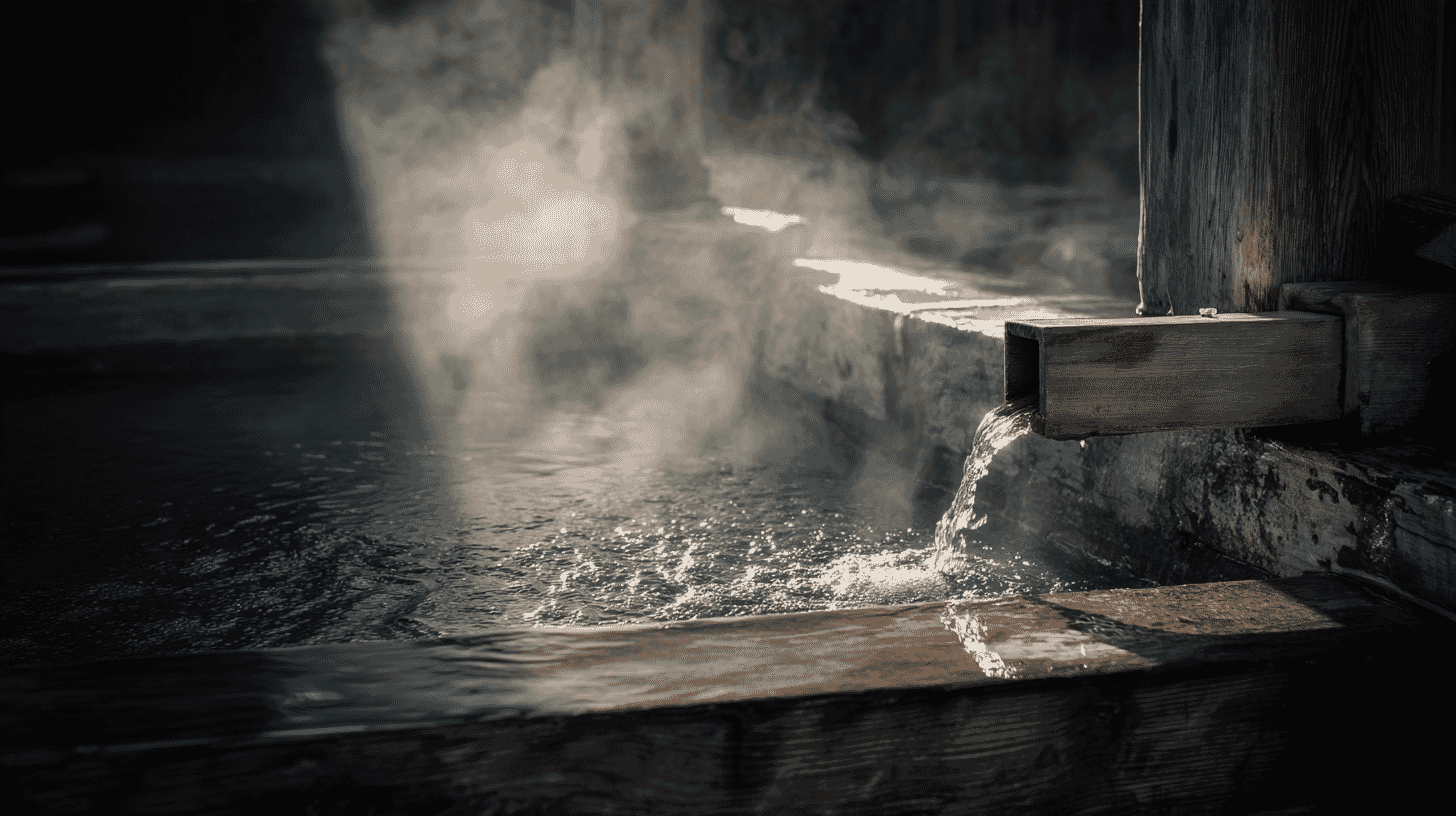
♨️ Hot spring inns in Japan are usually chosen on food, rooms, service and scenery. A shared yardstick for the water people actually soak in has barely existed. That is the view of a new private group, which has launched Yuchelin, a system that gives stars to the water in the tub, and will name its first 21 three-star facilities on October 26, 2026.
Five yardsticks, three stars
The system is run by Yuchelin, a private association set up in Tokyo in August 2025. The name riffs on Michelin, and the English text on its website cites the restaurant guide as its model, but its announcements describe no partnership with Michelin. The Ministry of the Environment is backing the award event; the system itself is privately run.
Architecture, rooms, food, service, fame and social media popularity are left out of the stars. What gets judged is the water as delivered to the tub, on five criteria:
- Character: mineral content, pH, temperature, color, smell, taste and how it feels on the skin
- Freshness (delivery): distance and time from the source to the tub, piping, and how the water is heated, diluted, recirculated or disinfected
- Rarity: how the spring formed, how it emerges, unusual bathing styles, remote locations
- Safety and hygiene: cleaning, safety measures in the bathhouse, legal compliance
- Environmental and cultural value: landscape, care for nature, history and culture, and the local work of keeping the spring alive
Under Japan's Hot Springs Act, water from underground counts as an onsen if it emerges at 25°C or warmer, or contains enough of at least one of 19 listed substances. The Japan Onsen Association groups onsen into 10 types, such as simple springs, chloride springs and sulfur springs. Two baths with the same "onsen" sign can hold very different water.
Assessment starts with lab analyses and other documents, then an inspector visits. According to the association's website, inspectors in principle do not reveal who they are. An evaluation committee does the scoring, and a council of experts in onsen science, balneology and tourism oversees the system. Facilities pay no review or certification fees. The money is to come from crowdfunding and sponsors, and the association says it will not take sponsorship from facilities that could be rated or from municipalities with a stake.
Three stars means "a life-changing bath," two stars "a famous spring worth the trip," and one star "worth a stop if you're nearby." As of October 2026, only three-star awards are planned this year, with two- and one-star ratings to follow from 2027.
"Freshness" usually turns into a flow-through debate
In gensen kakenagashi, spring water keeps flowing into the tub and the overflow is not reused. In junkan roka, tub water is run through filters, reheated and sent back.
Enthusiasts often rank flow-through higher, but recirculation has its reasons. In sample wording the Ministry of the Environment gave operators in 2005, the reasons listed for recirculating are "hygiene management" and "protecting the hot spring resource and hygiene management." If a spring yields only so much water, flow-through may not be able to supply a large bath or an outdoor one. Reused water needs care: Japan's health ministry says Legionella bacteria, which live in soil and rivers, become an infection risk when they multiply inside man-made equipment. The ministry publishes a dedicated prevention manual for recirculating baths.
Yuchelin says it will not treat "straight from the source" as an absolute standard, since temperature, flow and location sometimes require adjustment. It says it looks instead at how a facility carries the spring's character into the tub.
The notice on the changing-room wall
Japanese onsen facilities already post information about their water by law: its components, contraindications and bathing precautions. In 2004, some facilities were found to be adding bath agents without saying so. Since May 24, 2005, baths that add water, heat it, recirculate it, add bath agents or disinfect it have had to state that, and why. Failing to post the notice or posting false information can bring a fine of up to 300,000 yen (about $1,900).
The rule asks "whether" and "why," not "how much." When it was introduced, the ministry listed the degree of dilution and disinfection, how often the water is changed, and the state of cleaning only as information operators could usefully volunteer.
In Germany, states can officially recognize a spring as a Heilquelle, a healing spring, based on lab analysis. In Saxony, an application needs a water analysis, plus a fresh control analysis if it is more than two years old. That certifies the source for therapeutic use. Japan's law requires disclosure but does not judge quality. Yuchelin's stars judge the water in the tub and make no health claims.
A five-step scale that already came and went
Yuchelin's English homepage calls it "Japan's first hot spring rating guide." Grading onsen water is not a new idea, though. The Japan Onsen Association, an industry body, began issuing a new "natural hot spring display sign" on a trial basis in April 2003, inspecting tub by tub and handing out 670 signs. The full version, launched in May 2005, showed 17 items and graded six of them on a five-step scale of naturalness and appropriateness: source, spring type, piping, supply and drainage method, added water, and the share of fresh spring water entering the tub. According to the association, every sign had expired by February 28, 2019, and the system was abolished.
The old sign mainly measured naturalness. Yuchelin says it judges how the water is handled, adjustments included. The first awards will show whether five criteria can tell a well-run recirculated bath from a poorly kept flow-through one.
The Japanese pages state that buildings, food and service are not evaluated. The English summary on the same homepage says inspectors assess "water quality, facilities, hospitality, and scenery."
Twenty-one stars are not yet a map
According to the Ministry of the Environment, at the end of March 2025 Japan had 2,839 onsen areas with lodging, 27,899 hot spring sources and 13,425 lodging facilities in onsen areas. The first list has 21 facilities. According to the association, as of October 2026 inspector recruitment and training were still being prepared for full operation from fiscal 2027.
The announcement does not say how the five criteria become a score or how they are weighted. If freshness counts heavily, flow-through baths will have an edge; if safety and culture weigh more, the lineup will change. Two of the seven councilors who oversee the system also serve as the association's director and auditor. The announcement does not address that overlap.
Onsen areas with lodging fell from 3,185 in fiscal 2010 to 2,839 in fiscal 2024. If travelers choose inns for their water, the association argues, money will reach the small inns and communal bathhouses that keep good springs going. Its slogan: "Today, let's choose an inn by its water."
If you are visiting
As of October 2026, the plan is to list certified facilities on Yuchelin's website and to build a "Yuchelin MAP." Part one of the October 26 award event (1:00 to 2:30 p.m. Japan time) will stream online for free.
Until then, check the lines on added water, heating, recirculation and disinfection in the changing-room notice. The Japan Onsen Association advises pouring water over yourself before getting in, starting with your hands and feet, drinking a glass of water beforehand, and avoiding the bath right before or after meals or alcohol. Yuchelin's own six principles ask visitors to do their homework, put locals first, not hog the spout or take photos, and accept natural water as it is, hot one day and lukewarm the next.
Tattoo rules vary by facility. In a 2015 Japan Tourism Agency survey of hotels and inns, about 56% of the 581 that responded turned away bathers with tattoos, 31% did not, and 13% allowed them under conditions such as covering them. In 2016 the agency compiled options such as cover stickers and private baths. Check before you go.
Where you live, when you pick a spa or thermal bath, do you compare the water, or decide by everything around it?
References
- https://prtimes.jp/main/html/rd/p/000000002.000191740.html
- https://www.travelvoice.jp/20261006-160632
- https://yuchelin.org/
- https://yuchelin.org/about/
- https://yuchelin.org/interact/
- https://yuchelin.org/news/announcement-of-the-yu-shuran-award-2026-to-be-held-on-monday-october-26th/
- https://www.env.go.jp/press/5743.html
- https://www.env.go.jp/content/900492867.pdf
- https://www.env.go.jp/nature/onsen/pdf/6-7_p_1.pdf
- https://www.env.go.jp/nature/onsen/pdf/6-7_p_3.pdf
- https://www.spa.or.jp/onsen/483/
- https://www.spa.or.jp/en/onsen/
- https://www.spa.or.jp/en/spring-quality/
- https://www.spa.or.jp/en/caution_bathing/
- https://akakura.gr.jp/iyashi/n066-kakenagasi-junkan.htm
- https://www.mhlw.go.jp/stf/seisakunitsuite/bunya/0000124204.html
- https://www.revosax.sachsen.de/vorschrift/1864-Heilquellenverordnung
- https://www.travelvoice.jp/20151022-53183
- https://www.travelvoice.jp/20160317-63167



Global Discussion
4 comments