
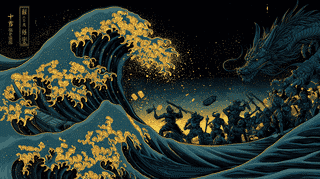
🛠️ There is a word Japanese hobbyists use: makaizō, literally "demon modification." It started in otaku and model-builder culture and means rebuilding something so radically that it stops being the thing it was. A toy gets gutted and rewired until it's a different machine entirely. Right now, the question hanging over NTT, Japan's former telephone monopoly and still one of its largest companies, is whether the sweeping changes it is making amount to a careful redesign or a full makaizō: a telecom giant taking itself apart to become something its founders would barely recognize. Let's lay out the facts, then take a guess at the final form.
The flow so far: a decade spent putting the family back together
To understand where NTT is going, start with what it has spent ten years undoing. After Japan privatized the old state telephone monopoly in 1985, the group was deliberately broken into pieces to encourage competition. For decades those pieces, mobile and fixed-line and IT services and overseas, ran as semi-independent companies, several of them separately listed on the stock exchange.
Then NTT reversed course. In 2020 it spent roughly ¥4 trillion (about $25 billion at today's rate) to buy out the minority shareholders of NTT Docomo, its mobile arm, and make it a wholly owned subsidiary, still the largest acquisition in the group's history. In 2022, Docomo absorbed the former NTT Communications, rebranded NTT Docomo Business, and moved a 5,000-strong corporate sales force into it; by the year ending March 2026 that corporate unit had grown past ¥2 trillion ($12.6 billion) in revenue. Then in 2025 came the second-biggest deal in group history: a ¥2.37 trillion ($14.9 billion) tender offer to buy the 42% of NTT Data Group it didn't already own, taking the IT-services firm fully private.
Seen together, these moves are one long project: pulling the scattered family back under a single roof, so the parent can move money, people, and strategy across the group without asking minority shareholders for permission. The re-consolidation phase is essentially finished. What comes next is the interesting part.
And from here: take Docomo apart, put data at the center
On May 8, 2026, NTT posted record annual results, with revenue of ¥14.4 trillion (about $90.6 billion), up 5.1%, and operating profit of ¥1.71 trillion (about $10.7 billion), up 3.4%. But it quietly delayed a flagship target of ¥4 trillion (about $25 billion) in EBITDA from fiscal 2027 to fiscal 2030. The reason was the mobile business: the Docomo-centered segment's operating profit fell 7.7% to about ¥942 billion ($5.9 billion) as customers kept defecting to cheaper rivals in a saturated, price-warring market.
So NTT stopped pretending mobile would lead the way. Its new mid-term plan, branded "powered by AIOWN," rests on three pillars: fuse NTT Docomo Business with NTT Data to build a stronger domestic corporate business; pour investment into AI and data centers through NTT Data's overseas arm; and carve Docomo's financial business, meaning payments, banking and securities, into a wholly owned holding company, NTT Docomo Financial Group, which began operating on July 1, 2026, and now holds four companies: SBI Sumishin Net Bank (renaming to Docomo SMTB Net Bank in August), Docomo Insurance, Docomo Finance and Docomo Monex Holdings. Docomo aims to roughly double the revenue of its finance-led services, from about ¥600 billion ($3.8 billion) in fiscal 2025 to ¥1.2 trillion ($7.5 billion) by fiscal 2030.
Notice the pattern. Docomo is being unbundled piece by piece: corporate sales hived off in 2022, finance hived off in 2026. "AIOWN" is NTT's name for an AI-native infrastructure layer built on its homegrown optical technology, IOWN, optimizing GPUs, networks, and power, all the way to the edge. The future flow, in other words, points away from the phone and toward the data center.
My read on the final form: two engines and one spine
Here is where I'll stop reporting and start predicting. Strip away the corporate-structure detail and a blueprint appears. I think NTT is trying to become a two-engine, one-spine company.
The first engine is global and aimed at businesses: a digital-infrastructure and IT-services giant, built from NTT Data and NTT Docomo Business fused together. This is a serious base to build on. NTT Data is already Japan's largest IT-services firm, a $30-billion-plus business that serves three-quarters of the Fortune Global 100 and is the world's number-three operator of data centers, the physical real estate of the AI boom, generating around a fifth of group operating profit on its own. The second engine is domestic and aimed at consumers: an "economic sphere" platform that monetizes Docomo's roughly 90 million users through finance and services rather than airtime, which is exactly what the new Docomo Financial Group is for.
The spine connecting them is infrastructure: data centers, wired together by IOWN/AIOWN optical networking. And the legacy mobile network? In this blueprint it gets demoted: from the growth engine it used to be to a stable, low-growth utility that throws off cash and, more importantly, supplies a captive customer base to feed the finance and services engines. NTT's profit, on this reading, is meant to come less and less from selling phone plans, and more from selling compute and connectivity to the world's enterprises on one side, and financial and lifestyle services to its captive Japanese users on the other. The phone business becomes the moat, not the castle.
Overseas precedents: a failure, a metamorphosis, and a textbook
NTT is not the first carrier to try this, and the world offers three instructive examples.
The cautionary tale is AT&T. America's telecom titan decided the future was content, bought Time Warner for around $85 billion in 2018, and renamed it WarnerMedia, only to discover that running Hollywood is nothing like running a network. Four years later it spun the whole thing off into Warner Bros. Discovery, and its chief executive refocused the company on being, once again, a phone company. The lesson: a telco wandering far outside its competence can destroy enormous value, and "diversification" is not automatically a strategy.
The metamorphosis is SoftBank, and it is a true makaizō. It began as a domestic mobile carrier and is now described by investors as an "AI holding company," anchored not by phone lines but by its chip-design arm Arm and a cumulative stake of over $60 billion in OpenAI, plus the $500 billion Stargate data-center venture. But note the crucial difference: SoftBank became an investor in AI, placing bets with borrowed money. NTT wants to be an operator, owning and running the infrastructure itself. That is a harder, slower, more capital-hungry path.
The textbook is India's Reliance Jio, which took a massive, cheap subscriber base and layered commerce, payments, and digital services on top, turning a telecom into a national digital ecosystem. That is essentially the move NTT is making domestically with Docomo's user base and finance, a model that, when it works, is extremely sticky. Europe's Deutsche Telekom offers the conservative version: stay close to connectivity, add sovereign cloud and AI on top, and don't blow up your own structure. NTT, by buying back subsidiaries and dismembering Docomo, has chosen the more radical route.
Will it work? The bull case, the bear case, and the real key
The bull case is genuinely strong. NTT is one of the very few non-American players large enough, with around 340,000 employees and revenue near $90 billion, to compete for the global AI-infrastructure layer at all. It already holds the world's number-three data-center position and a captive base of 90 million users most Western carriers would envy. The consultancy Deloitte sizes the "beyond connectivity" opportunity in AI, cloud, and security at $1.7 trillion by 2029, growing at roughly twice the rate of old-style business connectivity. The destination is real, and the runway is long.
The bear case is just as real. The American hyperscalers, Amazon and Microsoft and Google, each spend more on capital investment in a single year than NTT's entire annual revenue, so as a plain data-center landlord NTT loses the scale game before it starts. Reorganizing the corporate chart is not the same as fixing operations; none of the M&A directly stops the mobile bleed that triggered the rethink. A former state monopoly is not famous for moving at AI speed. And AT&T is a standing reminder that grand reinventions can incinerate money.
So what decides it? In my view, almost everything hinges on one bet: IOWN must be real. If NTT's optical technology genuinely delivers a step-change in power efficiency and the world adopts it, then NTT is not just another landlord: it is a differentiated infrastructure operator that wins on technology where it can't win on scale, and the whole two-engine blueprint holds together. If IOWN underdelivers and stays a slogan, NTT becomes a smaller, slower hyperscaler wannabe that beats nobody on either scale or differentiation, and the elaborate reorganization will have been expensive theater. The secondary key is speed: the domestic cash base has to be monetized into finance and services before the mobile erosion eats the foundation. Redesign or makaizō, the verdict won't come from the org chart. It will come from whether the spine actually holds weight.
🌐 In Japan, a company born to run telephone lines is rebuilding itself around data centers and AI, and betting its future on a homegrown technology most people have never heard of. Is the dominant carrier in your country attempting a quiet redesign, or a full reinvention into something new? And when telecoms have tried to become something else where you live, did it work? We'd love to hear how it played out.
References
- https://diamond.jp/articles/-/391149
- https://group.ntt/jp/newsrelease/2026/05/08/pdf/260508ba.pdf
- https://businessnetwork.jp/article/34400/
- https://www.docomo.ne.jp/info/news_release/2026/03/31_00.html
- https://www.watch.impress.co.jp/docs/news/2107331.html
- https://www.nikkei.com/article/DGXZQOUC086DL0Y5A500C2000000/
- https://www.nttdata.com/global/en/news/press-release/2026/january/011501
- https://www.lightreading.com/ai-machine-learning/at-t-headcount-drops-by-30-760-with-warnermedia-spinoff
- https://en.sedaily.com/international/2026/05/22/softbank-surges-as-investors-rebrand-it-an-ai-holding
- https://reports.weforum.org/docs/WEF_The_Strategic_Role_of_Telecom_Providers_Across_the_AI_Value_Chain_2026.pdf








Global Discussion
3 comments