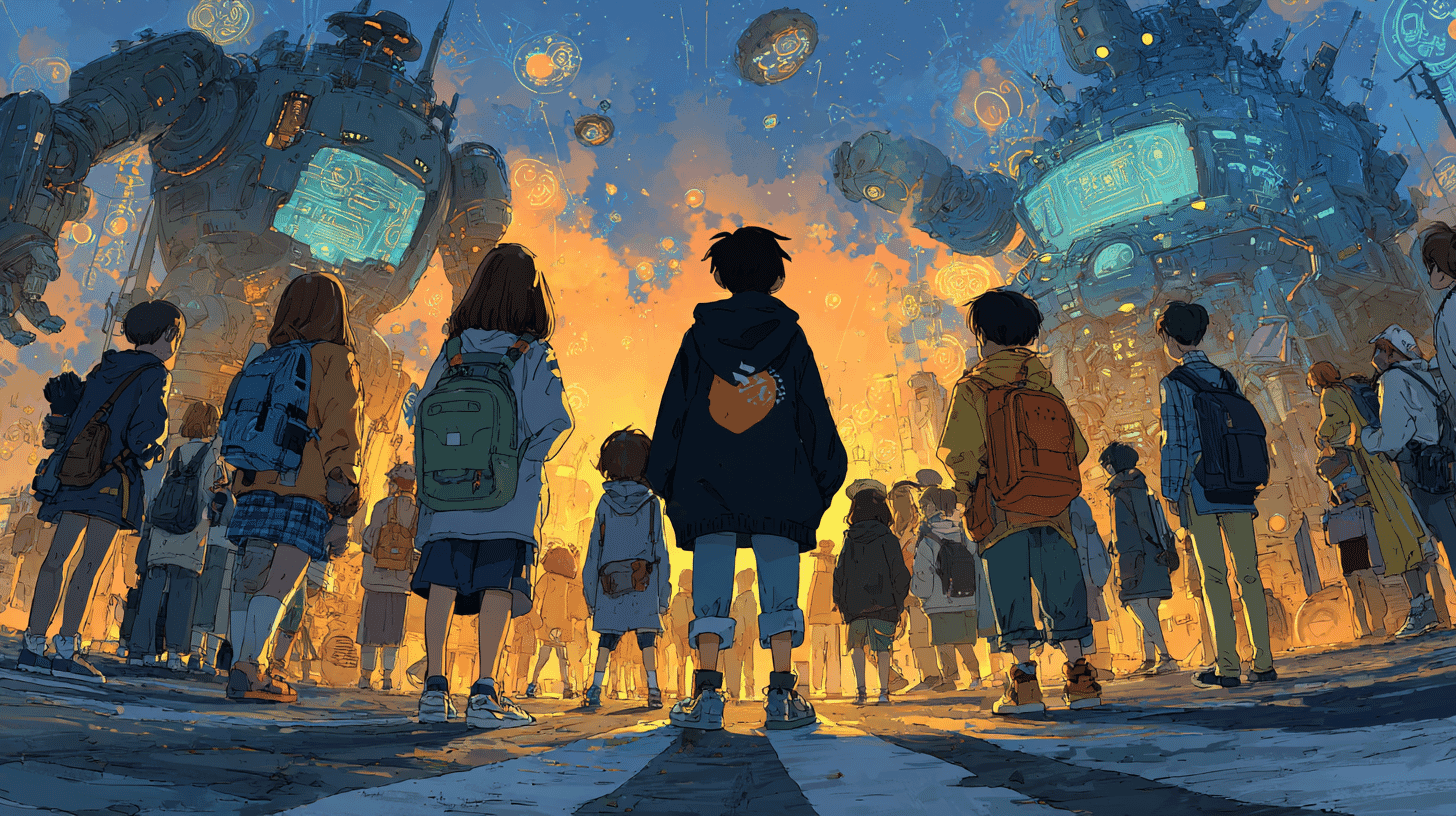
It's not just adults worrying about AI taking jobs. When 2,469 Japanese elementary and middle school students were asked, 75% said they believe certain professions will vanish within the next decade. The job they think will disappear first? Translator. Here's what Japan's AI-native generation really thinks about the future of work, and what they actually want to be when they grow up.
Three Out of Four Japanese Kids Say Some Jobs Won't Survive AI
Nifty Corporation, operator of the popular children's website "Nifty Kids," conducted a large-scale survey on career aspirations from December 2025 to January 2026. A total of 2,469 children, primarily elementary students (ages 6–12) and middle school students (ages 12–15), participated.
The most striking finding: when asked whether they think any current profession will cease to exist in ten years, 74.1% answered "yes." That means three out of every four Japanese children believe some of today's jobs will be gone by the time they enter the workforce.
The top three professions predicted to disappear were:
- #1: Translator
- #2: Train/bus driver
- #3: News anchor / TV broadcaster
In open-ended responses, children frequently cited "jobs AI is good at" and "work robots can do" as most vulnerable. Conversely, careers like entertainer and athlete, professions requiring human personality and physical ability, were ranked least likely to vanish.
Why Translator Tops the "Endangered Jobs" List
The reason children picked translator as the most vulnerable profession likely reflects their everyday experience. Tools like Google Translate and DeepL are free, accessible on any smartphone, and deliver near-instant results. A separate Nifty Kids survey found that roughly 40% of Japanese students already use AI tools for homework and studying.
When you grow up watching AI translate your homework in seconds, the leap to "translators will be replaced" feels obvious. And the translation industry has indeed been shaken by AI advances, with the emergence of "post-editors" (humans who refine machine-translated text) represents a fundamental shift in how the profession works.
However, industry experts caution that literary translation, legal documents, and medical texts still demand human judgment. AI excels at converting standardized text but struggles with cultural nuances, idiomatic expressions, and authorial intent. The children's prediction isn't wrong, but the reality may be more "transformation" than "extinction."
Dream Jobs: Illustrator for Elementary Kids, Musician for Middle Schoolers
The survey also explored what children actually want to become. An impressive 93.2% said they have a career aspiration: 95.4% of elementary students and 89.3% of middle schoolers.
The most popular careers differed by age group:
- Elementary school #1: Illustrator (followed by VTuber and idol)
- Middle school #1: Musician / music artist (jumped from 4th place last year)
The rise of "musician" among middle schoolers mirrors global trends: platforms like YouTube and TikTok have made music creation accessible to anyone with a laptop. In Japan specifically, the Vocaloid Producer (Bokaro-P) and "utaite" (singing content creator) cultures have turned music from a distant dream into something kids see peers doing in real time.
For elementary students, the popularity of illustrator and VTuber reflects a broader fascination with digital creativity. Notably, VTuber (Virtual YouTuber), content creators who use animated avatars instead of showing their real face, has overtaken traditional YouTuber in popularity. In a culture where online anonymity can feel liberating, becoming a virtual character offers a unique form of self-expression.
Other aspirations included F1 racer, cosplayer, space technology engineer, and entrepreneur, showing a diverse and globally aware generation.
"Because I Love It": But Family Still Matters
When asked why they chose their dream career, over 60% of both elementary and middle school students said "because it's something I love." There's a Japanese proverb, suki koso mono no jouzu nare ("you excel at what you love"), and this generation appears to live by it.
An interesting generational gap emerged in secondary motivations. Elementary students cited role models and media influence, while middle schoolers ranked "because I think I'm suited for it" and "because I want to help others" higher. As children mature, their career thinking shifts from aspiration to aptitude and social purpose.
The role models children named were fascinatingly varied: an idol group member, midwives from the manga Kounodori (a medical drama about childbirth), a flight attendant seen during a family trip, and a cousin who passed Japan's notoriously difficult bar exam on the first attempt. Many children mentioned being inspired by adults who "were kind to me" or "took me seriously," a reminder that small interactions with children can shape their entire career trajectory.
Work Means "Helping Others": A Surprisingly Mature View
Perhaps the most revealing question was: "What do you think 'work' is?"
Beating out "earning money" and "doing what I like," the most popular answer was "helping others." Despite their young age, these children view work not merely as income generation but as social contribution.
Free-form answers ranged from optimistic ("something that enriches your life," "something challenging but wonderfully rewarding") to startlingly pragmatic ("a lifeline for survival," "something you have to do to pay taxes").
The Japanese word yarigai (やりがい) captures a concept difficult to translate into English; it means the sense of fulfillment and accomplishment derived from work. In adult Japan, there's even a critical term yarigai sakushu (やりがい搾取), meaning exploitation that leverages workers' passion to justify poor compensation. But among these children, the concept remains beautifully untainted.
What This Means for Education in the AI Era
This survey reveals that Japanese children aren't just vaguely aware of AI; they're thinking about its impact at the level of specific careers. Their instinct that "routine" jobs (translator, driver, announcer) are vulnerable while "human" jobs (entertainer, athlete) are safe aligns remarkably well with what AI researchers and economists predict.
What's emerging is a generation that intuitively grasps the skills AI can't easily replicate: creativity, empathy, physical ability, and human connection. The challenge for education isn't to teach children to fear AI, but to help them develop the irreplaceably human qualities they already seem to value.
Japan has been expanding programming education in elementary schools and introducing AI literacy curricula. But this survey suggests that what children care about most isn't technology; it's passion and purpose. Nurturing both the emotional intelligence to find yarigai and the technical literacy to work alongside AI may be the defining educational challenge of this generation.
Japanese kids are already processing the reality of AI disruption, and choosing to chase their passions anyway. What about young people in your country? What jobs do they dream about, and do they worry about AI replacing careers?







Global Discussion
15 comments