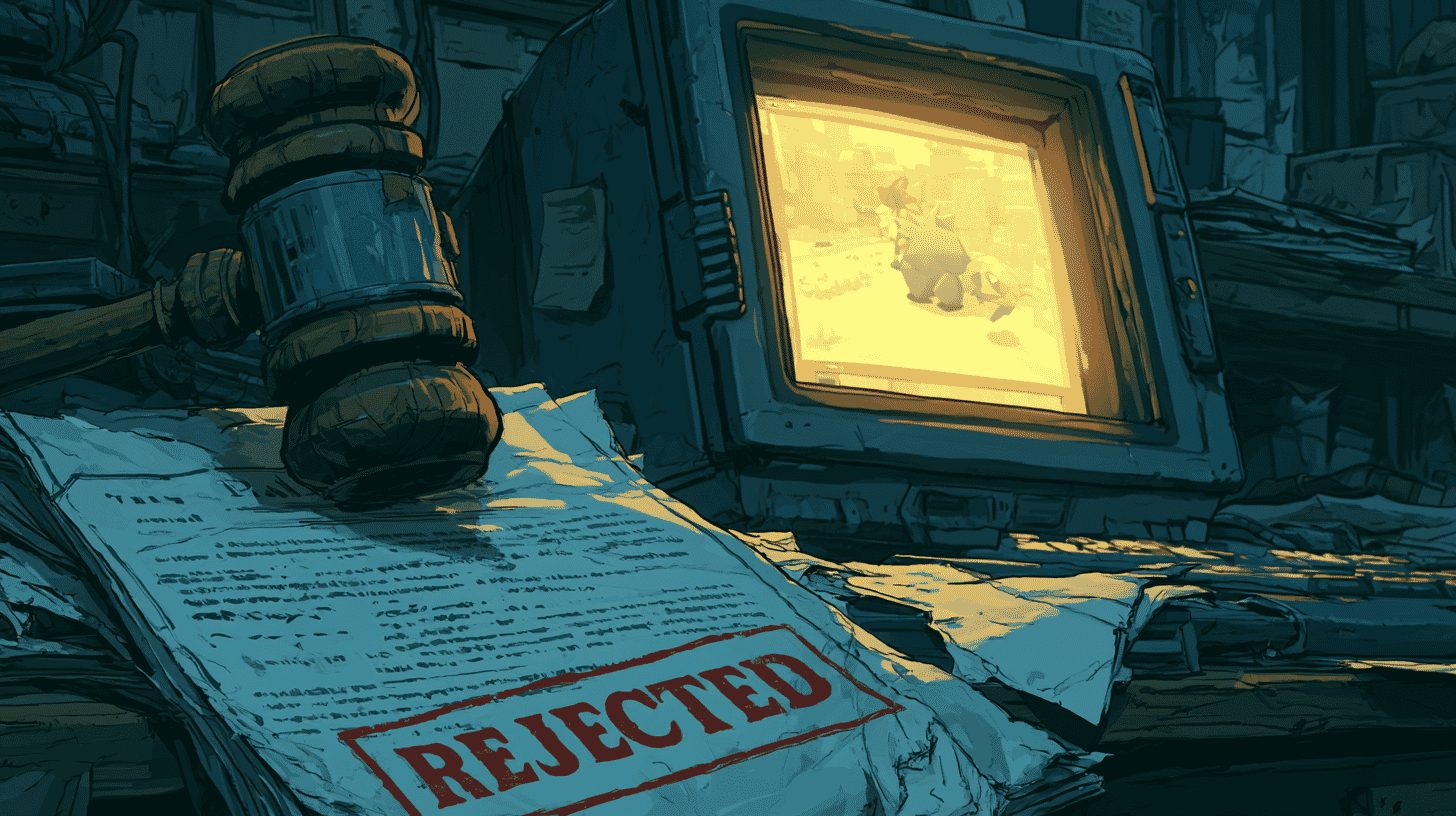
⚖️ An unauthorized fan game from 2013 just helped sink one of Nintendo's patents. Japan's Patent Office has thrown out Nintendo and The Pokémon Company's attempt to lock down a touchscreen creature-capture mechanic, and the piece of evidence that did it was a fan-made 3D Pokémon game posted to YouTube more than a decade ago. The twist that has Reddit and ResetEra talking: Nintendo argued that video shouldn't count because it infringed Pokémon's own copyright. The examiner didn't buy it.
What actually got rejected
First, the boring-but-important part, because a lot of the online chatter blurs it together.
This is not one of the three patents at the center of the actual Nintendo v. Pocketpair lawsuit. Those are Japanese patents 7545191, 7493117, and 7528390, and that case is still grinding along in Tokyo District Court.
What the Japan Patent Office (JPO) rejected on July 15 is a separate patent application, number 2026-019762. It's a "divisional application," meaning it was carved out of an earlier filing in the same family, and it narrows the invention down to monster-capturing on a touchscreen device. According to the games-industry legal outlet Games Fray, that touchscreen focus most likely has Palworld Mobile in its sights, though Nintendo hasn't said so publicly.
The application had already drawn a warning shot: the JPO issued a preliminary rejection back in April 2026. This latest ruling is the escalation. A "decision of refusal" ends the normal examination process. The examiner is finished.
A fan game becomes Exhibit A
To reject a patent, an examiner points to "prior art," basically, proof that the idea already existed and wasn't new enough to deserve exclusive rights.
The prior art here is a video from 2013 showing a fan project called Pokémon Generations, an attempt by an indie developer to build a 3D version of Pokémon. It was never authorized by Nintendo. It's the kind of fan creation Nintendo's legal team usually spends its time shutting down. And yet the footage, still sitting on YouTube, demonstrated the capture concept well before Nintendo's filing. The video was not the only reference cited: the examiner also pointed to the smartphone version of ARK: Survival Evolved, PUBG Mobile, official Pokémon X and Y material, and earlier patent publications.
Nintendo's copyright gambit, and why it failed
Here's where it gets interesting, and where the legal reasoning is worth slowing down for.
Nintendo and The Pokémon Company filed a formal response fighting the use of that video. They made two main arguments.
The first was essentially a copyright argument. They objected that Pokémon Generations was itself an infringing work, and that describing it using words like "Pokémon," "Ash," and "Pikachu" was inappropriate. The implication: a video that violates their copyright shouldn't be admissible as prior art against them.
The JPO rejected that logic cleanly. Whether the cited work infringes copyright, the examiner reasoned, has no bearing on whether an invention is novel or obvious. Those are separate questions under patent law. And to drive the point home, the office noted that you could strip out every trademarked name and the analysis wouldn't change: swap "Pokémon" for "an object shaped like a small animal," swap "Ash" for "an object shaped like a boy wearing a red cap," and the mechanic on display is still the same mechanic. The copyright status of the video is beside the point.
Nintendo's second argument was more technical: gameplay footage alone, they said, can't establish a "game program" invention, because you can't tell from watching what operations are actually happening under the hood. The examiner turned that down too. For the purpose of showing that a concept existed at a particular moment in time, the video does its job.
There's one nuance worth flagging for fairness. On several of the application's claims, the examiner didn't actually cite a specific reason for rejection at this stage. But Nintendo pushed the entire claim set forward, which forced the JPO into an all-or-nothing decision, and the application went down as a whole.
What this means for the Palworld lawsuit
This is where it's easy to overstate things, so let's keep fact and speculation apart.
The facts. This application is legally separate from the three patents being litigated. Its rejection doesn't automatically decide anything in the Tokyo courtroom. Nintendo now has three months to respond, and it has three roads: request a formal appeal trial before a panel of JPO judges, file a fresh divisional application with reworded claims, or drop the application entirely. All three remain open.
The bigger picture, per the analysts. Games Fray's reading is that the lawsuit was already in deep trouble before this. The main case seeks 5 million yen (about $32,000) per plaintiff, roughly 10 million yen (about $64,000) total, small money by the standards of a corporate patent fight. Nintendo also narrowed its claims to older versions of Palworld, and Pocketpair patched out the disputed mechanics long ago. A court hearing is set for October 1, 2026, with a ruling expected in November.
The speculative part. Games Fray goes further and argues that, as things stand, Nintendo doesn't appear to hold a single patent capable of threatening the current game, especially now that Palworld 1.0 launched on July 10, 2026, leaving Early Access after more than two years. That's an analyst's conclusion, not a court finding, and Nintendo could still change the math with an appeal or a new filing. But it captures why the mood among Palworld fans right now is somewhere between relief and quiet gloating.
What lingers is the irony. A company famous for its aggressive protection of intellectual property just watched an unauthorized fan tribute become the thing that stood between it and a new patent, with a government examiner explaining, in effect, that copyright infringement and patent novelty are two different conversations.
In Japan, the debate over whether basic game mechanics should be patentable at all keeps getting louder with each of these rulings. Where does your country land on it? Should a studio be able to own a mechanic like "throw a ball to catch a creature," or are ideas like that just part of the shared toolbox every developer gets to use?
References
- https://www.gamebusiness.jp/article/2026/07/19/27506.html
- https://gamesfray.com/japan-patent-office-rejects-nintendos-touchscreen-monster-capture-patent-and-its-attack-on-use-of-indie-gameplay-video-as-prior-art/
- https://www.gamespark.jp/article/2026/07/18/169451.html
- https://www.j-platpat.inpit.go.jp/c1801/PU/JP-2026-077713/11/ja








Global Discussion
4 comments