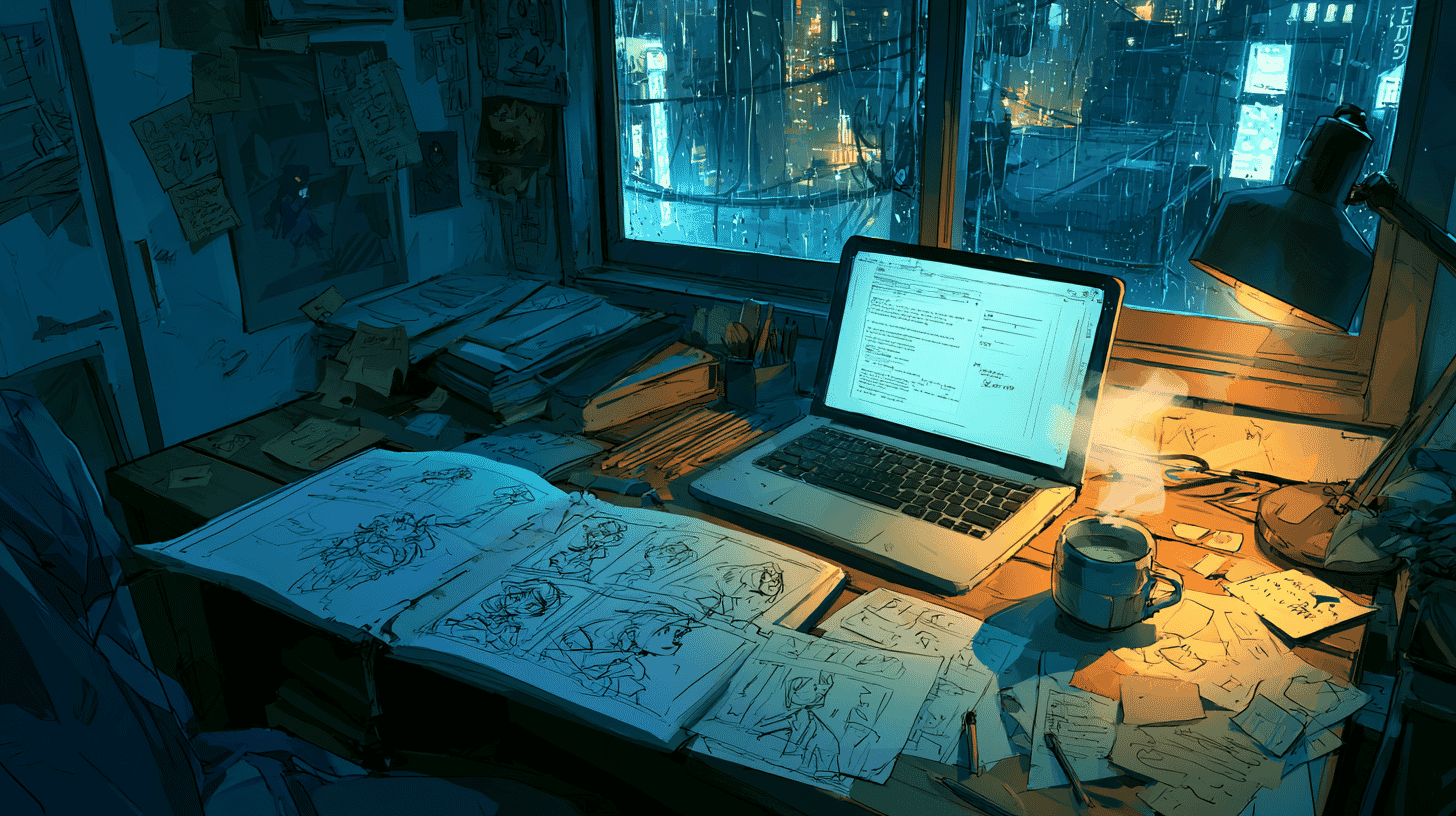
🎮 You have a game idea scribbled in a notebook. A weird mechanic, a story setup, a vibe. You're not a coder. You don't have a studio. In most of the world, that's where the dream ends. In Tokyo, the company that publishes One Piece just said: send it to us, we'll help you build it.

Source: Shueisha Games / PR Times
On May 19, 2026, Shueisha Games, the gaming subsidiary of the Tokyo publisher behind Weekly Shonen Jump, the magazine that gave the world Naruto, Dragon Ball and Demon Slayer, opened a new round of its global pitch program. The hook is so generous it almost reads like a typo: prior game development experience is not required. You need two things to apply. A proposal for the game you want to make. A portfolio of your past creative work, and that work doesn't have to be a game. Drawings, music, a short film, a comic, a tabletop prototype: all fair game.
Pitches can be submitted in Japanese or English, from anywhere in the world. Shueisha Games reviews them in roughly a month.
So what exactly is Shueisha Games?
A short detour, because most readers outside Japan have heard of Shueisha but not of its gaming arm. Shueisha is one of Japan's two giant manga publishers, with Weekly Shonen Jump as its flagship and a back catalog that includes most of the titles people think of when they think "anime." In 2022 the company spun off a fully owned subsidiary called Shueisha Games to handle interactive media, with a deliberate twist: it would not be a vehicle for licensed Jump adaptations. Other companies could keep doing those. Shueisha Games would instead apply the publisher's century-old muscle for finding and developing new talent to a different medium.
The bet has been paying off in a quiet way. Shueisha Games published Urban Myth Dissolution Center, the point-and-click mystery game that became one of 2025's better-reviewed Japanese indies overseas. Schrödinger's Call, an emotional visual novel about a girl who answers calls from souls caught between life and death, launches May 28. ANTHEM#9 is a roguelite deckbuilder that earns regular comparison to Slay the Spire. The pipeline also includes a four-player co-op stealth game with the studio behind the Tenchu series, plus a partnership with NetEase that's been in the works for years.
Underneath all of that is Game Creators CAMP, a community platform Shueisha has been running since 2021. According to the company, registrations have now crossed 10,000, a number that on its own says something about how much latent indie ambition exists in Japan with nowhere obvious to channel it.
The two-piece application
The application requirements are striking precisely because they are not what you would expect from a publisher this size.
A proposal must describe the game you want to make, an estimated development budget with a breakdown, a production schedule, and an introduction to your team (if you have one). That's it. No vertical slice, no demo, no working prototype.
A portfolio showcases the past creative work of you and your team. The official guidelines explicitly note that non-game work counts. A manga artist with no Unity experience can pitch. A musician who's never made a game can pitch. A film student with a strong sense of story can pitch.
If you already have a build, scripts, trailers or design documents, you can include them. But you don't have to. The pitch page openly says: "You don't need to be perfect at the time of application."
The three "strengths" they're hunting for
Shueisha Games evaluates pitches on three axes, and you only need to nail one of them.
The first is a personality nobody else can copy: a creative voice that's recognizably yours. The second is an idea no one has thought of: a mechanic, premise, or angle that doesn't already exist on Steam. The third is quality that stands out among similar works: if your game shares a genre with twenty others, yours should be the one that visibly outclasses the rest in some specific dimension.
The rest, according to the company, they'll help with.
What "help" actually means
This is the part of the announcement that made gaming-industry watchers pay attention. The support list is unusually long for an open pitch program, and it goes well past what a normal publisher would handle. Shueisha Games says it will cover, depending on the project: budget and schedule management; direct investment in development costs; loaned development hardware and software; recruiting help when the team is short on people; outreach to platform holders (Sony, Nintendo, Microsoft, Valve); store-page logistics; full marketing and PR; commissioned video and graphic assets; QA, localization and linguistic QA; and even IP extension into things like merchandise.
In other words: the publisher is offering to do the bookkeeping, hire your teammates, lend you the laptop, run your trailer through a studio, pitch your game to Nintendo, get it through Steam's submission process, and turn it into a plush toy line if it pops. The catch, and there is one, is that all of this gets calibrated to the project, and the project is broken into four phases (prototype, playable demo, beta, master), each with its own budget and a checkpoint review at the end. Pass the review, you move forward. Don't, and the project either gets reshaped or stops.
This is the kind of arrangement that until recently you mostly only got with a big-name agent, or by winning a slot at an incubator like Y Combinator. Putting it behind a public form on a webpage is the part that's different.
Why the timing is not an accident
The announcement landed three days before BitSummit PUNCH, Japan's biggest indie game festival, held May 22–24 at the Kyoto International Exhibition Hall. Shueisha Games took booth 3F-A05, showing the world premiere of chapter three of Schrödinger's Call, with the same demo running at Nintendo's booth next door. Most of the country's indie scene turns up, along with a meaningful number of overseas press, developers and platform reps. Dropping a global open call into that week guarantees the maximum number of conversations across the show floor.
It also lands in the middle of a larger pattern. The film studio Toei recently launched Toei Games. Toho, yes, the Godzilla company, has TOHO Games. Shochiku has Shochiku Games. Even PARCO, a Japanese department store chain, runs PARCO GAMES for indie publishing. Japan's media and retail giants have all decided, more or less simultaneously, that games are too important to outsource. What's distinctive about Shueisha Games is that it explicitly opens the door to applicants outside Japan and to applicants who have never shipped a game.
For an aspiring developer in São Paulo, Manila, Warsaw or anywhere else with a Steam account and an idea, that's a door that wasn't there before. The IP rights stay with the creator, by the way, the company's terms are explicit that copyright and other rights belong to the applicant.
A small but real caveat applies to the fine print: Shueisha Games is also not contractually prohibited from creating its own work that happens to resemble a submission, so long as the resemblance is coincidental. Applicants agree, by submitting, not to claim that future Shueisha Games titles are derivative of their pitch, though they can argue otherwise if the resemblance looks intentional. This is standard language for major publishers handling unsolicited material, but worth reading before clicking submit.
The pitch page is up at shueisha-games.com/pitch. The form is at the bottom. Applications go to a project manager whose statement in the press release ends with what sounds, by Japanese corporate-comms standards, almost like a dare: "If you want to deliver your work to the world, let's take the first step together."
What's the indie-funding landscape like in your country, does a setup like this exist where you are?
References
- https://shueisha-games.com/en/pitch/
- https://shueisha-games.com/pitch/
- https://prtimes.jp/main/html/rd/p/000000152.000116303.html
- https://automaton-media.com/en/news/urban-myth-dissolution-center-publisher-shueisha-games-solicits-new-title-pitches-and-even-creators-with-no-development-experience-are-eligible-to-apply/
- https://automaton-media.com/articles/newsjp/20260519-443810/
- https://www.gamebusiness.jp/article/2026/05/19/26977.html
- https://bitsummit.org/en/sponsors/shueisha-games2025_en/








Global Discussion
5 comments