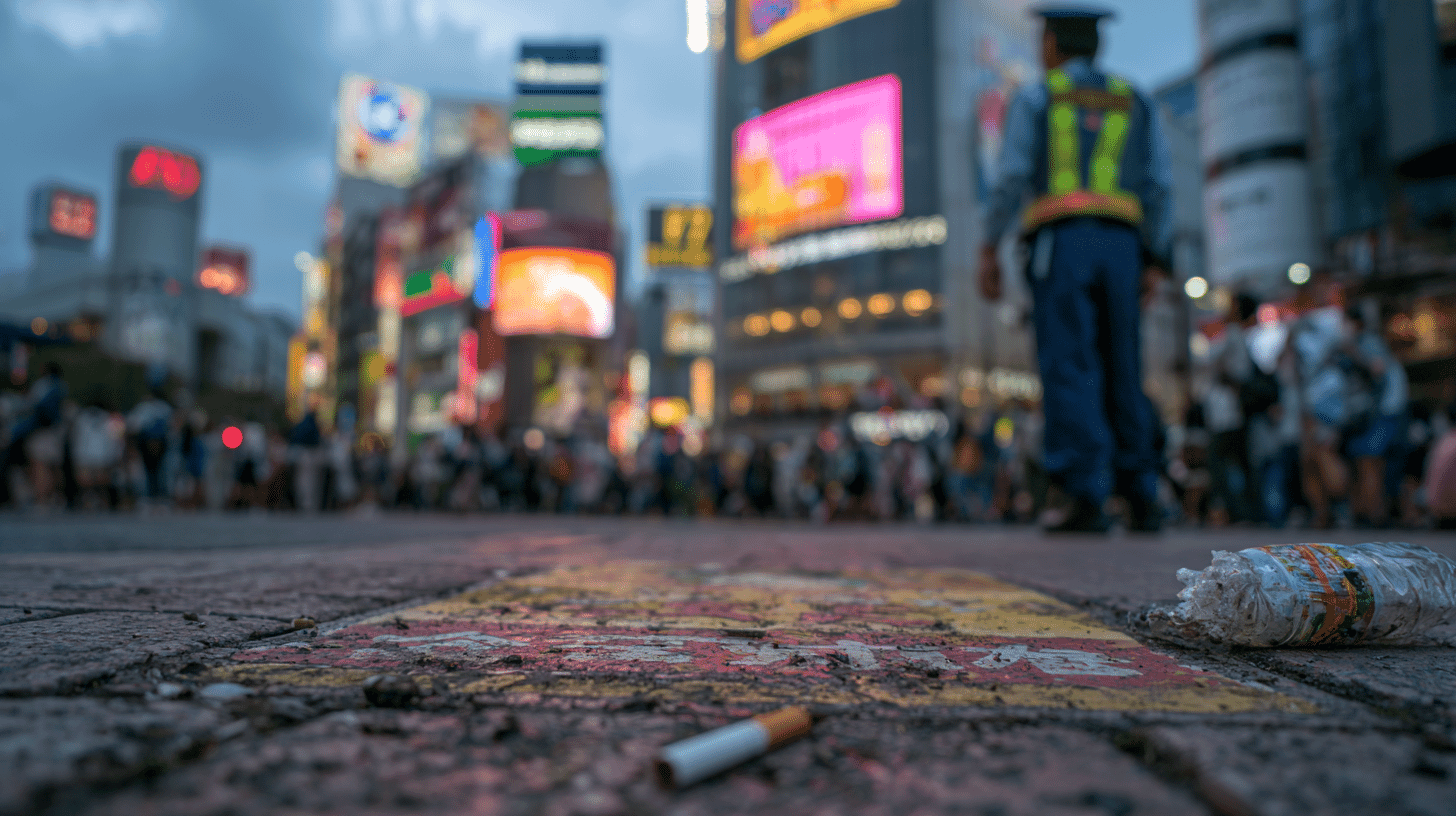
🚯 Drop a cigarette butt on a Shibuya sidewalk and it could cost you ¥2,000 (about $13), collected on the spot. That's the new rule that kicked in on June 1, in a country that spent the last thirty years quietly removing its public trash cans. Welcome to Japan's most awkward contradiction: don't litter, but also, good luck finding a bin.
Ten fines before 9 p.m. on day one
Shibuya didn't ease into it. On the first day the rule took effect, ward patrollers had already issued ten on-the-spot penalties by 9 p.m., according to ward officials. Nine were for cigarette butts dropped in a no-smoking zone. The tenth went to someone caught nudging an empty plastic bottle under a vending machine with their foot.
The penalty is what Japanese law calls a karyō: an administrative fine, not a criminal one. The distinction matters more than it sounds. A criminal fine would require police and a prosecutor; an administrative penalty can be levied by municipal staff directly on the street, which is exactly why Shibuya chose it. The ward says it plans to deploy as many as 50 patrollers walking the streets around the clock. And there's no escape hatch: if a patroller sees you drop something, picking it back up and dropping it in a bin won't cancel the charge.
Officials are blunt about the logic. With the sheer volume of people passing through Shibuya every day, gentle awareness campaigns weren't moving the needle, so they reached for something with teeth. The ward frames it as borrowing a page from cities known for being strict on litter, with Singapore the obvious model, where a first offense can run to roughly ¥200,000 ($1,250) or more. By that yardstick, ¥2,000 is gentle. Charging an on-the-spot penalty for street littering is, the ward says, a first among Tokyo's 23 wards.
So where are the trash cans?
Visitors find this part baffling. Japan is one of the cleanest countries on earth, yet finding a public bin can feel like a scavenger hunt. In a recent Japan Tourism Agency survey, "no trash cans" was the single most common complaint among foreign travelers, ahead of language barriers and crowds.
The scarcity traces back to a specific morning. On March 20, 1995, the Aum Shinrikyo cult released sarin nerve gas on Tokyo subway trains during rush hour, killing more than a dozen people and injuring thousands. In the aftermath, bins were pulled from stations and streets as a security measure: an opaque metal cylinder is an easy place to hide something dangerous. The bins that survived were often swapped for transparent bags so police could see inside. Three decades later, that reflex still shapes Japanese public space; bins get sealed off entirely whenever a high-profile event or visiting head of state raises the threat level.
But security is only half the story. There's also a deep-rooted cultural rule that your trash is your responsibility. Plenty of Japanese carry an empty can or a sandwich wrapper in their bag all day and sort it at home, partly to avoid the very real social awkwardness of putting something in the wrong recycling category. Combustibles, PET bottles, cans, plastics: the sorting rules shift from ward to ward, which makes a single all-purpose street bin almost impractical anyway. For locals, this is second nature. For a tourist holding a dripping bubble-tea cup, it's a minor crisis.
"We built the bins," but did we build enough?
There's an obvious objection, and Shibuya saw it coming: you can't fine people for littering if there's genuinely nowhere to put the trash. So the ward didn't just write a penalty. The same amended ordinance, in effect since April 1, now requires food-and-drink retailers and vending-machine operators in designated zones around Shibuya, Harajuku and Ebisu to install and properly maintain collection bins. Obliging businesses to put out bins is itself a first for a Tokyo municipality. Ignore the order and a business faces a graduated path of warnings, public naming, and eventually a ¥50,000 (about $315) fine of its own.
In other words, Shibuya's answer to "there's nowhere to throw my trash" is to push that duty onto convenience stores and the people who own the vending machines, rather than dotting the ward with city-run bins. It's a clever sidestep of the post-1995 security worry: private operators, not the government, own the risk and the upkeep. But it leaves a question hanging that local broadcasters have been poking at: who actually keeps those bins from overflowing, and is a patchwork of shop-front bins enough for a district that swallows tens of thousands of visitors a night?
Update: On June 3, 2026, Mayor Ken Hasebe told the ward assembly that Shibuya itself will install "smart bins" around Shibuya Station, units that compress waste automatically and signal when they fill up. Drawing on a Tokyo metropolitan subsidy, the ward is aiming to have them in place within the fiscal year, a direct response to criticism that it had offloaded the job onto shops.
The theater director Amon Miyamoto put it neatly in one TV segment: the message can't just be "don't throw it away." You also have to give people somewhere to throw it. A fine without infrastructure is a trap; infrastructure without a fine, Shibuya clearly decided, wasn't working either. So it's trying both at once and watching what happens.
A test the whole country is watching
Strip away the specifics and Shibuya is testing a question every crowded tourist city eventually hits: when the streets get dirty, whose job is it to fix it? Japan's old answer was everyone's, individually, and it worked for decades, until the crowds got too big and too unfamiliar with the unwritten rules.
Whether ten fines in a single evening marks real deterrence or just a jittery opening day, nobody knows yet. The ward sounds cautiously encouraged; the rest of Japan is watching to decide whether to copy it.
In Japan, clean streets have always been treated as a personal duty more than a public service. Where you live, who's expected to handle it: the city, the shops, or you?
References
- https://news.yahoo.co.jp/articles/740b731dd6413e9d48bcb7ffb492279b20bb871c
- https://www.city.shibuya.tokyo.jp/kankyo/machi-seiso/seiso/shibuyaku_poisute_rule.html
- https://www.khb-tv.co.jp/news/16591312
- https://news.yahoo.co.jp/articles/bcb72a288a5b5d8fd98ff2761ede64519dc490f8
- https://www.cnn.com/travel/japan-trash-cans-explainer-intl-hnk




Global Discussion
5 comments