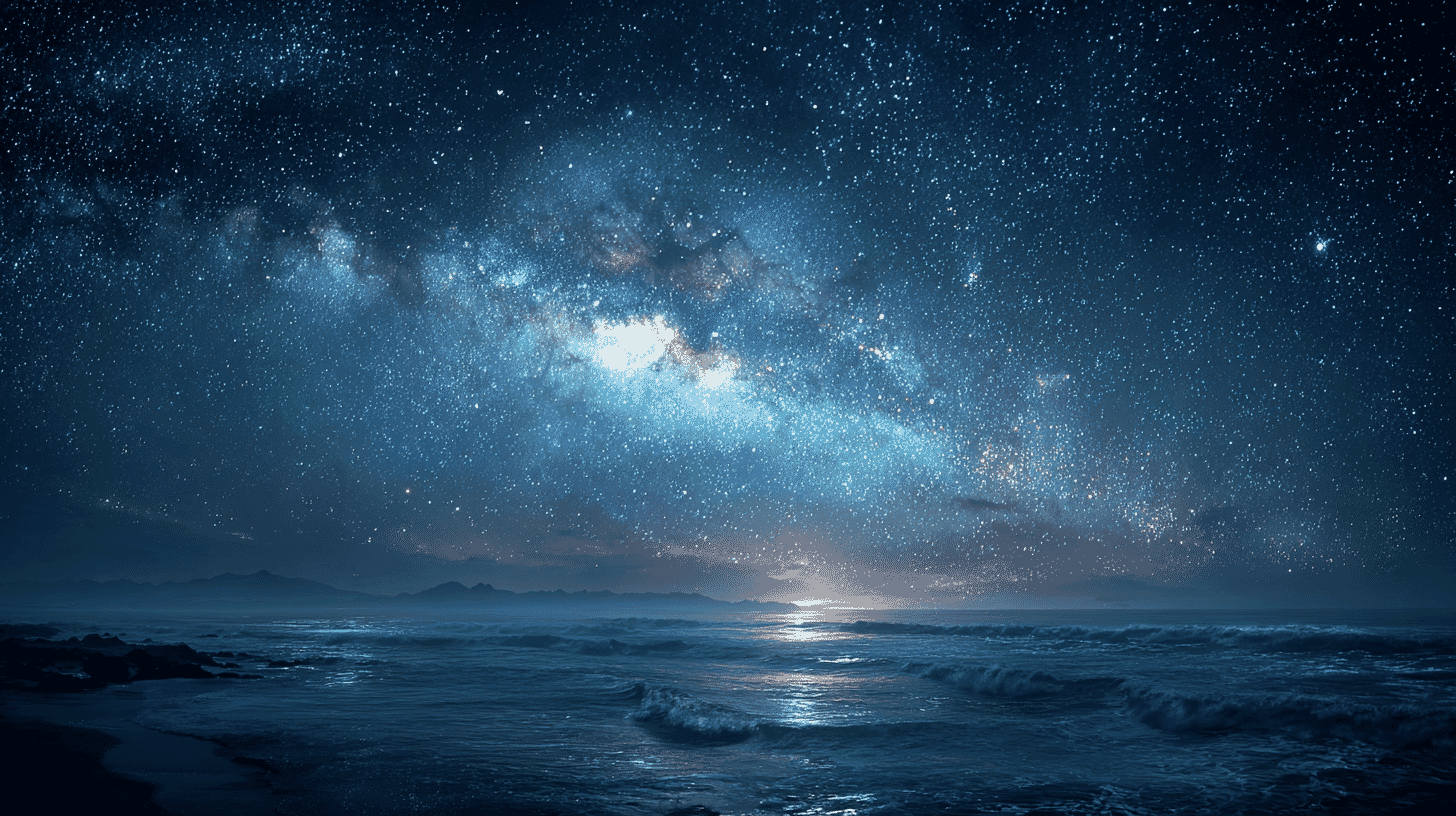
🌌 On a resort island off Okinawa, you can now watch a telescope catch Jupiter live, then walk outside and find the same planet with your own eyes minutes later. That's the pitch behind MIYAKO GALAXY-DOME, a new facility that pairs a working observatory with an LED-dome planetarium. Its operator calls it a first for Japan, and it sits on an island where you can see stars the mainland never gets to.
A telescope and a planetarium, wired together
MIYAKO GALAXY-DOME opened on June 1, 2026, inside the grounds of the Seawood Hotel on Kurima, a small island linked to Miyako by a bridge in Okinawa. It's built around two domes that do opposite jobs. One is an observatory for looking at the real sky; the other is a planetarium for projecting it.
What ties them together is the part that hasn't existed in this combination in Japan before, according to operator Iida Sangyo. The observatory dome holds several telescopes, and whatever one of them is pointed at that night gets beamed, live, onto the neighboring planetarium dome. Aim a scope at the Moon and its craters fill a 7.5-meter dome overhead. Iida Sangyo calls it "electronic stargazing": a whole room looks at the same live view instead of taking turns squinting into an eyepiece.
The planetarium side is unusual in its own right. Instead of a traditional optical projector, it uses a self-illuminating LED dome system called DYNAVISION-LED, built from ultra-high-density panels made by Konica Minolta. Reporters at the preview described the 6K imagery as startlingly bright and sharp, closer to stepping into a film than watching a slideshow of stars. The panels are also micro-perforated so sound passes through them, which means audio rains down from every direction rather than out of speakers on the floor.

663highland / Wikimedia Commons (CC BY 2.5)
Why this speck of an island has some of Japan's darkest skies
Kurima is tiny, but its location does something most of Japan can't. It sits at 24 degrees north, roughly the same latitude as the northwestern Hawaiian Islands. That far south, the southern sky climbs high enough to reveal constellations that never clear the horizon back on Honshu.
The headliner is the Southern Cross. According to Hidehiko Agata, an associate professor at the National Astronomical Observatory of Japan who supervised the facility, all four stars of the cross can only be seen in Japan from the Miyako and Yaeyama island groups. Canopus, the second-brightest star in the night sky, is another southern prize that's easy to miss further north.
Then there's the darkness. Kurima is surrounded by sugarcane fields and open water, with almost no city glow to wash out faint light. In the Environment Ministry's annual night-sky survey, the area earned a top rating in 2024 as a place where you can trace the Milky Way in detail, with a sky-brightness reading around 21 on the SQM scale astronomers use, which puts it near the darkest end. Agata summed up the island's draw as a mix of three gifts: the "sky" above, the "land" of that famous Miyako-blue sea, and the "people" who run the place.
What a night there actually feels like
The visit is designed as a build-up rather than a single show. In the late-afternoon PLANETARIUM TOUR, the dome recreates the sky you'll see over Miyako that same night, with a guide pointing out planets and the constellation tied to your birthday, so you know what to hunt for once it's dark. There's also a dome film called GALAXY ISLAND, narrated by Okinawa-born actor Hikari Mitsushima, that drifts through the island's landscapes.
The payoff comes after dark in the STARGAZING TOUR. The observatory opens up, a telescope locks onto something real, the view goes up on the LED dome for everyone at once, and then the group heads outside to find it in the actual sky. Seeing Jupiter on the dome and then catching it through an eyepiece a few minutes later lands hard for first-timers, even if the raw telescope image looks a little humble next to polished CG. On the preview night a near-full Moon limited what was visible, and the room still lost track of time.
There's a practical bonus buried in all this technology: it's an all-weather setup. Clouds and rain are a real gamble anywhere you go chasing stars, but here a washout still leaves you inside a 6K dome touring Miyako's skies. Agata leaned on a word from psychology for the feeling the place is chasing, "awe," the jolt you get from something vast, which research links to people becoming a bit kinder and more cooperative afterward.
For a look at the two domes taking shape, there's a video of the build:
How to visit
You don't have to stay at the hotel to go. Tours are open to outside visitors, hotel guests, and Miyako residents, at different prices.
- PLANETARIUM TOUR (4:00 p.m. and 5:30 p.m.) and STARGAZING TOUR (8:30–9:45 p.m.): ¥5,500 (about $34) for adults and ¥4,400 (about $27) for elementary-school children as an outside visitor; ¥4,400 ($27) and ¥3,300 ($20) for hotel guests and residents. Preschoolers are free.
- DOME TOUR, a free-roam look inside the dome: ¥1,500 (about $9) for outside visitors, ¥1,000 ($6) for residents, free for hotel guests.
- The facility is closed Tuesdays and Thursdays.
Getting there takes some effort, which is part of why the skies are so clean. Miyako is about a three-hour flight from Tokyo, two and a half from Osaka, or a 50-minute hop from Naha. From Miyako Airport the hotel is roughly a 20-minute drive across the Kurima bridge, and there's a free airport shuttle by reservation. The Seawood Hotel itself is a sprawling 130,000-square-meter resort of private-pool villas and a beach known for its sunsets, with rooms starting around ¥42,000 (about $260) a night for two on booking sites. If you'd rather just do the stars, the tour ticket alone is the low-commitment way in.
Japan's night sky is becoming a destination
Stargazing has, somewhere along the way, become a travel category of its own in Japan, from mountain villages that market their darkness to resorts now building it into the room rate. Miyako's twist is doing it on a subtropical island. Whether ¥5,500 to look at a screen of the sky you could see for free outside is worth it is a fair question, and the answer probably depends on how much you value the guiding, the telescopes, and not getting rained out.
Where do you go to see a truly dark sky where you live, and is it something you'd plan a whole trip around?

Global Discussion
5 comments