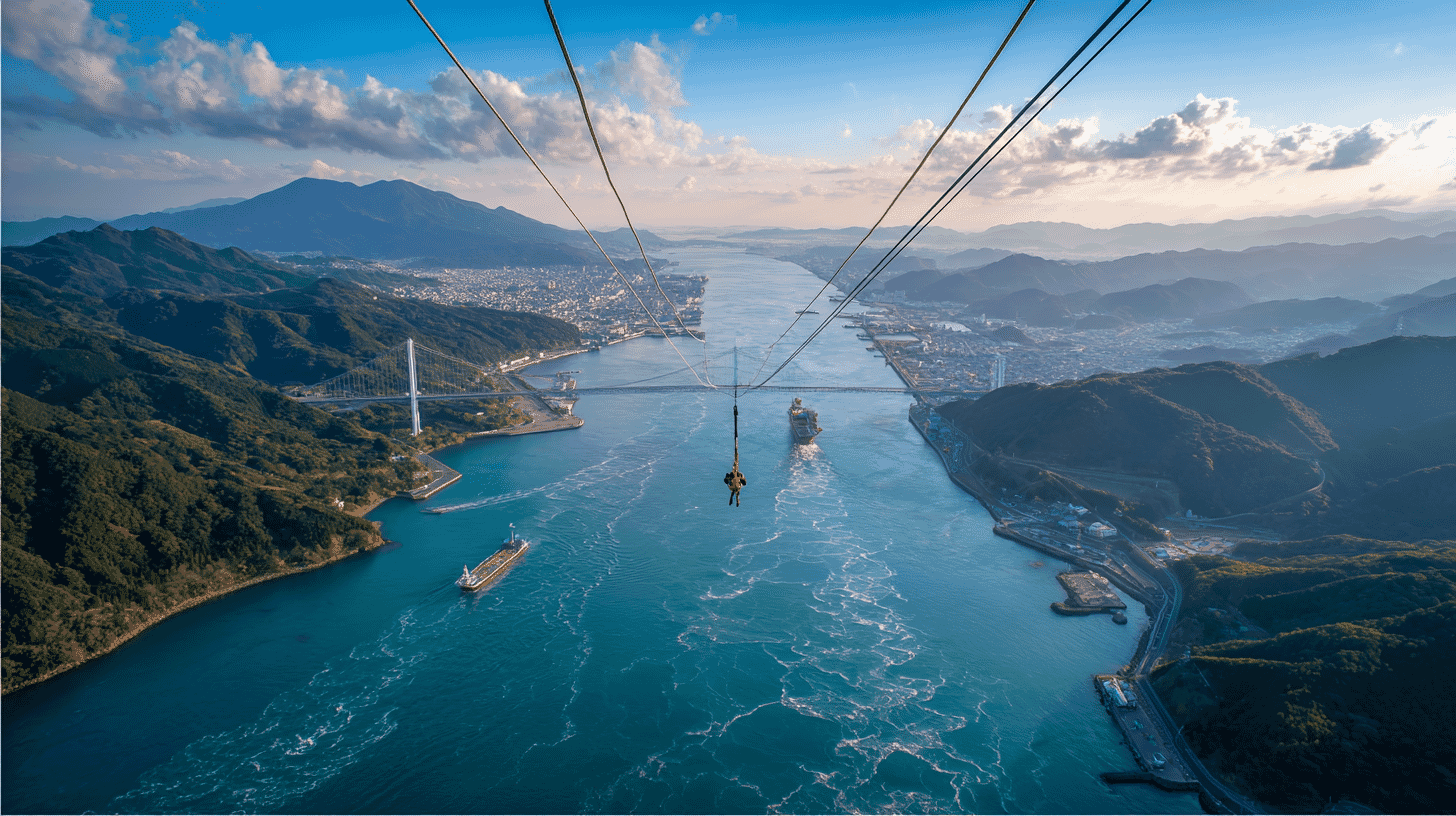
What if you could cross a prefecture border by flying through the air at 110 km/h? Japan planned exactly that: a 1,740-meter zipline stretching across the Kanmon Strait. Then funding collapsed and the project went dark for two years. Now, Shimonoseki City has put money on the table to bring it back from the dead. The dream of soaring 136 meters above the waters where samurai fought their final battles isn't over yet.
What Is the Kanmon Strait Mega Zipline?
The Kanmon Strait Mega Zipline is a proposed attraction connecting Hinoyama Park in Shimonoseki City (Yamaguchi Prefecture) to Mekari Park in the Moji district of Kitakyushu City (Fukuoka Prefecture). Riders would be strapped into a harness in a face-down "superman" position and launched across the strait on one of four parallel cables, soaring alongside the Kanmon Bridge.
Here are the key specs:
- Total length: 1,740 m (5,709 ft)
- Max speed: 110 km/h (68 mph)
- Max height above sea level: 136 m (446 ft)
- Flight time: approx. 90–120 seconds
- Cables: 4 (up to 4 riders simultaneously)
- Expected cost per ride: ¥28,000 (~$176), including GoPro rental and shuttle service
- Total construction budget: approx. ¥1.5 billion (~$9.4 million)
The project was originally driven by RINEX (formerly KM Adventure), a company founded in Shimonoseki. CEO Okubo Makoto says the idea started as a casual conversation over drinks with his wife: "Wouldn't it be fun if there were a zipline across the Kanmon Strait?" What began as a half-joke quickly gained traction when they found no strong opposition from local authorities, and plenty of enthusiastic supporters.
Government Backing: Both Cities Got On Board
In May 2023, Shimonoseki proposed the zipline concept during a joint mayoral meeting with Kitakyushu. The two cities formally established a project review team chaired by both cities' vice mayors. Kitakyushu Vice Mayor Katayama Kenichi called the mega zipline "a catalyst for the region," while acknowledging the immense challenges of spanning an international waterway.
Japan's Ministry of Land, Infrastructure, Transport and Tourism (MLIT) also endorsed the project through its Chugoku Regional Transport Bureau, incorporating it into the "Kanmon Strait Bridge of Light Mega Trip Area" initiative and praising it as having "one-of-a-kind originality that attracts travelers."
The Dream Hits a Wall: Two Years of Silence
But the road to realization proved far rougher than anticipated.
The original plan targeted a spring 2025 opening, with design and construction costs estimated at ¥1.5 billion (~$9.4 million). Crossing an international shipping lane demanded engineering far beyond typical zipline construction, specialized cable-tensioning methods, clearance for large cargo vessels, and maritime safety protocols that had no regulatory precedent.
The biggest obstacle was funding. As a private-sector-led initiative, raising ¥1.5 billion proved extraordinarily difficult. For approximately two years, the project ground to a complete halt. The dream of flying across the Kanmon Strait ran aground.
Restart: "I Will Not Give Up"
The turning point came in fiscal year 2026.
Shimonoseki Mayor Maeda Shintaro allocated ¥10 million (~$63,000) in the city's FY2026 general budget for a "feasibility study", a zero-based reassessment of the project's viability and commercial potential.
At the budget press conference, Mayor Maeda declared: "I will not give up on the zipline concept. I believe it can be done. I am convinced it will become the flagship tourism attraction of Shimonoseki." He also indicated plans to re-invite Kitakyushu Mayor Takeuchi Kazuhisa to rejoin the project once the outlook becomes clearer.
This restart takes a fundamentally different approach from the first attempt. Rather than relying on private-sector enthusiasm alone, the city government is investing public funds in a rigorous feasibility assessment, examining funding structures, legal frameworks, safety standards, and profitability from scratch.
Why a "Zipline" as "Transportation"?
This might sound unusual, but ziplines have been used as practical transportation for thousands of years. In China and India, rope-based systems carried people across rivers and gorges long before modern bridges existed. Japan has its own tradition: the yaen (wild monkey), a hand-pulled ropeway still preserved in Totsukawa Village, Nara Prefecture, once used by locals to cross rivers.
The Kanmon Strait Mega Zipline is positioned as more than a theme park ride. It would physically transport people from Yamaguchi Prefecture to Fukuoka Prefecture, functioning as a fourth way to cross the strait, joining the Kanmon Bridge (highway), Kanmon Tunnel (road and rail), and the Kanmon Ferry. The package includes shuttle service to Mojiko Retro District and Karato Market, integrating the zipline into a broader tourism circuit.
The zipline is also part of a larger "Mega Trip Area" concept that envisions a loop tour connecting the strait crossing with ferries, drone taxis, and a trolley train. Hinoyama Park itself is slated for renovation into a multi-use complex with camping facilities.
How It Compares to the World's Famous Ziplines
To appreciate the scale, here's how the Kanmon project stacks up globally:
Jebel Jais Flight (UAE): The Guinness World Record holder stretches 2,830 meters across the Hajar Mountains at 1,680 meters above sea level, with speeds up to 160 km/h. Operated by Toroverde, it has carried over 120,000 riders since 2018 and costs approximately AED 650 (~$177) per ride.
The Monster (Puerto Rico): Formerly the world's longest at roughly 2,200 meters, this zipline sends riders soaring above tropical rainforest canopy at speeds approaching 150 km/h.
HANAZONO ZIPFLIGHT (Niseko, Japan): Currently the longest zipline experience in Japan and Asia, covering 2,591 meters across three lines with views of Mount Yotei.
At 1,740 meters on a single line, the Kanmon zipline wouldn't set a distance record. But no other zipline in the world crosses an international shipping lane, spans a prefecture border, or flies over waters where some of history's most dramatic battles took place.
Adventure Tourism Potential
The projected price of ¥28,000 (~$176) is several times the cost of a typical Japanese zipline experience, but it's competitive with premium international offerings like Jebel Jais Flight at a similar price point.
The Kanmon Strait is steeped in Japanese history. The Battle of Dan-no-ura (1185), the final clash between the Taira and Minamoto clans, was fought in these waters. Nearby Ganryujima Island is where swordsman Miyamoto Musashi defeated his rival Sasaki Kojiro in 1612. This combination of extreme adventure and historical narrative could make the zipline a compelling draw for the growing global adventure tourism market.
Can It Actually Happen This Time?
This restart has elements the first attempt lacked.
First, the government is putting its own money in. The city-funded feasibility study will produce objective data on profitability and legal hurdles, giving private investors and banks the evidence they need to make decisions.
Second, the broader Kanmon area is booming. Hoshino Resorts opened "Risonare Shimonoseki" in November 2025, dramatically raising the area's profile. A zipline would amplify the region's growing appeal.
Third, inbound tourism to Japan has been setting records since 2024, and the adventure tourism segment is expanding rapidly. "Fly over the strait where samurai fought" is an incredibly powerful marketing hook for international audiences.
Challenges remain formidable: cable installation over an international lane handling 30,000 vessels annually, typhoon protocols, regulatory classification for a structure that doesn't fit existing building codes, and the ¥1.5 billion price tag. None of it is easy.
But Mayor Maeda's "I will not give up" signals that this project, while not yet realized, refuses to die. Many people around the world are hoping the day comes when they can soar at 110 km/h over the waters of Dan-no-ura.
Would you try crossing a strait at 110 km/h while dangling from a wire 136 meters above cargo ships? Does your country have any extreme or unconventional forms of transportation? Share your thoughts in the comments!
References
- https://news.yahoo.co.jp/articles/9ec1764228c8a0b20dfaf1a6b48a1f512ae24d4d
- https://dime.jp/genre/1770726/
- https://rkb.jp/contents/202307/202307257153/
- https://shimonoseki.goguynet.jp/2024/06/03/zipline/
- https://www.city.shimonoseki.lg.jp/site/kisya/97124.html
- https://visitjebeljais.com/adrenaline/jais-flight/






Global Discussion
13 comments