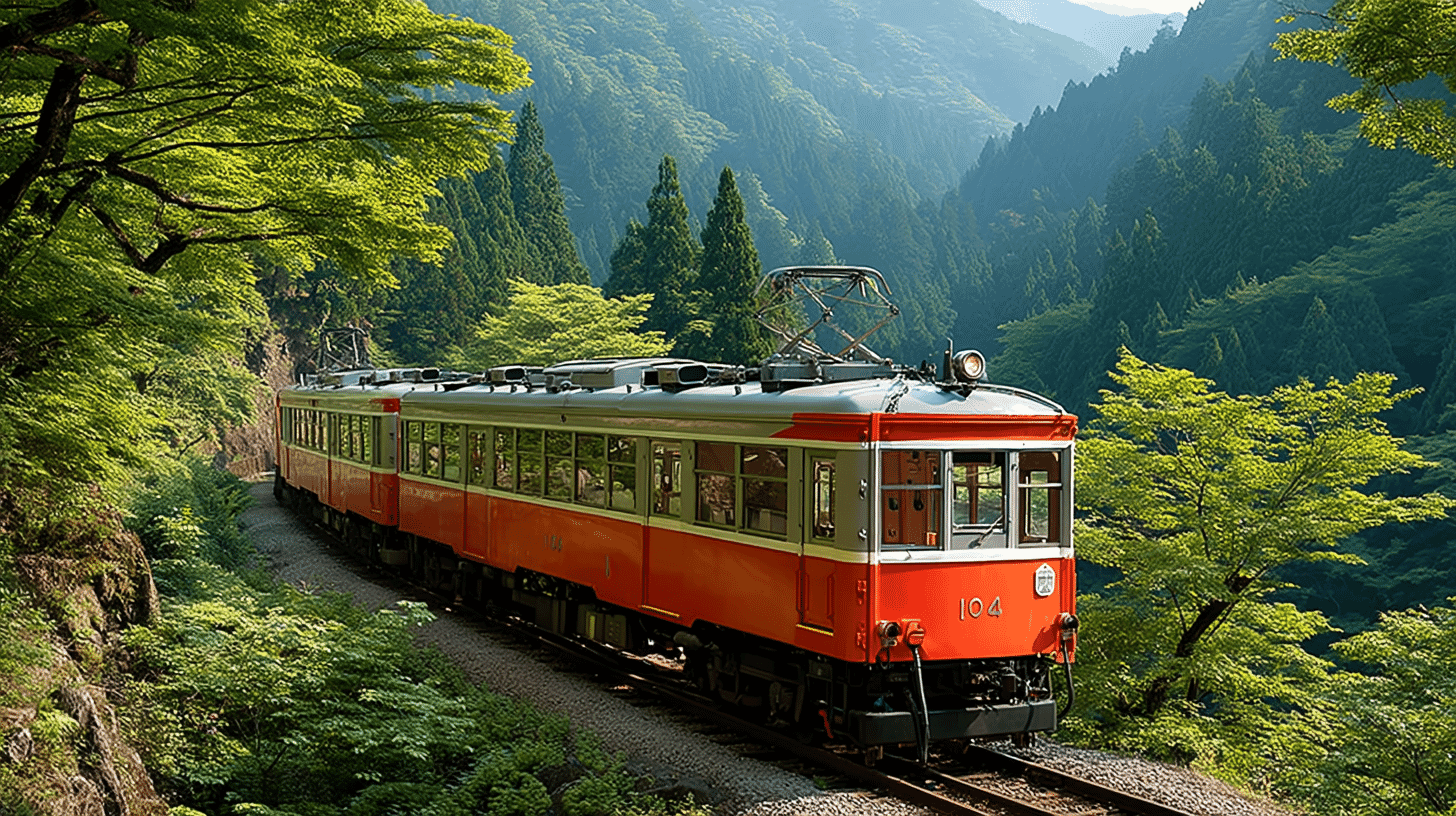
🚋 This train has no air conditioning, and that is exactly the point.
On August 30, a railcar registered in 1919 will haul a chartered service up Japan's steepest adhesion railway with every window pushed as far open as it will go. The operator is selling it as the "Natural Air Conditioning Experience." It is also one more step in a farewell that started in October 2025 and still has a year and a half to run.
A charter train with every window wide open
Odakyu Hakone announced the tour on August 3, 2026, as the third instalment of a retirement campaign for the Hakone Tozan Railway's Type 100 cars. A three-car set will be chartered end to end for a single Sunday round trip between Hakone-Yumoto and Gora.
Every passenger gets one reserved seat and one window to themselves, with no one leaning across for the view. There are 60 places, and the tour needs 40 to run. Fares range from ¥3,800 to ¥13,000 (roughly $24 to $82) depending on which seat you get. According to the rail news site Tetsudo.com, the cheapest tier is in car 108, whose box seats sit beside windows that do not open, which is a rather cruel joke on a tour named after fresh air.

Source: Odakyu Hakone press release
Everyone goes home with a boarding certificate, a copy of the train's working timetable and the crew duty sheet, which tells you something about the audience. At Gora, the group gets to inspect and photograph Moni 1, the orange works car that hauls rails, sleepers and ballast around the line and normally sits in the yard there, since it works mostly at night. Rail Channel, a Japanese rail news outlet, traces its lineage back to the Yu 1 cars of 1921, nicknamed the "fish and vegetable train" because they carried food up to the inns at Miyanoshita and Kowakidani when the roads were still bad.
Bookings opened through Lawson Travel at 10:00 on August 4, first come, first served.
What exactly is 107 years old here
The Type 100 is really two classes travelling together. Cars 104 and 106 are Moha 1; car 108 is Moha 2. All three run as a single fixed set.
Moha 1 was registered in 1919 as the Chiki 1 class, built by Kisha Seizo for the opening of the Hakone-Yumoto to Gora section on June 1 that year. Moha 2 followed in 1927. Fourteen cars were built in all. Three are left.

Source: Odakyu Hakone press release
Those 1919 cars were wooden. In 1950 the bodies were replaced with steel and the class was renamed, and 108 got the same treatment in 1956. Bogies, traction equipment and interiors have all been updated since. What survives from before the war is the registration, the dimensions and a set of design decisions: painted wooden panelling inside, luggage racks of an old-fashioned design, and passenger windows that open wide from the bottom. Cars 104 and 106 seat 48 along the sides with room for 93 standing and sitting; 108 has semi-cross seating for 44 and takes 100.
So is it a 107-year-old train or a 76-year-old body wearing a 107-year-old name? Odakyu Hakone hedges precisely: it calls the Type 100 the oldest electric car in regular service on a conventional railway in Japan, and adds "according to our research." In Osaka, the Hankai Tramway's Mo 161 cars of 1928 are routinely described in the Japanese rail press as the oldest railcars still in active service anywhere in the country; they reach 100 years of service on December 21, 2028. Both claims can stand, because a tramway and a conventional railway are separate categories under Japanese law, and because nobody agrees on whether a rebodied car counts as the original.
The reason for retirement is less philosophical. Odakyu Hakone said in October 2025 that age had made repairs and parts procurement difficult. Replacements are due in fiscal 2028.
Japan's steepest climb, and a Swiss connection
The Hakone Tozan Railway is short and absurd. In 8.9 kilometres it climbs from Hakone-Yumoto at 96 metres to Gora at 541, a gain of 445 metres in about forty minutes. Part of that involves an 80 per mil gradient, meaning 80 metres of rise per kilometre, which is the steepest in Japan for a railway that relies purely on friction between steel wheel and steel rail. One line in the country climbs harder, the Oigawa Railway's Ikawa Line at 90 per mil, but it does so with a toothed rack rail.
To manage it, trains zigzag through three switchbacks at Deyama, Ohiradai and Kami-Ohiradai. At each one the driver and the conductor swap ends of the train, walking past the passengers to do it. Curves get down to a 30-metre radius, tight enough that water is sprayed onto the rails from a tank under the cab floor to cut wear and noise. On a three-car train, the Japan Society of Civil Engineers notes, the front and rear ends can differ in height by about 3.6 metres. The line was named a Civil Engineering Heritage site in 2007.
None of this was the original plan. The first design called for a rack railway on a 125 per mil grade. The company sent its chief engineer, Mitsugu Handa, to Europe to check, and he came back from the Bernina line in Switzerland convinced that adhesion plus switchbacks would work. Sixty years after the line opened, on June 1, 1979, the two railways signed a sister agreement, and in 2014 St. Moritz and Hakone became friendship cities. If the red cars climbing through the trees look a little Swiss, that is not an accident.
A farewell in slow motion
Odakyu Hakone announced the retirement in October 2025, twenty-seven months before the final run. That is a long goodbye, and the company has filled it.
The first wave, from July 2026, brought retro destination boards back onto the cars and put an exhibition of 34 archive photographs above the windows inside, running until late December. It also produced the strangest item of the lot: a line pass billed as solid gold, priced at ¥468,000 (about $2,960), limited to 100, on sale for the month of July only. It is valid from October 2026 through March 2028, and buyers are promised a seat on the final charter after regular service ends. The second wave centred on commemorative platform tickets dated 8 August of Reiwa 8, themed around car 108, the only car in the fleet with an eight in its number. The third is this tour, plus a set of ten model cars in liveries never previously produced, at ¥3,500 each (about $22) or ¥33,000 (about $209) for a box of ten, on general sale from November 4, 2026.
Because the Type 100 has no air conditioning, it usually spends the summer as a spare and rarely appears. In 2026 the company is running it all season instead, and handing out paper fans on platform 2 at Gora to soften the consequences: 100 a day from July 24, 6,000 made. Odakyu Hakone has also published a notice for photographers, which reads as a polite acknowledgement that farewell campaigns in Japan tend to draw crowds onto trackside verges.

Source: Odakyu Hakone press release
You still have until January 2028
If the tour is full, or ¥13,000 for a seat by a window feels steep, the ordinary answer works fine. The Type 100 runs in normal service on a published schedule, listed on the Hakone Navi site and subject to change without much notice, and riding it costs the standard fare or comes included with a Hakone Freepass. No special ticket, no queue.
What you get is an interior lined in painted wood, a window that opens far enough to lean into, and forty minutes of a mountain the first designs said would need a rack rail. Sit near the front and watch the driver and the conductor trade places at each of the three switchbacks.
Plenty of countries keep a heritage line running on weekends. Far fewer have a century-old car turning up on the regular timetable, taking fares from tourists who have no idea what they have boarded. How does your country handle its oldest working trains: museum piece, or still on the roster?
References
- https://trafficnews.jp/post/694878
- https://www.hakonenavi.jp/topic/15954/
- https://www.hakonenavi.jp/_wp/wp-content/uploads/2026/08/71b363a903428ceb39625339dddaf61e.pdf
- https://prtimes.jp/main/html/rd/p/000000231.000098471.html
- https://railf.jp/event/2026/08/04/143000.html
- https://www.tetsudo.com/event/60986/
- https://www.hakonenavi.jp/hakone-tozan/history/
- https://grandtourofswitzerland.jp/cms/339/?lang=jp
- https://committees.jsce.or.jp/heritage/node/48
- https://www.pref.shizuoka.jp/kensei/information/myshizuoka/1002263/1040951/1011372.html
- https://tetsudo-ch.com/12980649.html
- https://railf.jp/news/2026/05/04/040500.html



Global Discussion
3 comments