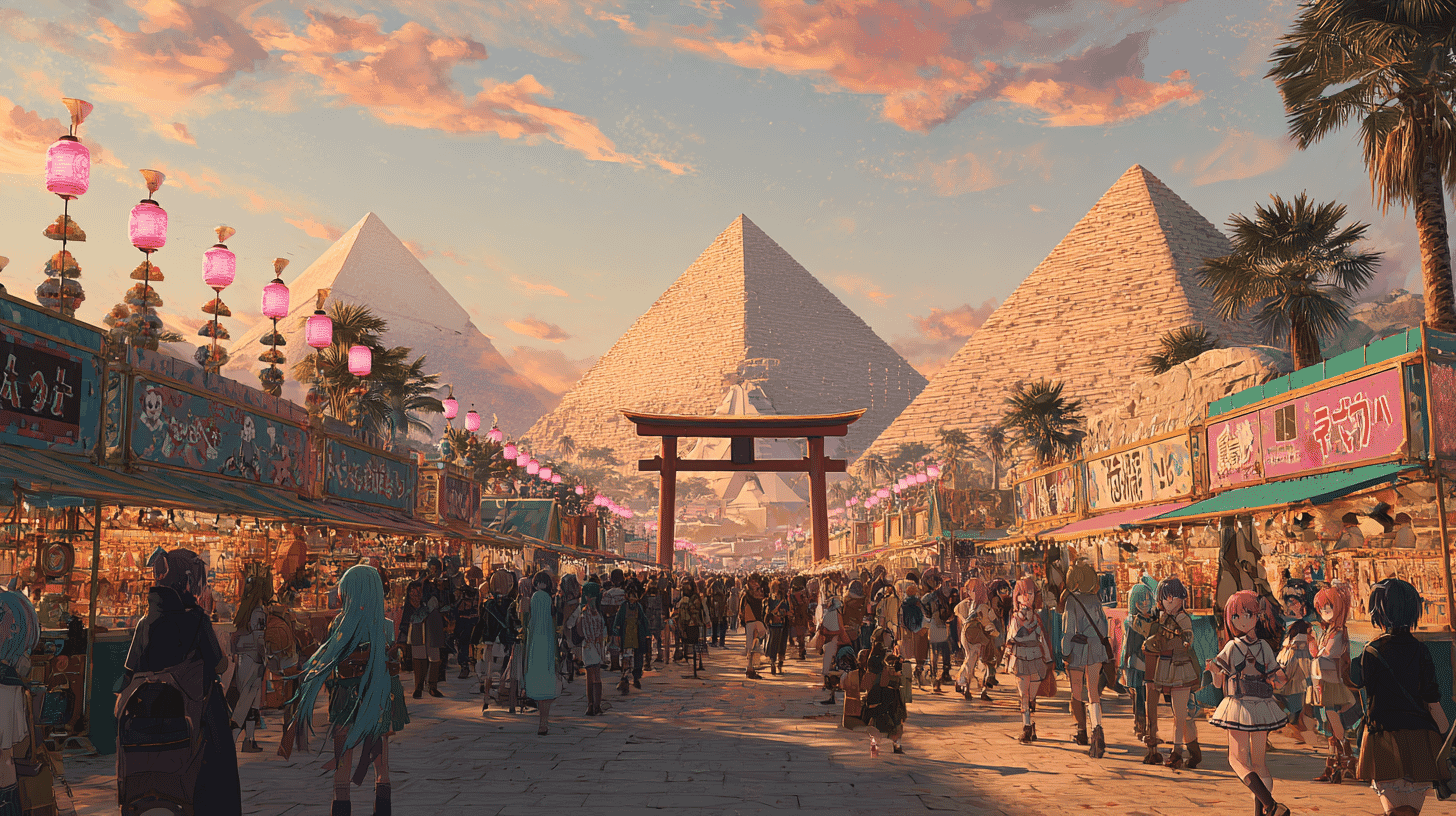
Anime, matcha, and cosplay, in the land of the Pyramids?
With over 108 million people and half the population under 25, Egypt is witnessing an explosive demand for Japanese pop culture. On February 6–7, 2026, JETRO (Japan External Trade Organization) hosted "Super Japan in Cairo", the organization's first-ever pop culture-focused event anywhere in the world. With 16 Japanese companies including Bandai Namco and Yamaha showcasing anime, games, matcha, and stationery, about 3,000 young Egyptian fans were expected to attend. Here's how Japan's "soft power" is captivating Africa's youth.
JETRO's World-First: A Pop Culture Event in Cairo
On February 6, 2026, JETRO launched "Super Japan in Cairo" in Egypt's capital, the first time the organization has ever hosted an event specifically focused on Japanese pop culture anywhere in the world.
The two-day event brought together 16 Japanese companies and organizations, including Bandai Namco (the gaming and entertainment giant behind titles like Gundam and Pac-Man), Yamaha (musical instruments), Itoen (Japan's largest green tea company), and Pentel (stationery and art supplies). The program featured live performances by Japanese idol singers, cosplay contests organized by local anime fan communities, and hands-on workshops.
Naruyo Nishizawa, head of JETRO's Cairo office, pointed out that while young Africans have strong demand for Japanese pop culture, the supply side is severely lacking, creating a massive "supply-demand gap." He expressed hope that Japanese companies would seize the opportunity to enter Africa, which he described as a "huge market" with continued population growth ahead.
Egypt: Africa's Biggest Japan-Loving Market
Egypt's population exceeds 108 million and is projected to reach 160 million by 2050. With a median age of approximately 24 years, younger than most major Asian emerging economies, the country represents one of Africa's largest consumer markets, valued at over $320 billion.
What sets Egypt apart is its exceptionally high interest in and affinity for Japan. Five Egyptian universities have Japanese language departments, and the country boasts roughly 3,500 Japanese-language learners, the highest number in the entire Middle East and Africa region. The Japan Foundation's Cairo Cultural Center consistently sees full enrollment in its Japanese language classes.
The connection with Japanese anime runs deep. Thanks to SpaceToon, an Arabic-language TV channel that has broadcast Japanese anime across the Middle East and North Africa (MENA) region since the 1980s, generations of Egyptians grew up watching shows like Captain Tsubasa (known as "Captain Majid" in Arabic), Mazinger Z, and Yu-Gi-Oh!. The latter holds special significance for Egyptian fans, as its storyline weaves together ancient Egyptian history and culture with Japanese animation, a fusion that many young Egyptians find uniquely cool.
Inside Egypt's "Otaku" Community
EGYCON, an Egyptian event for anime fans that began in 2014, has its roots in an event launched in 2013 with support from the Japan Foundation. Its first edition featured Japanese anime singer Hironobu Kageyama, famous for the Dragon Ball Z opening theme, as a guest and drew great excitement.
Today Egypt's anime fan community is the largest in the Middle East. One Egyptian influencer says she reached 100,000 followers just a week after starting to post about anime on social media. In Egypt, the word "anime" has taken root as the common term for Japanese animation, and titles such as One Piece, Jujutsu Kaisen, Attack on Titan and Demon Slayer are hugely popular among young people.
Cosplay is thriving too, and the community is led by a diverse cast, from a dentist who also works as a professional cosplayer to influencers who combine Japanese-language learning with anime content.
Matcha Mania: But Does Egypt Know It's Japanese?
One of the event's highlights was a matcha latte-making workshop hosted by Itoen, Japan's leading green tea company. Matcha-based drinks, especially lattes, have already gained significant popularity among Egyptian youth.
Yet there was an unexpected twist: some attendees asked whether matcha is actually Japanese. While matcha as a beverage has become well-known, its identity as a product of Japanese culture hasn't fully taken hold. Itoen representative Moeto Furukawa acknowledged this gap, calling it "disappointing but also an opportunity." Establishing matcha's Japanese origins could significantly boost brand value and market differentiation.
Pentel, the Japanese stationery maker, also reported strong interest in art supplies, noting that many Egyptian anime fans are passionate about drawing. This illustrates how anime fandom naturally extends interest toward other Japanese products, from art materials to food and beyond.
Africa's "Supply-Demand Gap" and the Business Opportunity
JETRO's analysis highlights a significant mismatch in Africa: strong demand for Japanese pop culture among youth, but very limited legitimate supply channels. While streaming services like Netflix and Amazon Prime Video offer some anime content in the region, dedicated Japanese content platforms and physical merchandise remain scarce.
By 2050, Africans are projected to comprise one-quarter of the world's population, and the continent's youthful demographics underpin its potential as a long-term consumer market. JETRO's "Super Japan in Cairo" initiative goes beyond intellectual property licensing, it aims to use pop culture as an entry point for marketing a wide range of Japanese products to Africa's growing youth market.
Two Ancient Civilizations Connected by Modern Pop Culture
Egypt and Japan share something profound: both are nations built upon millennia of civilization. In Japan, the Egyptian god Medjed has become an unlikely pop culture icon, beloved as a "yuru-chara" (cute mascot character) since being introduced to Japanese audiences at a British Museum exhibition in 2012. In Egypt, Yu-Gi-Oh! creates a bridge between ancient Egyptian mythology and Japanese anime storytelling.
These cultural exchanges, flowing in both directions, build a foundation for mutual understanding that transcends mere business transactions. The growing demand for Japanese pop culture in Egypt could serve as a litmus test for Japan's cultural outreach across the entire African continent.
In Japan, pop culture exports like anime, matcha, and stationery are increasingly embraced worldwide. How popular is Japanese pop culture in your country? What aspects of Japanese culture interest you most?
References
- https://www.jiji.com/jc/article?k=2026020700144&g=int
- https://www.jetro.go.jp/events/car/53b13d7d37ac024f.html
- https://www.jetro.go.jp/biz/areareports/special/2025/0702/405ce237d03ae1b8.html
- https://www.jetro.go.jp/biz/areareports/special/2025/0702/968a681830ef08a6.html
- https://www.arabnews.jp/article/arts-culture/article_51855/
- https://www.arabnews.jp/article/arts-culture/article_122727/








Global Discussion
15 comments