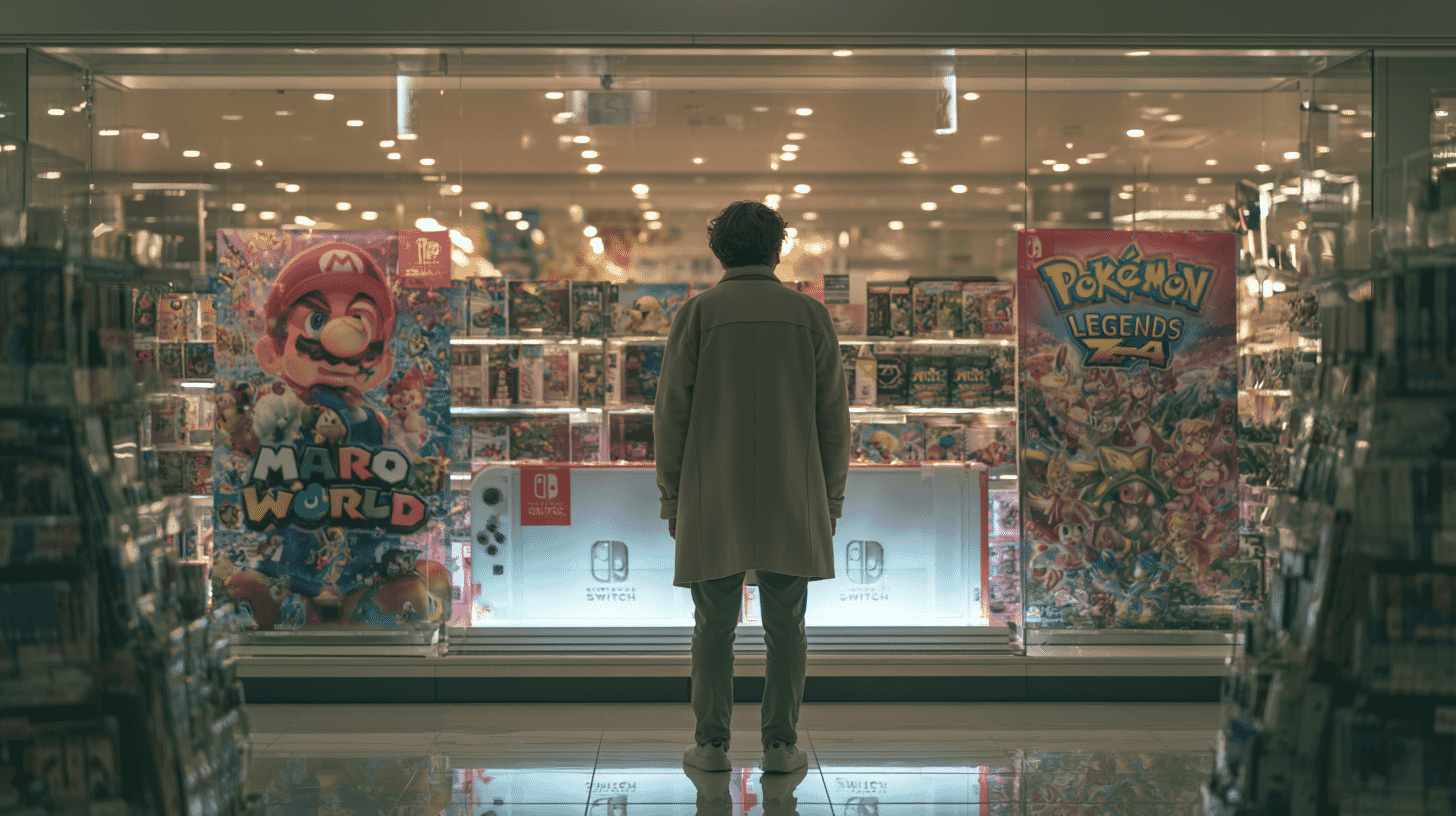
🎮 Here's a number that doesn't get reported much: +772.5%. That's the year-over-year jump in operating profit for Happinet's video game segment in fiscal year 2026, not Nintendo's own results, but those of one of the wholesalers sitting between the platform holder and Japanese retailers. While Western coverage of the Switch 2 has fixated on 19.86 million units sold and the price hike announced on May 8, which took the Japanese console from ¥49,980 to ¥59,980 on May 25, a different story has been playing out one rung down the supply chain. Console generation transitions don't just enrich the platform holder, they reroute cash through the entire ecosystem of distributors, toy stores, and capsule machines. This is what that looks like in spreadsheet form.
Who is Happinet, anyway?
If you've never heard of Happinet (TSE: 7552), you're not alone outside Japan. Founded in 1969, it's a Tokyo-listed wholesaler and middleman, the kind of company that buys consoles, plastic figures, gacha capsules, and CDs from manufacturers and ships them to retailers like TSUTAYA, Yamada Denki, and the local toy shop. It's one of Bandai's biggest distribution partners, runs the Gashacoco capsule toy chain (more on that in a minute), and draws the bulk of its toy revenue from BANDAI SPIRITS' "Ichiban Kuji" prize lottery products.
In other words: not a game company. A logistics and channel business. Which is exactly why its earnings reading is interesting, when a wholesaler at this position in the chain posts a near-eightfold jump in segment profit, something real is moving through the pipes.
The headline numbers
For the fiscal year ended March 31, 2026, Happinet announced on May 14:
| Metric | Result | YoY change |
|---|---|---|
| Net sales | ¥439.05B (~$2.78B) | +20.5% |
| Operating profit | ¥15.59B (~$98.7M) | +33.5% |
| Net profit | ¥10.10B (~$63.9M) | +49.2% |
A 33.5% jump in operating profit is the kind of result that gets a press release printed in larger font. But buried in the segment breakdown is where the Switch 2 story actually lives.
Video games: the segment that exploded
This is the one that matters for anyone tracking Nintendo's supply chain:
- Segment sales: ¥119.02B (~$753M), up 52.5% YoY
- Segment profit: ¥2.20B (~$13.9M), up 772.5% YoY
A 52.5% sales increase that translates into a 772.5% profit increase means margins expanded dramatically, not just volume. Happinet attributes the lift to Switch 2 hardware and accessories, plus heavy software flow: Mario Kart World, Pokémon LEGENDS: Z-A, and the surprise late-fiscal-year hit Pokémon Pokopia. None of this is exotic; these are the same titles that drove Nintendo's own books. The difference is that Happinet sells through to retailers, which means every one of those Switch 2 boxes that moved through Yodobashi or Bic Camera passed through a wholesaler's hands first.
The 772.5% figure has a small asterisk: the prior-year comparison is from the tail end of Switch 1's life cycle, when console hardware margins for distributors had compressed sharply. So this is partly a base-effect rebound. But even adjusting for that, it's a structural recovery, the kind of margin reset that happens once per console generation and then doesn't recur for seven years.
The non-game segments tell their own story
The video game line wasn't the only winner.
Toys, the largest segment by sales, posted ¥192.42B (about $1.22B), up 13.5%, with profit up 24.1% to ¥11.32B. The drivers were "Ichiban Kuji" prize draws (the lottery-ticket-meets-anime-merch format that's become a cornerstone of Japanese fan retail), Bandai's Tamagotchi Paradise revival, and steady demand for plastic models and figures.
Amusement, which includes the company's Gashacoco capsule toy stores, surged to ¥65.40B (+24.9%) with profit up 71.7% to ¥5.19B. Happinet now operates 154 Gashacoco locations, 121 directly and 33 as franchises, alongside a separate and growing set of stores run jointly with Bandai Namco Amusement. Capsule toys have quietly become one of the most resilient retail categories in Japan, propelled by adult collectors and inbound tourists hunting for ¥300-to-¥500 anime trinkets.
Visual and music, the laggard. Sales fell 3.6% to ¥62.22B and the segment swung to an ¥11.15B loss after the prior year's ¥0.98B profit. Happinet blamed market shrinkage compounded by an investment loss on a foreign film acquisition. Physical home video continues to bleed in Japan as it has elsewhere; the surprise is that Happinet still has a foot in that business at all.
Why a wholesaler made so much money
The mechanics behind the 772% line deserve a moment.
When a new console launches, demand is constrained by hardware supply, not by distribution capacity. Retailers will pay near-list to secure allocation; the wholesaler's negotiating position firms up. Bundle software sells alongside hardware at unusually high attach rates, lifting margins further. Accessories (Joy-Con 2 controllers, Pro controllers, charging docks, screen protectors) carry better margins than the console itself, and a generation transition flushes out years of pent-up accessory demand all at once.
All of that lands on a distributor's P&L as a temporary, generational windfall. Sales rise; margins rise faster. Hence: sales +52.5%, profit +772%.
Nintendo's own May 8 earnings showed how big the underlying wave was. Switch 2 sold 19.86 million units in its first 10 months, well ahead of the company's initial 15M plan and even the upwardly revised 19M target. Total FY26 net sales doubled to ¥2.31 trillion (~$14.6B), with 77% coming from outside Japan. Mario Kart World moved 14.7 million units, Donkey Kong Bananza 4.52 million, and Pokémon LEGENDS: Z-A Switch 2 Edition reached 3.94 million. That entire cascade flowed through Happinet, Sega Toys, Asmodee Japan, and the rest of the wholesale layer.
The international comparison: is the Switch 2 ripple a Japan-only story?
Not really. Ampere Analysis reported earlier this year that combined third-party software sales on Switch and Switch 2 reached $2.3 billion across Q2-Q4 2025, a 76% year-over-year increase from $1.3 billion. Warner Bros. and Bandai Namco led that third-party surge.
The same wholesale dynamic exists abroad, but the data is harder to see. US and European game distribution has consolidated heavily. Amazon, GameStop, Best Buy, MediaMarkt, Argos, Fnac all buy more directly from publishers, so margin lifts get captured by retailers rather than middlemen. Japan's retail topology is different: more independent specialty stores, more category-specific wholesalers (toys vs. games vs. anime merch), more layers between manufacturer and shelf. So when a console generation flips, the wholesale tier in Japan literally shows up on a balance sheet in a way that's invisible in Western markets.
The other comparison worth noting: Bloomberg reported in March that Nintendo had cut Switch 2 production by about 33% after weaker-than-expected US holiday sales. VGChartz estimates also tracked Switch 2 behind Switch 1 in the US, UK, and France during the 2025 holidays. Yet the Japan number kept climbing, Pokémon Pokopia (a slow-life sandbox in which you play a Ditto in human form, building a town for Pokémon, and a niche proposition abroad) sustained domestic demand into the spring. Happinet's earnings are downstream of that Japan-specific strength.
The outlook: gravity returns in FY27
This is where the story turns slightly sober. Happinet's own guidance for the fiscal year ending March 2027 is +2.5% sales (¥450B) and +1.3% operating profit (¥15.8B), essentially flat after the surge. Nintendo, similarly, projects 16.5 million Switch 2 units in FY27, down 16.9% from the FY26 figure, citing the steep launch comparison and the Japanese price increase that took effect on May 25.
In other words: the windfall is being budgeted as one-off. Both companies expect demand to remain healthy, just not at launch-year intensity. The 772% profit growth at Happinet's video game segment was an artifact of where the company sits in time: first year of a new platform, with prior-year comparables from the bottom of the previous cycle. That kind of math doesn't replicate.

Source: gamebiz / Happinet Corporation
What it does demonstrate is the spread of a generation change. Nintendo got the headlines. Happinet got the cash flow. Bandai's Tamagotchi got a runway. The capsule toy chain expanded another wave. The whole ecosystem that surrounds a console launch in Japan benefited, and the wholesale tier, the most invisible part of that ecosystem from a Western consumer's perspective, is where the leverage showed up most plainly.
For overseas Switch 2 owners, none of this changes the experience of playing Mario Kart World. But it does answer a question that gets asked a lot in Reddit threads and on resetera: "Who actually makes money in this generation, besides Nintendo?" The answer turns out to include companies you've never heard of, doing logistics work you'll never see, whose stock you can't easily buy without a Japanese brokerage account.
How does game distribution work in your country? Is there a wholesale tier between publishers and retailers, or has direct distribution flattened it? And do retailers in your market visibly cycle through inventory differently when a new console launches?









Global Discussion
0 comments