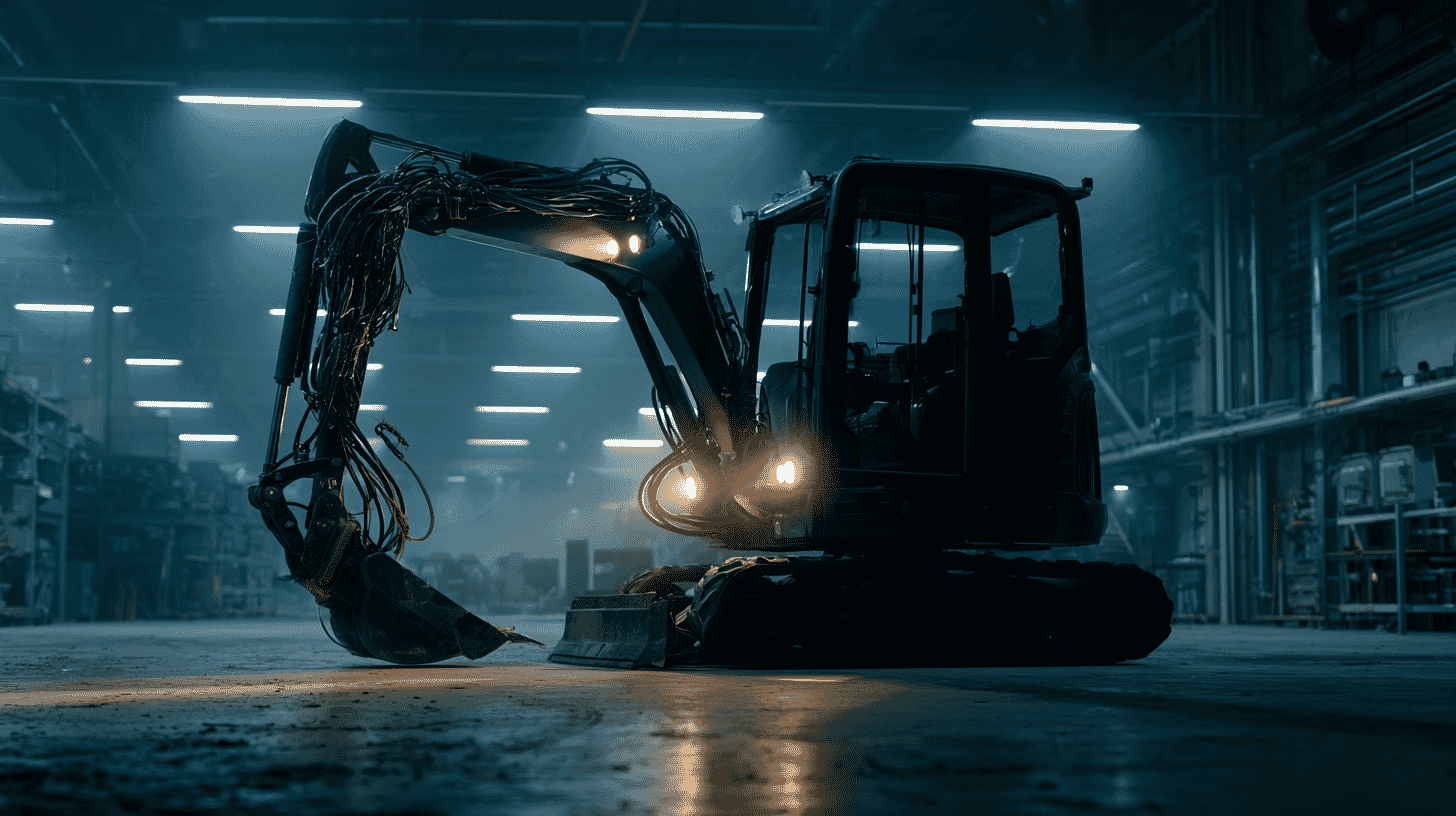
🚜 Look around the next construction site you pass in Ohio, Yorkshire or the suburbs of Lyon, and there's a decent chance one of the compact diggers clawing at the dirt says TAKEUCHI on the side. Ask the operator where the machine comes from and you'll often get a shrug. The company that built it sits in a town of a little over ten thousand people in the mountains of Nagano, sells almost nothing at home, and invented the entire category of machine you're looking at. About 99% of its revenue now comes from outside Japan. This is the story of how a subcontractor from rural Japan created a market that didn't exist, then went out and owned it.
When the only diggers were giants
Takeuchi started in 1963 in Sakaki, a small town on the west bank of the Chikuma River, making parts for other companies' machines. For its first years it was a subcontractor, not a brand.
The turn came from a favor. A man the founder knew was doing residential foundation work by hand, and asked whether someone couldn't build a small, affordable digging machine for tight spaces. At the time, excavators came in one flavor: huge. Machines weighed tens of tons and were useless on a cramped urban lot, so on those jobs crews still swung pickaxes and shovels the way they had for a century.
Takeuchi's founder, Akio Takeuchi, chased the idea, scavenging substitute parts and improvising, and in 1971 the company finished the TB1000: a two-ton excavator that could rotate fully and swing its boom to the side. It was the world's first "mini excavator," a class of machine that simply hadn't existed before.
The effect on a job site was immediate. Work that had taken a crew a week by hand could be done in a day. The machine became, in the words of Japanese builders, a power tool that replaced the pickaxe. It sold so fast the factory couldn't keep up. Akio Takeuchi later recalled shipping units before the paint had dried, then having to repaint machines caught in a sudden rain.
A market that didn't exist, on ground that broke the machines
Success at home came with a trap. Once Takeuchi proved mini excavators worked, Japan's big manufacturers, the Komatsus and Hitachis of the industry, moved in, and the home market filled up fast. A small company from Nagano was not going to out-muscle giants on their own turf.
So Takeuchi did something counterintuitive: it more or less gave up on Japan. Beginning with exports in 1978 and a US subsidiary the following year, it poured its resources into North America and Europe, where the mini excavator was still an unknown quantity. There was no crowd of rivals there. There was also, at first, barely any market at all. Takeuchi wasn't fighting for share; it was explaining to overseas builders why they'd want a machine they'd never seen.
Then the machines started breaking. Abroad, a mini excavator runs about 2,000 hours a year, roughly double the Japanese average. Contractors overseas treat the cab as a place they'll spend most of their working day, and they run the equipment hard. Takeuchi's domestic-spec machines couldn't take it. The company spent years reworking the fundamentals, thickening steel and hardening components, until the products could survive conditions they were never designed for.
The bet on "nothing off the shelf"
Durable was necessary but not sufficient. A machine as tough as the competition, from a company with no track record and no brand, still doesn't sell itself. Takeuchi's answer became its whole philosophy: never build the second version of someone else's product.
In its early export years the company had even built machines that were sold under other firms' badges. Rather than settle into that supplier role, Takeuchi committed to growing its own name on original designs: specialize in the small machines the majors ignored, and keep being first.
That meant loading mini excavators with features nobody expected in that size class: a parking brake, a joystick control that let operators steer with their elbows resting so they tired less, an undercarriage that could widen or narrow to slip down alleys, a floor that tilted up for easy servicing, a boom that slid side to side to dig flush against walls. Buyers who knew equipment noticed. The little machines were doing things that were supposed to require a big one.
The clearest expression of the strategy came in 1986. Watching wheeled loaders bog down in America's clay-heavy soil, Takeuchi developed the world's first crawler loader, a hauling and loading machine that ran on tracks instead of tires, letting it work in mud and on broken ground where wheels sank. In the United States it became close to essential.
Just as unusual was how Takeuchi sold. It skipped the trading houses that most Japanese exporters relied on, showed up at trade fairs with sample machines it would actually run in front of buyers, and built a network of local distributors whose real job was to funnel customer complaints and requests straight back to Nagano. The company treated the gripes of a contractor in Iowa or Bavaria as product specifications.
The diggers that helped take down the Berlin Wall

Wikimedia Commons (Public Domain / CC0)
In 1989, when the Berlin Wall came down, roughly 40 Takeuchi machines were among the equipment used to tear it apart. A compact digger from a Nagano town had a bit part in one of the century's defining images, and hardly anyone watching knew it.
That kind of visibility, plus a reputation for durability, cemented the company's standing in Europe and North America. Operators there gave the machines a nickname that stuck: the Mercedes of construction equipment. Takeuchi leaned into it, keeping prices roughly 10% above rivals and betting that customers would pay for a machine they trusted. Enough of them did.
The numbers today are the kind that make investors do a double take. In the year ending February 2026, Takeuchi posted sales of ¥225.3 billion, up 5.7%, roughly $1.5 billion at current exchange rates, and net profit of ¥28.3 billion. Both were records, and more than 99% of the revenue came from outside Japan. In mini excavators it ranks second in Europe and fifth in North America by unit sales, by its own tally drawing on Off-Highway Research figures. It carries essentially no debt, posts a 15.1% return on equity and a 16.7% operating margin, and raised its annual dividend from ¥200 to ¥210. All of it from a company most people in Japan have never heard of.
What the 99% doesn't tell you
It would be easy to end there, but the same thing that makes Takeuchi remarkable also makes it fragile. Depending on the world for 99% of your sales means depending on other people's economies. North America is now its single largest market, which ties its fortunes tightly to US housing starts and interest rates. The year to February 2026 swung back to growth as the American construction market recovered, but the footing is narrow. Over that year the company expected ¥5.1 billion in tariff costs on US sales and passed ¥2.5 billion of it through in price increases. Its guidance for the year to February 2027 has revenue rising to ¥244 billion while operating profit slips to ¥37.3 billion and net profit to ¥25.9 billion.
There is also the question of who comes next. Akio Takeuchi, the man who scavenged parts to build the first machine, is now past 90 and serves as chairman. In November 2023 he became the first Asian inducted into the Association of Equipment Manufacturers' Hall of Fame. A company this defined by one founder's instincts eventually has to prove it can run on something other than them.
Takeuchi's own answer is to keep moving. Its fourth medium-term plan, covering the years to February 2026 through February 2028, calls for a dedicated loader factory next to the Aoki plant and a bet on battery-powered mini excavators. By the final year it aims to sell 1.2 times as many excavators and twice as many loaders as in the year to February 2025, 1.5 times as many machines in total, and to reach ¥300 billion in consolidated sales. Development still happens entirely in Japan; production now runs in both Japan and a plant in South Carolina, closer to the market that matters most.
Update, July 2026: first-quarter results for the year to February 2027, released on July 10, showed sales of ¥56.8 billion, up 12.2% year on year, and net profit of ¥7.4 billion. Full-year guidance was left at ¥244 billion.
The machines are still out there, from Massachusetts to Marseille, doing the heavy lifting under a name almost nobody around them can place. Which makes you wonder: somewhere in your own country, what unsung world-beater is hiding in plain sight, badged with a name you've walked past a hundred times without a second glance?






Global Discussion
4 comments