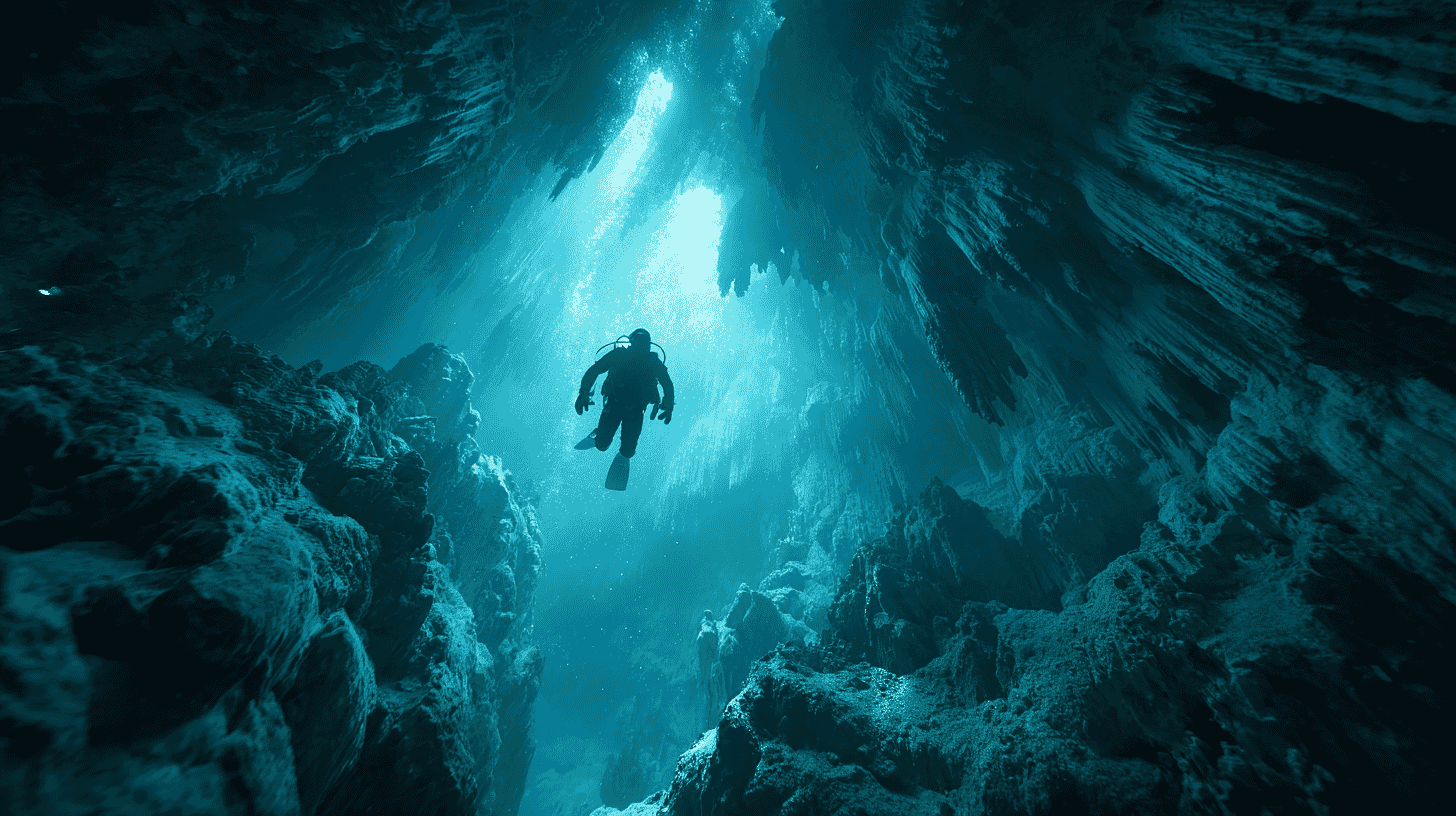
Deep inside a mountain in southern Japan lies a cave that spent the last 85,000 years underwater after a volcanic catastrophe. On March 20, 2026, two professional divers descended into its blackness and reached a depth of 97.4 meters, likely a new Japanese national record for cave diving. What they found there: 300-million-year-old stalactites and geological strata that have not seen daylight since long before humans reached these islands.
What Happened: A 3-Hour Dive Through a Submerged Mountain Cave
On March 20, 2026, a survey team led by professional diver Yuji Ohama (60) descended into the Inazumi Underwater Limestone Cave in Bungo-Ono City, Oita Prefecture, on Japan's southern island of Kyushu. The two-diver team aimed for 100 meters of depth and reached 97.4 meters before turning back. The full dive lasted approximately three hours.
This is believed to be the deepest dive ever recorded in a Japanese underwater limestone cave. The previous benchmark, a roughly 80-meter dive at Ryusendo Cave in Iwate Prefecture, has been surpassed by more than 17 meters. The cave's operating company plans to formally apply for recognition as a Japanese national record.
It's worth noting that Inazumi already holds an official Japanese national record as the country's longest underwater cave, certified at over 1,000 meters by the Japan Records Certification Association. The 97.4-meter dive is an attempt to add a second title, Japan's deepest, on top of that. If approved, Inazumi will officially be confirmed as both the longest and deepest underwater limestone cave in Japan. A single site holding both length and depth national records simultaneously is genuinely rare, even by global standards.
Reaching 97.4 meters required descending from the cave's deepest interior chamber, navigating through powerful underwater currents and passages so narrow that a diver could barely squeeze through. According to Ohama, what awaited at the bottom was "primordial, rugged stalactite formations and geological fault lines you would never see above ground, a magnificent landscape." The team turned back just 2.6 meters short of their 100-meter target.

inazumi.com
Background: The Strangest Cave You've Probably Never Heard Of
For overseas readers unfamiliar with the site, Inazumi is unusual even by global standards.
The cave's limestone began forming roughly 300 million years ago, during the Paleozoic Era, when the proto-Japanese landmass was still attached to the edge of Asia. Stalactites and stalagmites grew over the eons, creating what was originally a fairly conventional dry limestone cave.
Then, about 85,000 years ago, a catastrophic event reshaped the geography of southern Japan: the Aso caldera in Kumamoto Prefecture erupted on a colossal scale. Pyroclastic flow deposits, more than 70 meters thick, buried the gorge of the Nakatsumure River that ran in front of the cave. The entire cave system was submerged below the new groundwater table.
Over millennia that followed, the river slowly eroded away three-quarters of the pyroclastic blockage. The upper half of the cave re-emerged into the air, while the lower half remained permanently flooded. That's how Inazumi exists today: a half-dry, half-submerged limestone cave nestled in mountains over 200 meters above sea level.
This makes it geologically distinct from Mexico's famous cenotes. Cenotes are sinkhole features formed by collapsed limestone roofs, typically opening directly to the surface. Inazumi is the opposite: a cave hidden inside a mountain, drowned by volcanic ash, and re-exposed only at its top half. It's better described as a subterranean river system than a cenote-style spring.
A Children's Discovery in 1976, and Japan's First Diveable Underwater Cave
The cave's existence had been known since the Edo period (1603–1868), but no one had ever entered it. The breakthrough came when local children playing in the Hakusan River spotted a "hole" underwater, the cave entrance.
In 1976, the Saiki Diving Club conducted the first underwater survey under researcher Tokio Akamine. They confirmed the cave extended over 1,000 meters underwater, making it Japan's longest underwater limestone cave. A 2014 survey revealed the cave continues at least 800 meters past the tourist-accessible endpoint, with a side passage exceeding 100 meters in length.
On March 23, 2019, the cave became the first commercial underwater limestone cave diving and snorkeling site in Japan. Today, beginner-level cavern diving experiences cost around 4,000 yen (about $25 USD) per person for groups of two or more. Children under 10 can participate in the PADI Bubblemaker program in shallower sections.
Water temperature stays at a consistent 16°C year-round. Tracer studies show the underground water originates from the Hakusan River, designated one of Japan's "100 Famous Waters," about 4 kilometers upstream, taking five days to flow through the limestone bedrock to the cave.
How Inazumi Compares to Mexico's Cenotes and Florida's Cave Systems
Where does 97.4 meters rank in the world of cave diving?
Mexico's Yucatán Peninsula is the global epicenter. The Pit (also known as Pat Jacinto), part of the Dos Ojos system, plunges to 119–130 meters. The Sac Actun cave system stretches 370 kilometers, the longest underwater cave system on the planet. There are over 6,000 known cenotes across Yucatán. Florida hosts another major concentration of cave diving sites, where many of the sport's pioneering techniques were developed.
In terms of pure depth, the global picture is in another league. Sheck Exley, a Florida high school maths teacher and cave diving legend, pushed helium-mix diving past 250 meters through the 1980s and 1990s. He died in 1994 at 45, attempting to pass 300 meters in Mexico's Zacatón cenote; the cause was never established. The deepest cave dive on record belongs to Nuno Gomes, 282.6 meters at Boesmansgat in South Africa in 1996. Scuba depth records overall now sit above 308 meters, and going deeper is thought to require experimental measures such as hydrogen in the breathing mix, which Richard Harris and his team began testing in 2023.
So 97.4 meters is modest by world standards, but Inazumi's appeal isn't depth. It's the layered structure of the cave itself. The entry zone tops out at roughly 10 meters, accessible to introductory cave divers. As you push deeper, undulating passages descend to 20 meters, then suddenly drop into 40+ meter chambers where silt accumulation reduces visibility to zero. The full transition from beginner-friendly cavern diving to extreme technical exploration happens within a single cave system, a rare configuration globally.
A 60-Year-Old Diver Pushing Frontiers of "Adventure Science"
The dive's lead, Yuji Ohama, is 60 years old. A professional diver and cave explorer, he has spent years documenting and surveying Inazumi using closed-circuit rebreather technology that allows extended decompression dives. His team's gradual progression from intro-cave training to full-cave to staged-cave dives has steadily mapped the cave's furthest reaches.
The cave's manager, Zensuke Aomatsu (51), commented that he hopes visitors will "experience the romance of Japan's longest and deepest cave through this exploration."
The 97.4-meter dive isn't just a record. It opens potential discoveries about the cave's geology and biology that have been locked away for tens of thousands of years. Mexican cenotes have yielded ancient Mayan skeletal remains and unique cave-adapted ecosystems; Florida cave systems have produced prehistoric human bones and extinct megafauna fossils. What might Japan's deepest underwater cave hold? The "geological fault lines never seen above ground" Ohama observed at 97.4 meters could become research material that reshapes our understanding of southern Japan's geological history.
The Sobering Reality of Cave Diving Risks
Cave diving is one of the most dangerous sports on Earth. The combination of confined spaces, total darkness, decompression obligations, and equipment dependency means that minor errors quickly become fatal. Exley's death is a reminder that even legends die when pushing the limits.
In Japan, cave diving requires staged certifications. Inazumi's shallow cavern zone is open to certified Open Water divers, but anything beyond that, in the full cave and stage cave domains, demands skills like zero-visibility navigation, decompression theory, stage cylinder management, and high-level situational awareness. The 97.4-meter dive was the product of meticulous planning, redundant equipment, and decades of accumulated expertise.
That tension between adventure and discipline is part of what makes the story interesting. There's nothing showy about a 60-year-old veteran diver methodically exploring the bottom of a Japanese mountain cave. But what he's doing is pushing the boundaries of where humans can go in his country, one carefully calculated descent at a time.
Mexico's Yucatán Peninsula has more than 6,000 known cenotes. Florida is one of the world's premier cave diving destinations. Despite Japan being a volcanic archipelago with countless caves, Inazumi remains the only commercially diveable underwater limestone cave in the country. Does your country have notable underwater caves or cave diving sites? Have you ever tried cave diving yourself? Tell us in the comments below.
References
- https://news.yahoo.co.jp/articles/7504537adb0dedc82eb8f125f5e7be6c798cdb78
- https://news.tnc.ne.jp/social/891242_1.html
- https://japaneserecords.org/japanese-records/17414/
- https://ja.wikipedia.org/wiki/%E7%A8%B2%E7%A9%8D%E6%B0%B4%E4%B8%AD%E9%8D%BE%E4%B9%B3%E6%B4%9E
- https://inazumi.com/
- https://oceana.ne.jp/diving/diving-spot/148565
- https://www.technologyreview.jp/s/333572/meet-the-divers-trying-to-figure-out-how-deep-humans-can-go/






Global Discussion
14 comments