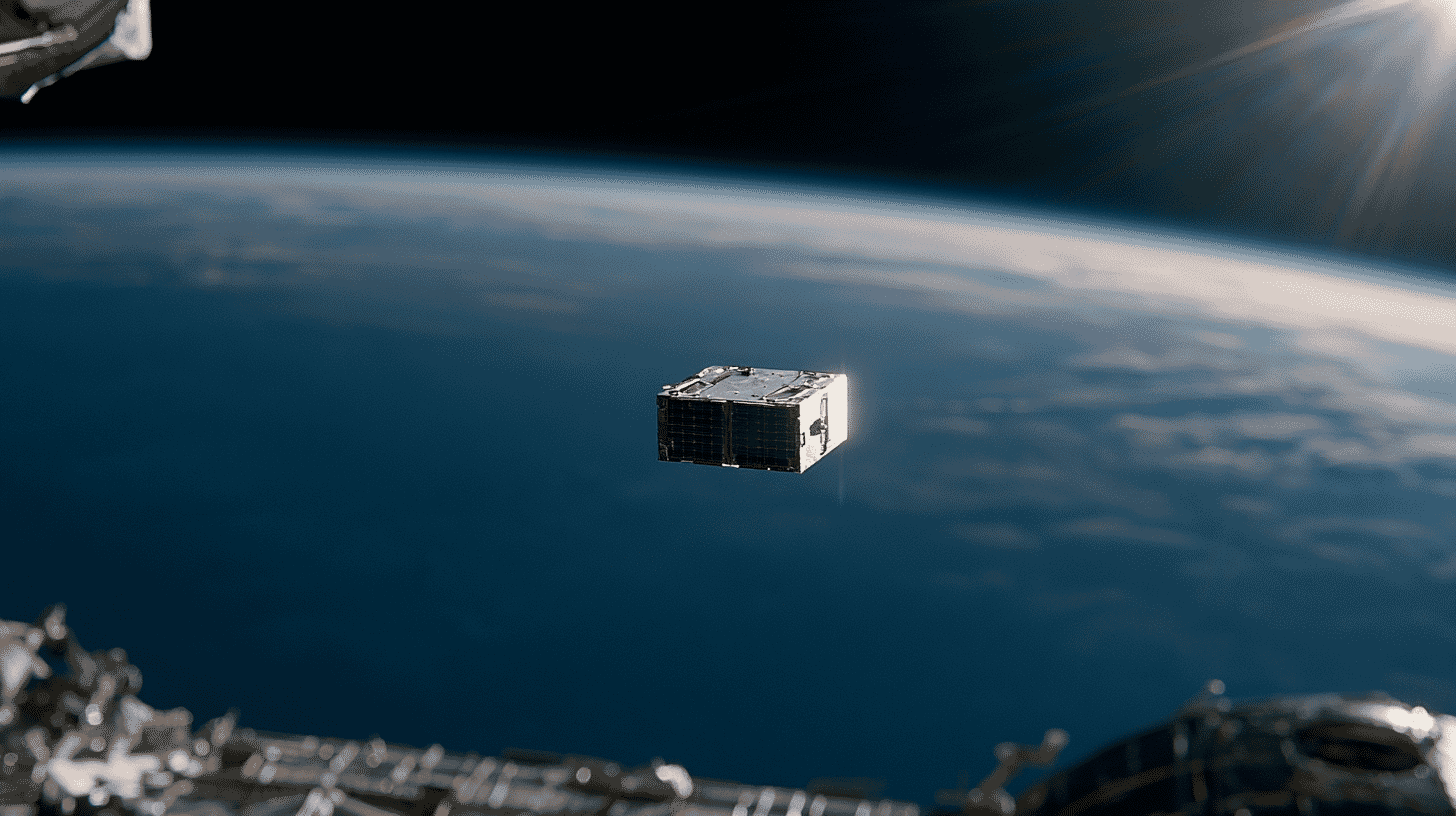
🛰️ More than half the tiny satellites that rode NASA's big Moon rocket in 2022 ran into trouble. Deep space is brutal on cubesats, the shoebox-sized spacecraft universities can actually afford. So when three Japanese universities set out to prove the technology a cubesat needs to survive beyond the Moon, they made an odd call: don't go to deep space. Not yet. On June 19, their satellite HOKUSHIN-1 floated out of the International Space Station to test the hard parts somewhere cheap and safe to fail: low Earth orbit.
Why deep space breaks small satellites
A cubesat is built from 10-centimeter cubes called units. One unit, "1U," is about the size of a Rubik's cube; HOKUSHIN-1 is a 3U, roughly a loaf of bread, weighing a few kilograms. The format is cheap and standardized, and over the past two decades it has let universities and startups fly hardware that once needed a national budget.
Low Earth orbit, a few hundred kilometers up, is the easy part. Deep space is a different sport. NASA's twin MarCO cubesats proved in 2018 that the format could leave Earth at all, they trailed the InSight lander to Mars and relayed its landing, but the pair fought thruster leaks and safe-mode resets, then fell silent within a year. When NASA's Artemis I rocket carried ten cubesats toward the Moon in late 2022, more than half hit problems after release. Japan's own OMOTENASHI, which would have been the smallest-ever Moon lander, never made contact, and NASA's NEA Scout solar sail was lost too.
The harder problem isn't the hardware. It's knowing where the thing is. A satellite in low orbit is easy to track from the ground. A spacecraft millions of kilometers out has to be located precisely across that emptiness, and the ground stations and navigation teams that do this don't get cheaper just because the spacecraft shrank. That fixed cost is what punctures the dream of the cheap deep-space cubesat: you can build a tiny probe for very little, then spend a fortune figuring out where it went.
Three universities, one detour
HOKUSHIN-1 is the answer that Tohoku University, Hokkaido University, and the Muroran Institute of Technology came up with. It's the first in a planned line of technology demonstrators aimed at "beyond the Moon", but instead of betting that ambition on an actual deep-space trip, the team is proving the riskiest pieces in roughly 400-kilometer orbit first, riding the cheapest lane available: a hand-off from the space station.
That lane is a JAXA program called J-CUBE, run with Japan's University Space Engineering Consortium, which gives domestic universities a deployment slot from Kibo, the Japanese module on the ISS. There's no dedicated rocket. The satellite goes up as ordinary cargo, astronauts load it into a spring-loaded deployer, and it's pushed gently into orbit. HOKUSHIN-1 was picked in 2021 and built from June 2022, with students doing the real hardware through vibration and thermal-vacuum testing. The completed flight model was handed to the launch provider, a milestone announced in February 2026.
It was released on June 19, 2026, around 8 p.m. Japan time, on a JAXA livestream. At that altitude the thin upper atmosphere will drag it back down within about a year, which is all the time there is to prove three systems. Operations are run out of Tohoku's Space Cross-Tech Research Center, a hub the university stood up inside its Green Goals Initiative on January 1, 2026, under director Toshinori Kuwahara, and billed as Japan's first research center for on-orbit servicing technology.
The three things bolted inside
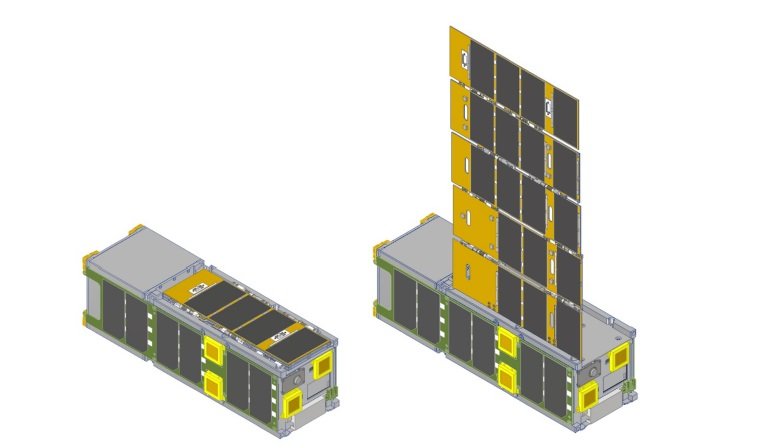
Source: HOKUSHIN-1 project (Tohoku University, Hokkaido University, Muroran Institute of Technology)
The first is power. A deep-space probe is hungry, it needs energy to shout across enormous distances and to run electric thrusters, but a satellite this small has almost no surface for solar cells. Muroran's team built a thin panel that unfolds after release to expose far more cell area, held flat during launch and then triggered by a shape-memory-alloy actuator that lets a spring snap it open. It has to survive the shaking of launch and then deploy cleanly, once, with no second chances.
The second is propulsion. Most cubesats can't change their own path at all; a deep-space craft has to. HOKUSHIN-1 carries a compact, high-efficiency thruster meant to give a satellite this size real control over its orbit.
The third is the navigation piece, the one that goes straight at the cost problem above. Tohoku developed a way for a university's own ground station to determine the satellite's orbit by ranging, building both the satellite-side and ground-side equipment, running comms tests from the prototype stage, and validating the whole system in an anechoic chamber. The point is independence: a campus antenna doing the kind of tracking that normally requires an agency. Hokkaido's engineering faculty rounds out the team. Three universities, three of the hardest problems, split between them.
Japan's quiet track record
Japan has been doing university-led deep-space microsats longer than most. PROCYON, built by the University of Tokyo and JAXA in barely a year and launched in 2014, was the first deep-space microspacecraft; its main thruster malfunctioned, yet the mission is widely counted as a success that opened the door for everyone who followed. EQUULEUS, from the same university-agency pairing, flew on that troubled Artemis I launch in 2022 and pulled off exactly what most of its companions couldn't, delicate trajectory maneuvers near the Moon, and a bonus video of a passing comet.
That uneven record is the whole argument. NASA and ESA tend to send deep-space cubesats straight into deep space: high reward, high failure rate. HOKUSHIN-1 flips the sequence, wring out the base technology where a failure costs a year in low orbit, not an expensive shot at deep space, and only then graduate to the real expedition. A proving ground before the journey. Europe is chasing the same prize from another angle, funding standalone interplanetary cubesats like ESA's M-ARGO, designed to reach an asteroid on its own. Everyone wants to shrink the cost of crossing the solar system. The unsolved part is reliability, and that's the part HOKUSHIN-1 is poking at.
Beyond the Moon, from a campus
If proving the stack in low orbit works, the reward is access. A navigation-plus-power-plus-propulsion kit that a university can actually build and operate means a lab, not only a national agency, could plausibly send something past the Moon. That would change who gets to explore, not just how.
For now, Japan's road to deep space runs through students in a clean room and an antenna on a campus rooftop. Does a university in your country get to reach that far, and should deep-space exploration stay the business of big agencies, or open up to anyone who can build a box tough enough to survive out there?
References
- JAXA Kibo Utilization, small satellite deployment notice: https://humans-in-space.jaxa.jp/kibouser/pickout/74505.html
- Tohoku University press release (flight model completion): https://www.tohoku.ac.jp/japanese/2026/02/press20260226-03-HOKUSHIN.html
- Muroran Institute of Technology release: https://muroran-it.ac.jp/research/info/post-26787/
- JAXA J-SSOD small satellite deployment service: https://humans-in-space.jaxa.jp/kibouser/provide/j-ssod/
- SpaceNews, "Deep space smallsats face big challenges": https://spacenews.com/deep-space-smallsats-face-big-challenges/
- NASA JPL, "The MarCO mission comes to an end": https://www.jpl.nasa.gov/news/the-marco-mission-comes-to-an-end/








Global Discussion
3 comments