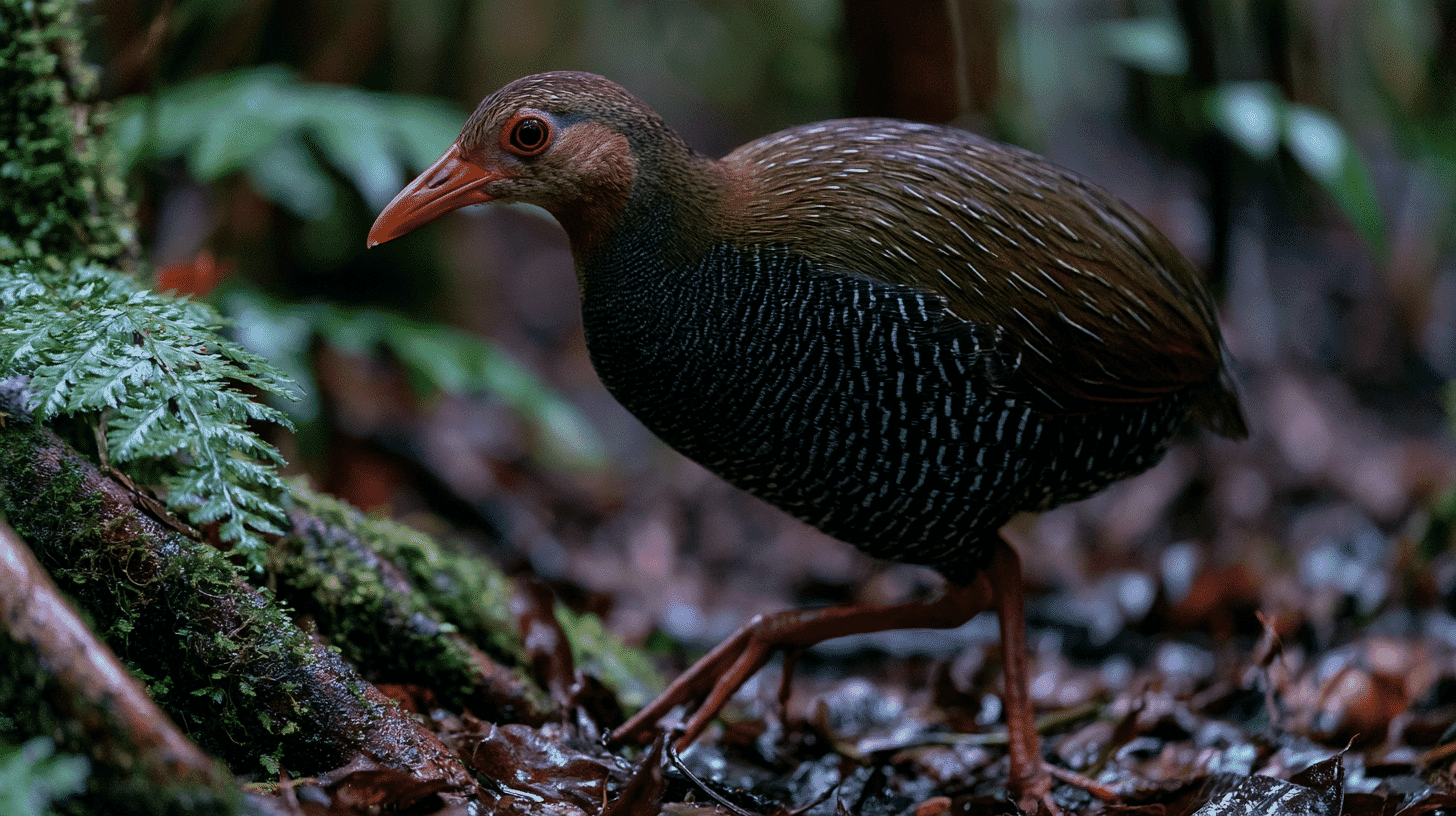
🧬 There is a bird in Okinawa that cannot fly, cannot leave its island, and, as researchers discovered a few years ago, cannot properly see a flu virus coming. Its immune system is missing a piece. Now scientists in Tsukuba are growing tiny lumps of its brain in a dish, so they can give the disease to the tissue instead of the bird.
The other Yanbaru, kept at minus 160°C
Drive north on Okinawa Island and the road eventually runs into Yanbaru, a subtropical forest of twisted evergreens added to the UNESCO World Heritage list in 2021. It is the only place on Earth where the Okinawa rail (Hypotaenidia okinawae) lives in the wild.
There is a second Yanbaru, more than 1,500 kilometres to the northeast, in a laboratory building in Tsukuba, Ibaraki Prefecture. The National Institute for Environmental Studies calls it the Environmental Specimen Time Capsule building. Inside are steel tanks chilled by liquid nitrogen to minus 160°C, and inside those are cultured cells and tissues from roughly 130 endangered Japanese species. NIES's own published count is 127 species and about 5,000 individuals.
More than 1,000 of those individuals are Okinawa rails, close to a fifth of the entire collection and a number that rivals the wild population. Most of them arrived as road kill. For two decades, veterinarians and volunteers in Okinawa have been boxing up birds killed on forest roads and shipping them to Tsukuba, where staff log each carcass, take skin and muscle, and start a culture.
A dead animal is not the same thing as dead cells. In a 2012 interview, NIES researcher Manabu Onuma said his team had found that bird cells can still be cultured roughly three weeks after death, and mammal cells about a week, even when the body has visibly begun to decay. The tanks hold cells from Kin and Midori, the last crested ibises born in Japan. The Japanese lineage of that species is gone. In a freezer in Ibaraki, it is still dividing.
NIES dates the freezing programme to 2002. Onuma has said its origin was simple: he had worked at an orangutan rehabilitation centre in Malaysia, could not save every animal that came through, and then learned that a zoo in San Diego had been freezing tissue for decades.
A hole in a flightless bird's immune system
The Okinawa rail was described as a new species only in 1981, and the Environment Ministry calls it Japan's only flightless bird. It nests and feeds on the ground, which was fine for the tens of thousands of years the island had no ground predators, and disastrous once people introduced mongooses and cats.

Source: Kugel / Wikimedia Commons (CC BY-SA 4.0)
About 1,800 birds in 1986. Around 700 by 2005. In 2006, IUCN specialists brought in for a workshop in Yanbaru ran the analysis and concluded the species would probably be extinct in roughly 15 years. Then mongoose trapping, cat control and road-kill countermeasures started to bite, and the line turned. As of July 2026 the wild population is back to about 1,500. Japan's fifth national Red List classifies it as Critically Endangered; the IUCN lists it as Endangered.
The new threat is highly pathogenic avian influenza. It reached Japanese poultry in January 2004, in Yamaguchi Prefecture, the first outbreak in 79 years. It has since become an annual event: in the 2022 season alone there were 84 outbreaks and roughly 17.71 million birds culled. Okinawa stayed clear for a long time, which made the threat feel abstract. Then in December 2022 a poultry farm in Kin, on Okinawa Island, tested positive. It was the prefecture's first confirmed case, wild birds included.
NIES examined the rail's cells to gauge the risk, and found something worse than expected.
Birds detect an invading virus using a family of internal sensors called RLRs. Two matter most: RIG-I and MDA5. Most birds carry both. Chickens are a known exception, since RIG-I has never been found in them and is thought to be absent, and researchers have long suspected that gap is connected to how badly chickens fare against bird flu.
When the team searched the rail's genome, they could find fragments resembling MDA5 but never a working full-length gene. The sequence was riddled with stop codons, the genetic equivalent of a sentence broken up by full stops every few words. MDA5, in the Okinawa rail, has become a pseudogene: present, unreadable, dead. Cell experiments confirmed it. Expose rail cells to a virus mimic and MDA5 expression does not rise at all. Everything downstream, from interferon to inflammatory cytokines such as IL-6 to the antiviral gene Mx, switches on later than it does in chickens. The findings were published in PLOS ONE in August 2023.
A follow-up, published in Scientific Reports in May 2025, widened the lens. Working with Hokkaido University, NIES infected cultured cells from 11 bird species with an H5N1 strain and compared what the genes did. Species that tend to survive bird flu, including feral pigeons and hooded, white-naped and red-crowned cranes, sharply ramped up two antiviral genes, IFIT5 and OAS. Species that die of it, including chickens, goshawks, peregrines and golden eagles, barely did. The Okinawa rail and the oriental stork sat in the "unknown" group, because nobody had ever had data on them. Both showed markedly low IFIT5 and OAS expression.
So the rail cannot see the virus coming, and it has no wings to leave with. Its only wild refuge is this one forest.
How do you study a disease you can't give the patient?
Conservation vets run into the same wall over and over. If you want to know what a pathogen does to a critically endangered animal, the honest experiment is to infect one and watch. That experiment is unthinkable when 1,500 individuals exist.
The workaround NIES has been building since 2016 is iPS cells, or induced pluripotent stem cells, the technology Shinya Yamanaka reported in 2006 and won a Nobel Prize for in 2012. Take an ordinary body cell, switch a handful of genes back on, and it reverts to a blank state from which it can become almost any tissue.
The mouse and human protocols do not transfer directly to birds. The team had already cracked chicken iPS cells and extended that method, introducing seven reprogramming genes at once, eight for the golden eagle, including a version of Oct3/4 engineered for stronger transcription. The starting material came from the freezer and from routine care: somatic cells from dead Okinawa rails and rock ptarmigans, and newly grown feather quills from Blakiston's fish owls and Japanese golden eagles. NIES and its partners, including Iwate and Gifu universities and the Institute for Raptor Biomedicine Japan, published the result in Communications Biology in October 2022 and reported it as the first iPS cells anywhere from endangered bird species.
From iPS cells you can grow organoids, small three-dimensional clumps of tissue, informally "mini-organs", that behave like a simplified version of the real thing. An organoid carries the genotype of the individual it came from. A rail organoid inherits the rail's broken MDA5.
Birds that develop severe avian influenza very often die of encephalitis, so the team went for the brain. As of September 2026 they are growing brain organoids from Okinawa rail iPS cells, with the plan of infecting them and watching, at cellular resolution, how the inflammation starts and where it might be interrupted. No living rail is involved at any point.
The golden eagle and the lead in the venison
The same trick is being aimed at a different problem. The Japanese golden eagle is one of the country's largest raptors: an estimated 500 birds in 2022, with a national breeding success rate of 17.4%, which is not a population with much slack in it.
Here the threat comes through the food chain. Eagles scavenge deer and boar, and hunters using lead ammunition leave fragments in the carcasses and gut piles they abandon in the mountains. The eagle swallows the metal along with the meat and dies slowly of lead poisoning.
Japan has been circling this for years. Hokkaido banned lead bullets for large-game hunting in 2004 and, from 2014, banned even carrying them on deer hunts. In September 2021 the Environment Ministry announced a national plan: phased restrictions from fiscal 2025, and zero lead poisoning in wild birds by fiscal 2030. Progress has been careful to the point of slow. At the expert panel held in March 2026, the rollout was still at the model-region stage, beginning with Lake Kasumigaura in Ibaraki, with nationwide rules to follow once the effects are measured. The argument will look familiar to anyone who has followed the lead-shot fights in the US or the EU.
NIES is building golden eagle brain organoids too, with the stated plan of using them to test how lead and other toxic substances damage the tissue. That turns a post-mortem tally into a dose-response experiment on eagle cells.
Where this sits among the world's frozen zoos
Japan did not invent cell freezing, and says as much itself: its own 2022 announcement notes that the Frozen Zoo and Frozen Ark projects were already using pluripotent stem cells for endangered mammals.
The San Diego Zoo Wildlife Alliance's Frozen Zoo was founded in 1975 by the pathologist Kurt Benirschke, at a point when nobody could say what the samples would eventually be for. It now holds more than 11,500 samples representing around 1,300 species at minus 196°C, and it has already produced clones: Kurt, a Przewalski's horse born in 2020 from cells frozen in 1980, and Elizabeth Ann, a black-footed ferret cloned the same year. The organisation has said it intends to biobank every endangered species on Earth by 2075. Europe caught up more recently: Nature's SAFE, launched in the UK in 2021 as the EAZA Biobank's British cryopreservation partner, now holds tissue from more than 400 species alongside the Frozen Ark and CryoArks networks.
Stem cells entered this world through the same door. In 2011 a team used Frozen Zoo fibroblasts to make iPS cells from a drill and a northern white rhino, reported at the time as the first from endangered species. In 2022, a Berlin-led group produced iPS cells and cerebral organoids from the Sumatran rhino. Also in 2022, Katsuhiko Hayashi's group at Osaka University, working inside the BioRescue consortium, coaxed northern white rhino iPS cells into primordial germ cell-like cells, the precursors of eggs and sperm. BioRescue called it a first for large mammals. The cells came from Nabire, a female who died in Czechia in 2015 and whose skin outlived her.
That branch of the field is aimed squarely at reproduction, and it is hard going. As of April 2026 BioRescue had 39 pure northern white rhino embryos, had attempted six transfers into southern white rhino surrogates, and had not achieved a sustained pregnancy. Two females of the subspecies remain alive.
The NIES work sits at a different angle. It is birds, which are technically harder and far less glamorous than rhinos. And the goal is not to bring anything back. It is to answer a question about an animal that is still here: what will kill it next, and can we be ready. It is a less cinematic aim, and it runs entirely on cells the institute already holds, so no living bird is captured or harmed.
Getting ready before the day arrives
Whether any of this works gets decided on the ground in Okinawa.
The veterinarian Takashi Nagamine, who runs the Okinawa NPO that handles rail rescue and captive breeding, told a NIES interview published in July 2026 that the field side had not felt much urgency about bird flu before, simply because Okinawa had never had an outbreak. NIES's cell work told them the rail was probably highly susceptible, and then, in 2022, the virus arrived at a farm on the island. Because the risk had been quantified in advance, they could prepare rather than react. An isolation facility followed within a year of the 2023 findings. In July 2026, the Environment Ministry's Okinawa-Amami office, the Okinawa Churashima Foundation and NIES signed a three-way agreement covering the transport, testing and reporting of suspect wild birds.
No Okinawa rail has been confirmed infected. There is also no treatment if one is. Nagamine's argument is that this is precisely why speed of detection matters, and why the captive population of 70 to 80 birds, with 235 hatched at the facility between 2011 and May 2026 including rescued eggs, is kept deliberately dispersed.
The researcher at the centre of the iPS work, Masafumi Katayama, was an agriculture student in 2006 when Yamanaka's announcement landed, and it hit him hard enough that he changed course. He went into industry first, then returned to research the year after the 2012 Nobel Prize. Speaking to the Yomiuri Shimbun for its 4 September 2026 report, he made the case plainly: without iPS cells, studying how rare animals respond to infections and toxins would be close to impossible, and he wants what comes out of it to feed back into protecting other birds as well.
Japan runs this through a public research institute; San Diego runs it through a zoo, Britain through a charity. What does your country do with its rarest species, is anyone keeping their cells, and who pays for the freezer?
References
- https://news.yahoo.co.jp/articles/624ce505a9f9f90f3277d8d3b299bd417eca75d0
- https://www.nies.go.jp/whatsnew/20221025/20221025.html
- https://www.nies.go.jp/pr/news-and-updates/2023/20231003/20231003.html
- https://www.nies.go.jp/pr/news-and-updates/2025/20250806/20250806.html
- https://www.nies.go.jp/kokkanken_view/deep/column-20260731.html
- https://www.nies.go.jp/kokkanken_view/deep/column-20260731-2.html
- https://doi.org/10.1038/s42003-022-03964-y
- https://doi.org/10.1371/journal.pone.0290436
- https://doi.org/10.1038/s41598-025-01316-4
- https://www.env.go.jp/nature/kisho/hogozoushoku/yambarukuina.html
- https://www.env.go.jp/nature/choju/effort/effort14/effort14.html
- https://sandiegozoowildlifealliance.org/frozen-zoo
- https://www.natures-safe.com/the-science/
- https://www.biorescue.org/en/news/biorescue-produces-primordial-germ-cells-northern-white-rhino-stem-cells-worlds-first-large
- https://www.nippon.com/ja/features/c00507/




Global Discussion
4 comments