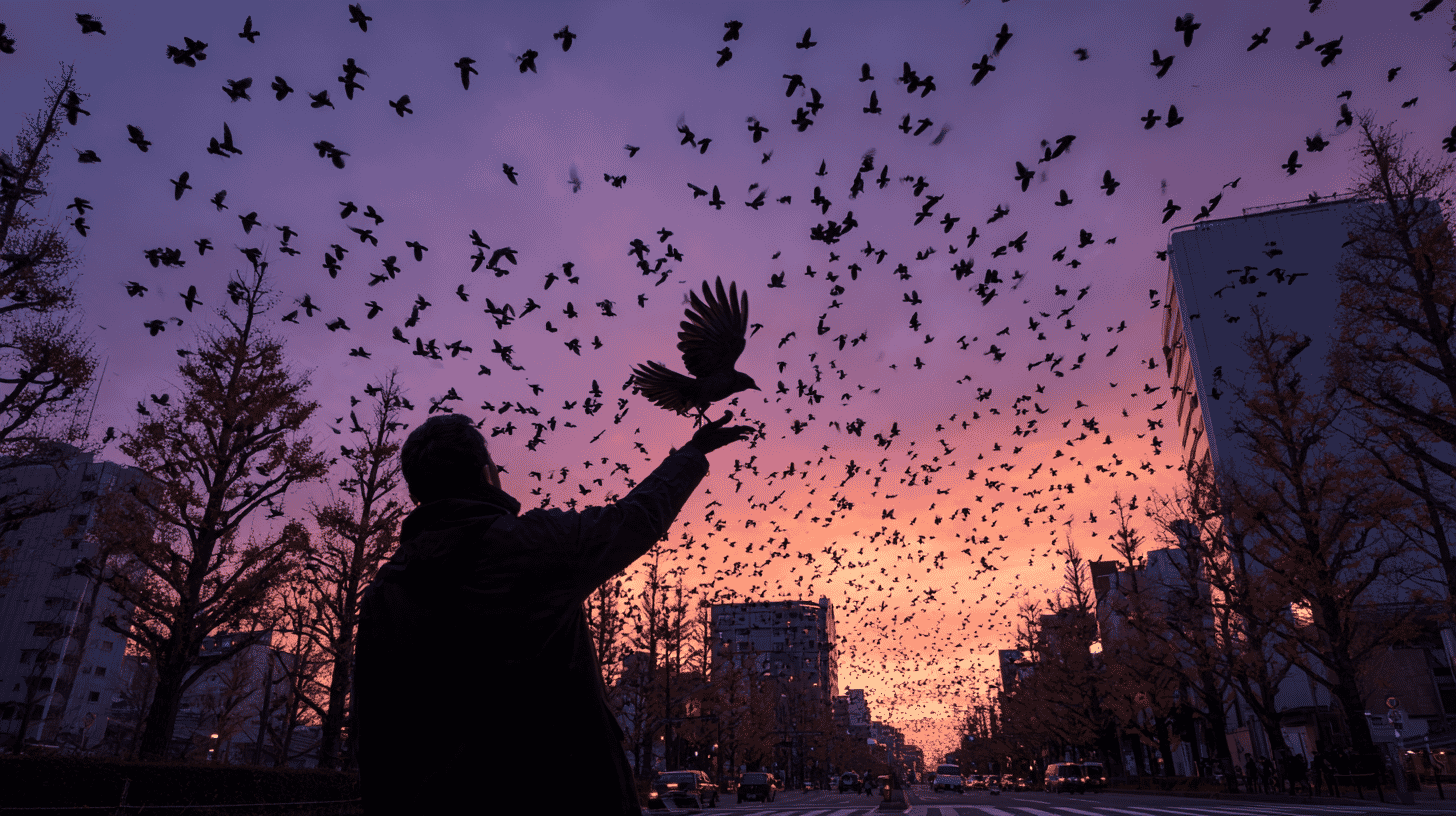
🦅 The Asian Games in Nagoya had a staff member who never appeared on a start list, worked the evening shift and was afraid of TV cameras. It was a hawk, and its job was to evict about 1,000 crows from the race walk course. For Japan's falconers, that is not a novelty act. It is everyday work.
One hawk, a thousand crows
The race walks at the 20th Asian Games (Aichi-Nagoya) were held on a 1-kilometer loop through Sannomaru, Nagoya's government district, past the Aichi Prefectural Government office and Nagoya City Hall. The street is lined with zelkova trees, and every evening those trees fill with roosting crows.
Local broadcaster Nagoya TV (Mētele) counted about 1,000 crows settling onto rooftops at dusk. The head of the city's Naka Public Works Office described the droppings on the road as terrible. Tokai TV reported that crews had power-washed the course, only to find it covered again by the next morning.
The usual fix would be firecrackers or ultrasonic devices. But a hospital sits along the route, and the office told Tokai TV that nighttime firecrackers were not realistic there. So it called a falconer.
As the crows come in to roost, falconer Wakayama sends out a lure made to look like a crow, and his hawk strikes it in full view of the flock. The goal is to teach the flock that this street is dangerous. One evening's standoff lasted about two hours, according to Mētele, and the hawks had flown eight sessions by September 22, Tokai TV said.
"If you do it many times, they recognize it as a dangerous place and the numbers drop," Wakayama told Mētele. "But overdo it and they figure out it's a lure." The hawk, he added, is scared of cameras.
The races went ahead on September 23 and September 27, and on the 27th Hayato Katsuki won gold in the men's marathon race walk.
Wait, this is the day job?
Falconry in Japan tends to bring to mind demonstrations at castle grounds, but Waraku Web, a culture magazine published by Shogakukan, describes falconers as in demand from municipalities and neighborhoods that want nuisance birds gone.
Kazo, a city in Saitama Prefecture north of Tokyo, is one of them. In August 2025 it hired a falconer for the first time to deal with starlings, up to 20,000 or more of which were roosting in the trees around the train station, the Saitama Shimbun reported. The falconer was Yuna Miwa, 24, seven years in the trade, working with Tsuyu, a five-year-old female Harris's hawk. The schedule ran in bursts: three nights in a row twice in August, four nights twice in September, three nights twice in October. A resident told the paper that patients in a nearby hospital, kept awake by the noise, were sleeping better.
In August 2026, a falconry business called Takanoan posted a video of a hawk being released at a train station at night, captioned as its third year of starling control there. HuffPost Japan reported the clip drew more than 60,000 likes.
A pest-bird company covering central and western Japan lists starling removal from 30,000 yen (about $190, at 157.7 yen to the dollar as of October 2, 2026) per session for one hawk and one falconer, plus travel. Crows start at 50,000 yen (about $317). The company says starlings usually give up after about five rounds. Crows, it seems, are the premium client.
Scare, don't kill
According to Waraku Web, crows are protected under Japan's wildlife law and cannot be captured or killed without a permit. So the work is psychological: fly a predator over a roost often enough, and the birds decide to sleep somewhere else.
The Harris's hawk, a medium-sized raptor from the Americas, is a common choice for urban jobs. Waraku says it is easy to train and adapts quickly to new surroundings. It is not especially fast, though, and the magazine notes that crows sometimes don't take it seriously, so some operators bring in a northern goshawk instead.
There is no national license for falconers in Japan; Waraku says certification comes from private schools of falconry that run their own tests. The magazine also recounts an episode from the chronicles of Oda Nobunaga: when villagers found a hawk he had lost, he rewarded them and returned land that had been confiscated. Today's clients are city halls, train stations and building managers.
Wimbledon has a hawk too
Since 2008, the All England Club has used Rufus, a Harris's hawk, to keep pigeons away from Wimbledon. He has a security pass with the job title Bird Scarer, worked daily during the 2012 London Olympics, and was stolen from his owner's car in 2012 before turning up three days later on Wimbledon Common. His handlers told Al Jazeera they keep his appetite balanced so he scares pigeons rather than eats them, the same principle Japanese falconers rely on.
Crows have beaten him before: British press reported in 2013 that Rufus had been chased off by crows. In 2026, his handler worried that drones might one day take his job, though the club said it had no plans to replace him.
So where do the crows go?
Will the campaign end when the race walk does? As of October 4, 2026, there have been no reports on whether Nagoya will keep a falconer on the payroll after the Games. And yes, the birds may simply move next door: a hawk does not reduce the number of crows, it changes their address. Takanoan told HuffPost Japan that it approaches starling jobs with the aim of getting the birds to move to big parks or wooded areas.
Japan also builds robots for wildlife control, including a robot wolf that patrols an airport in Hokkaido. For an international sporting event in Nagoya, though, the fix was a person in a glove with a camera-shy bird. How does your city deal with its noisiest birds? Spikes and speakers, or does it have its own Rufus?
References
- https://www.home-tv.co.jp/news/content/?news_id=000535251
- https://www.nagoyatv.com/news/?id=037290
- https://www.youtube.com/watch?v=RtHyMJMutGk
- https://www.daily.co.jp/general/2026/09/28/0020868041.shtml
- https://www.saitama-np.co.jp/articles/155619/postDetail
- https://topics.smt.docomo.ne.jp/amp/article/huffingtonpost/life/huffingtonpost-6a729a24e4b095f52300c22d
- https://gaichoukujyo-takumi.com/charge/
- https://intojapanwaraku.com/rock/culture-rock/122799/
- https://en.wikipedia.org/wiki/Rufus_the_Hawk
- https://www.aljazeera.com/sports/2015/7/2/rufus-the-hawk-ruling-wimbledon-skies









Global Discussion
3 comments