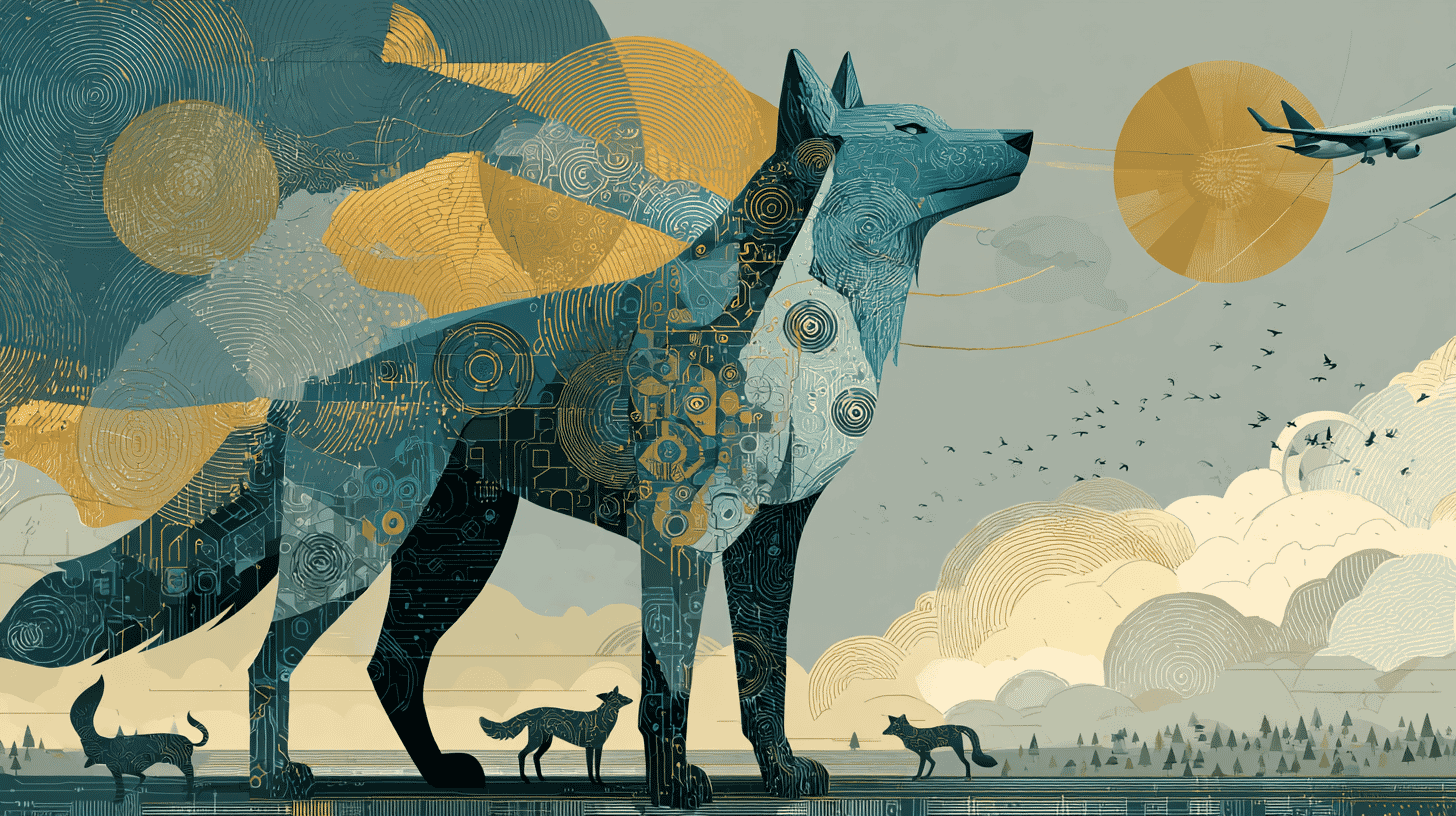
🐺 There's a wolf loose at a Japanese airport, and it's there on purpose. Kushiro Airport in eastern Hokkaido has become the first airport in Japan to fully deploy a self-driving robot wolf that patrols beside the runway around the clock, glaring with glowing red eyes and blasting howls at any fox or rabbit that dares to come close. Its name is WOLF-GUARD, and in trials its predecessor, the Monster Wolf, cut small-animal intrusions by roughly 60 percent.
A wolf now walks the perimeter road
Kushiro Airport sits on a hilly stretch of land about 20 kilometers from the city center, serving the wetland-and-wildlife tourism hub of eastern Hokkaido. That location is exactly the problem: according to local reports, Kushiro has long suffered some of the worst small-animal intrusions of any airport in Hokkaido, with foxes and rabbits regularly slipping into the airfield.
On June 12, 2026, the airport put its answer into full operation. WOLF-GUARD is a wolf-shaped deterrent robot mounted on an autonomous work vehicle, and it patrols a roughly 250-meter section of the perimeter road inside the restricted zone, about 150 meters from the runway. Guided by GPS, it trundles along at a walking pace of 1 to 2 km/h, completing a round trip in about 15 to 20 minutes. Transport outlet Traffic News reports one patrol an hour, around the clock. When its infrared sensors pick up an animal, it lets loose from a repertoire of about 50 sounds, from wolf howls and barking dogs to human voices, at roughly the volume of a car horn. At night it adds flashing lights to the show.
The machine measures 168 centimeters long and weighs about 120 kilograms, runs on a solar-charged battery, and, in a very practical touch, mows the grass as it goes. The base vehicle is a multi-purpose robot designed for mowing and snow clearing, so the wolf literally does yard work between scares.
When the system was shown to the press on July 13, Mikami, the head of airport operations at Hokkaido Airports' Kushiro office, said the robot's imposing presence had convinced him it would contribute to safe flight operations, and that the company hopes to roll the results out to other airports. According to Hokkaido broadcaster UHB, the current deployment is planned to run through November 2026.
The bear-scaring robot that went viral in 2020
If the wolf looks familiar, that's because it has been famous for years. The original Monster Wolf was developed by Ohta Seiki, a precision machinery maker in the small Hokkaido town of Naie, together with Hokkaido University and Tokyo University of Agriculture, and made its debut in November 2016 as a crop-protection device.
Then came October 2020. The Hokkaido city of Takikawa installed two Monster Wolves after bears started wandering into residential neighborhoods, and city officials told Reuters there had been no bear encounters since. The story ricocheted around the world, and the shaggy robot with the swiveling head and demonic red eyes became one of Japan's most recognizable pieces of wildlife tech. According to Hokkaido broadcaster HTB, about 380 of the conventional fixed-type units are now installed across Japan, guarding farms, roadsides and towns.
WOLF-GUARD is the next step: a Monster Wolf that moves. Ohta Seiki president Yuji Ota told reporters that seeing the moving version prove its worth was deeply gratifying, and that being adopted at an airport, one of the most safety-critical environments there is, meant a great deal to the company. He argues that automation increases both the deterrent power and the area a single unit can cover, and sees the mobile version as a promising tool against bears in farming districts as well.
Foxes, rabbits, and the bird strike problem
Why does an airport need a wolf at all? Because animals on and around runways are a genuinely serious aviation hazard. A fox crossing at the wrong moment can force a go-around; a bird sucked into an engine can bring a plane down, as the world learned in 2009 when a US Airways jet lost both engines to a flock of geese and ditched in the Hudson River.
Japan records well over 1,000 bird strikes a year. Data from the transport ministry's bird strike committee puts the 2023 figure at 1,463 reported collisions. In the United States, the Federal Aviation Administration logged more than 14,000 wildlife strikes in 2021 alone, and the US Department of Agriculture estimates wildlife collisions cost American civil and military aviation about 1 billion dollars a year.
Kushiro's problem is mostly furry rather than feathered, and the traditional fix was human: whenever a fox or rabbit was spotted, staff had to drive out and chase it off. The airport began trialing the Monster Wolf in fiscal 2024, and the results were striking. Small-animal intrusions fell by about 60 percent, collision risk dropped, and staff callouts fell with it. That track record is what justified upgrading to the roving version, and for a regional airport with limited staff, a robot that patrols, deters and mows on its own is as much a labor-saving device as a safety one.
Dogs, falcons and radar: how other airports fight back
Airports everywhere fight the same war, just with different soldiers. Falconry is a classic: Spain's airport authority Aena pioneered the use of trained birds of prey decades ago and still flies them at major hubs like Madrid-Barajas. In the United States, the FAA points to trained border collies, such as those adopted by Hawaii's transportation department, that chase geese off airfields, while Amsterdam's Schiphol uses dedicated bird radar to track flocks within 10 kilometers of the airport. And almost everywhere, the everyday toolkit is decidedly low-tech: pyrotechnics, propane cannons, distress-call speakers and keeping the grass at a height birds dislike. Japan has run human "bird patrols" at state-managed airports since 1982.
The catch with nearly all of these methods is habituation. Animals are quick learners, and a cannon that fires at the same time every day soon becomes background noise. That's the gap the wolf is built to exploit: it moves, it varies its threats across dozens of sounds, and it looks like a predator. Whether foxes eventually call its bluff is something Kushiro's data will reveal over the coming seasons.
There is something very Japanese about the answer, though. Where other countries train dogs or fly falcons, Japan built a robot wolf that howls, flashes and cuts the grass. How does your local airport keep animals off the runway? Falcons, dogs, cannons, or something stranger?







Global Discussion
4 comments