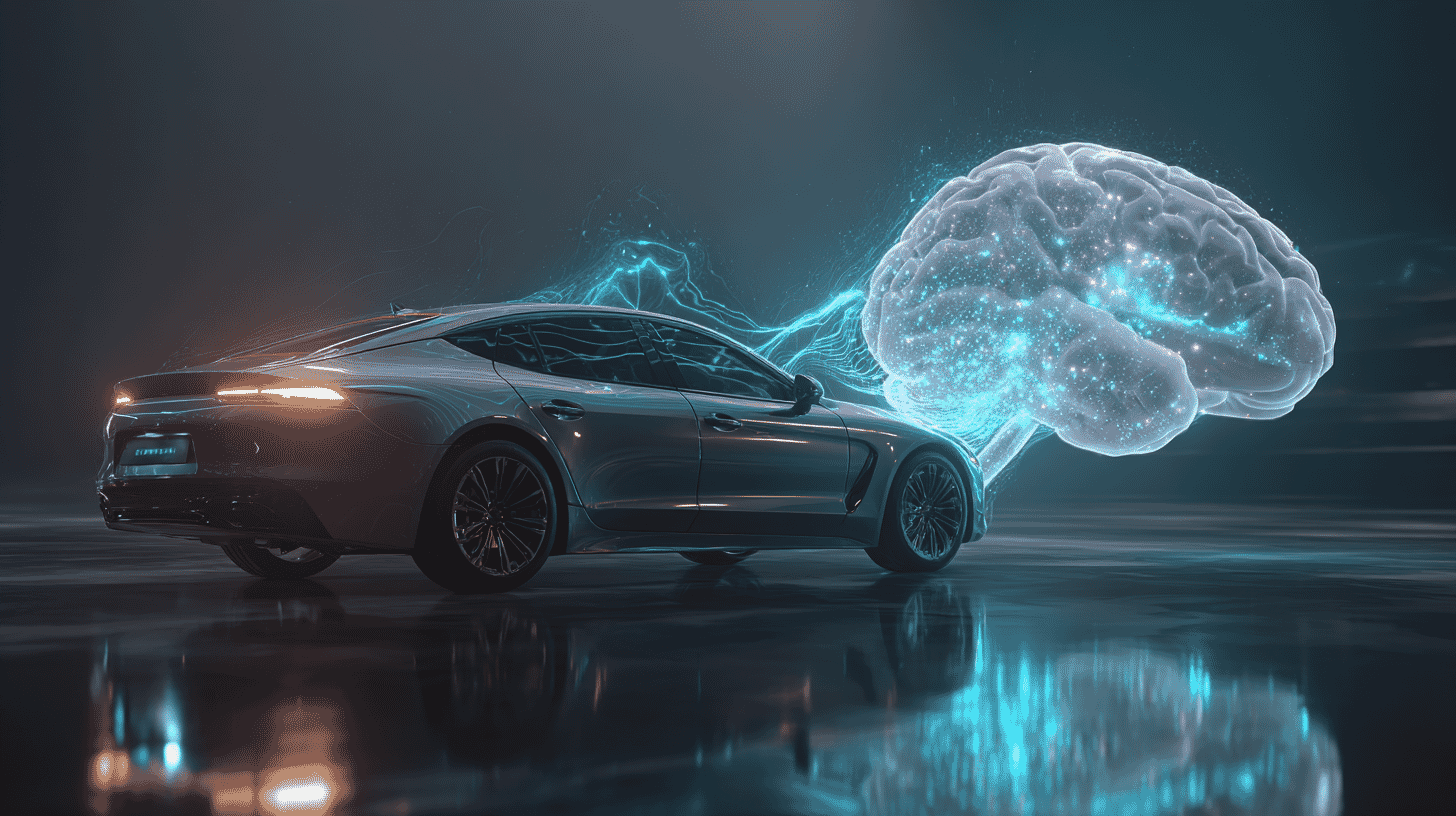
What if a car's AI chip worked like a human brain? Honda has invested in US startup Mythic and will jointly develop a "neuromorphic SoC" that mimics how the brain works. The technology is said to have the potential to far exceed GPUs in computing performance per watt, and it could change the future of autonomous driving.
Why Honda Is Betting on Brain-Like Chips
On February 4, 2026, Honda announced an investment in Mythic, an AI semiconductor startup based in Texas. It also revealed that Honda R&D, its research subsidiary, will jointly develop next-generation automotive SoCs (systems on chip) with Mythic.
Behind the decision is Honda's view that the era of the "software-defined vehicle" (SDV) is fast approaching. An SDV is a next-generation car whose functions are defined by software and keep evolving through updates after purchase. Because autonomous driving, ADAS (advanced driver assistance systems), powertrain control and comfort features are all consolidated into a single high-performance ECU (electronic control unit), the SoC it carries needs vastly more computing power than before.
But there is a problem: raising AI performance raises power consumption almost proportionally. In a car with limited battery capacity, that is a critical issue. To solve the puzzle of combining high performance with low power, Honda turned to an approach fundamentally different from conventional digital computing: neuromorphic technology.
What Is a Neuromorphic SoC? Recreating the Brain in Silicon
"Neuromorphic" literally means "shaped like the nervous system," and refers to semiconductor technology inspired by how the human brain works.
Ordinary computers use the "von Neumann" architecture, in which the CPU and memory are physically separate. Data must be moved from memory to the CPU for every operation, and this back-and-forth becomes a bottleneck that slows processing and consumes enormous power. It is widely known as the "von Neumann bottleneck."
In the human brain, by contrast, neurons and synapses store and compute information at the same time. On only about 20 watts, the brain instantly handles complex processing that even the world's most powerful supercomputers cannot match.
A neuromorphic SoC tries to reproduce this principle in silicon. By integrating computation and memory, it can greatly reduce the delay and power consumption that come with moving data between CPU and memory.
Mythic's Analog CiM: Why It Could Be Revolutionary
Mythic was founded in 2012 as a University of Michigan spinout and is based in Austin, Texas, and Redwood City, California. It has been backed by venture capital firms such as Lux Capital and DCVC, and in December 2025 it raised about $125 million in a round that included Honda and Lockheed Martin.
The core of Mythic's technology is "analog CiM" (compute-in-memory). While ordinary AI chips compute with digital signals, Mythic computes directly with analog signals inside flash memory. Using memory cells as variable resistors, it applies inputs as voltages and reads outputs as currents, carrying out multiply-accumulate operations in one step inside the memory.
The advantage is simple: because data does not have to move from memory to a processor, the power used for data transfer drops dramatically. Mythic's M1076 Analog Matrix Processor (AMP) is said to deliver up to 25 TOPS (25 trillion operations per second) on only about 3 to 4 watts.
For comparison, high-performance GPUs consume tens to hundreds of watts. Some observers point out that Mythic's chips have an overwhelming advantage over NVIDIA GPUs in performance per watt.
Honda's Semiconductor Strategy: Two Partnerships, Renesas and Mythic
To understand Honda's chip strategy, you also need to know about its collaboration with Renesas Electronics, announced at CES 2025 in January 2025.
Under the Renesas partnership, the two companies are developing a world-class SoC on TSMC's cutting-edge 3nm process, with 2,000 TOPS of AI performance and power efficiency of 20 TOPS/W. The chip was to be used in late-2020s models of Honda's new EV line, the Honda 0 Series. It combines Renesas's fifth-generation R-Car X5 SoC with Honda's own AI accelerator using chiplet technology, a project pursuing the cutting edge of digital computing.
That plan, however, has been shaken. On March 12, 2026, citing worsening results, Honda announced a full review of its EV strategy, cancelling development of three North American EVs, the Honda 0 Series SUV and sedan and the Acura RSX, and booking losses of up to ¥2.5 trillion (about $15.7 billion). With the 0 Series it was meant for scrapped, the future of the SoC developed with Renesas has become uncertain.
The Mythic partnership, by contrast, looks "beyond the next generation." It is positioned as a move to lay the groundwork for a fundamental innovation through analog computing, in anticipation of digital computing approaching its limits. Continuing the collaboration with Mythic even as the Renesas plan wavers shows that Honda is still investing in the long-term theme of low-power automotive AI.
Autonomous Driving: Why Power Efficiency Is Life or Death
Let's look more concretely at why autonomous driving consumes so much power.
Level 3 and higher autonomous vehicles carry multiple sensors, including cameras, LiDAR (light-based distance measurement) and millimeter-wave radar. They generate huge amounts of data every second, and AI must recognize objects, predict paths and make driving decisions in real time. Today's ADAS chips offer hundreds of TOPS, but power consumption above 100 watts is not unusual.
For an EV, that consumption directly cuts range. If an AI system kept drawing 100 watts, it would take a substantial amount of energy from the battery and shorten the driving range. Heat is another issue: high temperatures reduce semiconductor reliability, and extra cooling systems add cost and weight.
If neuromorphic SoCs become practical, they could deliver equivalent computing power at far lower power, making it possible to implement advanced autonomous driving with minimal impact on range. That could be a game changer for autonomous driving in the EV era.
The Global Race in Neuromorphic Computing
Mythic and Honda are not alone. A global development race is accelerating.
Intel has developed its Loihi series, pursuing real-time processing with spiking neural networks (SNNs). IBM's TrueNorth drew attention as a chip emulating one million neurons. BrainChip's Akida is strong in low-power edge AI. In Europe, the Fraunhofer institutes are researching next-generation neuromorphic chips using ferroelectric transistors (FeFETs).
Against this backdrop, it is significant that Honda, as an automaker, is directly involved in developing a neuromorphic SoC. When the end user, the carmaker, takes part from the upstream stage rather than leaving development to chipmakers or IT companies, the specific requirements of the automotive environment (vibration, temperature, safety standards) can be built into the design from the start.
Conclusion: The Future of "AI on Wheels"
The Honda-Mythic partnership is not just about sourcing chips. It is a fundamental technological challenge: reproducing the workings of the human brain in silicon and putting it to practical use in the harsh environment of a car.
That Honda moved ahead with Mythic even while being forced into a major review of its EV strategy is one sign of how Japanese automakers are trying to survive in the AI era.
As cars change from mere means of transport into "AI platforms on wheels," brain-like chips could fundamentally remake the car's "brain" itself.
In your country, are automakers getting directly involved in chip development?









Global Discussion
16 comments