Mitsubishi Electric is in talks to transfer 50% of its $4.3B auto parts subsidiary to Taiwan's Foxconn, with a deal expected by May. As BYD captures 19% of the global EV market, how is Japan's auto supply chain being reshaped?
Honda will end four-wheeler sales in South Korea by the end of 2026, closing a 23-year chapter with cumulative sales of just 108,600 cars. The retreat coincides with China factory shutdowns from June 2026, the cancellation of the Sony-Honda AFEELA EV, and scrapped North American EV plans, part of a sweeping strategy to concentrate resources on the US, Japan, India, and ASEAN. A deep dive for global readers.
On April 14, 2026, the headline from Nissan's long-term vision wasn't rare earths or robotaxis, it was the return of the Skyline, the continuation of the GT-R, the revival of the Xterra, and the debut of the all-new X-Trail/Rogue e-POWER and Juke EV. Here's Espinosa's 56-to-45 model cull, the new 'Heartbeat' classification, and how Japan, the US, and China each get distinct lineups as Nissan walks a standalone path after the Honda merger collapse.
Waymo and Toyota have agreed to explore bringing L4 robotaxi technology to personally owned vehicles. We unpack how Waymo's sensor-heavy approach differs from Tesla's camera-only FSD and China's Baidu Apollo, and what this means for Toyota's strategic direction.
In the world's 3rd largest auto market, Japanese brands hold 50% share. We break down Maruti Suzuki's 40% dominance, the rise of Tata and Mahindra, and how Japanese makers are navigating India's EV transition.
A rigorous evaluation of Nissan's triple strategy against a global EV slowdown. With Trump's tax credit repeal, China's sales slump, Honda canceling its 0 series, and BloombergNEF cutting EV forecasts by 14 million units, is this Nissan's genuine breakthrough or just the fifth failed long-term plan in six years? Surprisingly, the EV slowdown might actually be a tailwind for Nissan. Here is why.
Three weeks after the March 27 three-way merger announcement, Japan's power semiconductor reshuffle has accelerated. Denso declared its semiconductor-maker ambitions in CORE 2030, Rohm's CEO asserted leadership, Toshiba eyes re-listing, and Mitsubishi Electric opened a new Fukuoka plant. A timeline update.
Honda faces its first-ever annual loss since going public in 1957, with up to $15.7 billion in EV-related write-downs. Three flagship EVs cancelled, Sony-Honda AFEELA scrapped, and China sales declining for 25 straight months. We break down the crisis, analyze Honda's hybrid pivot and May 2026 strategy reveal, and share Japanese and global reactions.
Ritsumeikan University startup Patentix raised $1M in Series A1 funding to accelerate germanium dioxide (GeO2) power semiconductor development, a next-gen material that could outperform SiC and GaN.
An in-depth look at Woven by Toyota, the software subsidiary steering Toyota's transformation. From the Arene platform's debut in the new RAV4 to the $1B Woven City experiment, we analyze how Toyota is fighting Tesla and BYD in the SDV era.
Rohm has achieved its NEDO-funded technical target for 8-inch SiC MOSFETs two years ahead of schedule, demonstrating over 50% power loss reduction versus conventional silicon IGBTs. We explore what this means for EVs, renewable energy, and Japan's power semiconductor consolidation race involving Toshiba, Mitsubishi Electric, and Denso.
DENSO and the University of Tokyo signed a 10-year partnership starting April 2026 centered on Dynamic Wireless Power Transfer (DWPT). Learn how charging EVs while driving could shrink batteries, cut costs, and reshape energy infrastructure — plus how Japan's approach compares to Sweden, Israel, and the US.
Japan's Rohm, Toshiba, and Mitsubishi Electric have announced merger talks for their power semiconductor businesses. If realized, the combined entity would hold ~10% global market share, ranking second only to Germany's Infineon. We analyze the Denso $8.3B counter-bid, EV and renewable energy demand, and what this means for global chip competition.
Sony Honda Mobility has cancelled its AFEELA EV just months before its planned launch. With Honda posting a record $4.6 billion loss and abandoning its 2040 zero-engine goal, we analyze what went wrong—from Trump's EV policy rollback to BYD's rise—and what it means for Japan's auto industry.
Power Diamond Systems demonstrated the world's first actual power conversion using a diamond MOSFET in a DC-DC converter circuit. Following their recent 200V/1A switching milestone, this breakthrough advances diamond semiconductors from device-level testing to real circuit operation.
Toyota announces mass production of water electrolysis systems by 2029, developed with Chiyoda Corporation. With 5MW domestic and 20MW international units, Toyota bets on hydrogen alongside EVs and hybrids. How Japan's multi-pathway strategy compares to the global EV-first approach.
Japan's Power Diamond Systems, a Waseda University spinoff, achieved the world's first 200V/1A switching operation with a diamond MOSFET. With 550V breakdown voltage and 0.8A drain current in a single device, diamond semiconductors could surpass SiC and GaN as the ultimate power semiconductor for EVs and renewable energy.
Honda announces its first-ever net loss since going public, with losses of up to $43 billion from scrapping three North American Honda 0 Series EVs, acquiring LG battery joint venture assets, and writing down Chinese operations. With cumulative losses potentially reaching $157 billion, this signals a seismic shift in Japan's EV strategy. Analysis covers Toyota's hybrid vindication, the failed Nissan merger, executive pay cuts, and what it means for the global auto industry.
Denso proposed a tender offer for Rohm worth up to 1.3 trillion yen (about $8.2 billion), then withdrew it in April 2026 after Rohm's special committee declined to endorse the deal. Consolidation has shifted to a Rohm-Toshiba-Mitsubishi Electric alliance. Here is the competitive picture against Infineon, onsemi, and China's fast-rising players.
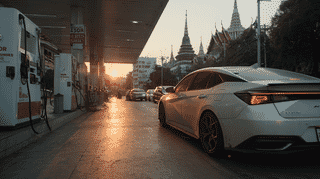
Thailand's BEV sales turned negative in 2024 while hybrid sales surged nearly 50%. Falling resale values, thin charging infrastructure and retreating Chinese brands exposed the limits of the EV boom. As markets from Bangkok to Berlin recalibrate, Toyota and Honda's multi-pathway strategy looks better than it did. A data-led look at the EV slowdown across Thailand, China and Europe.