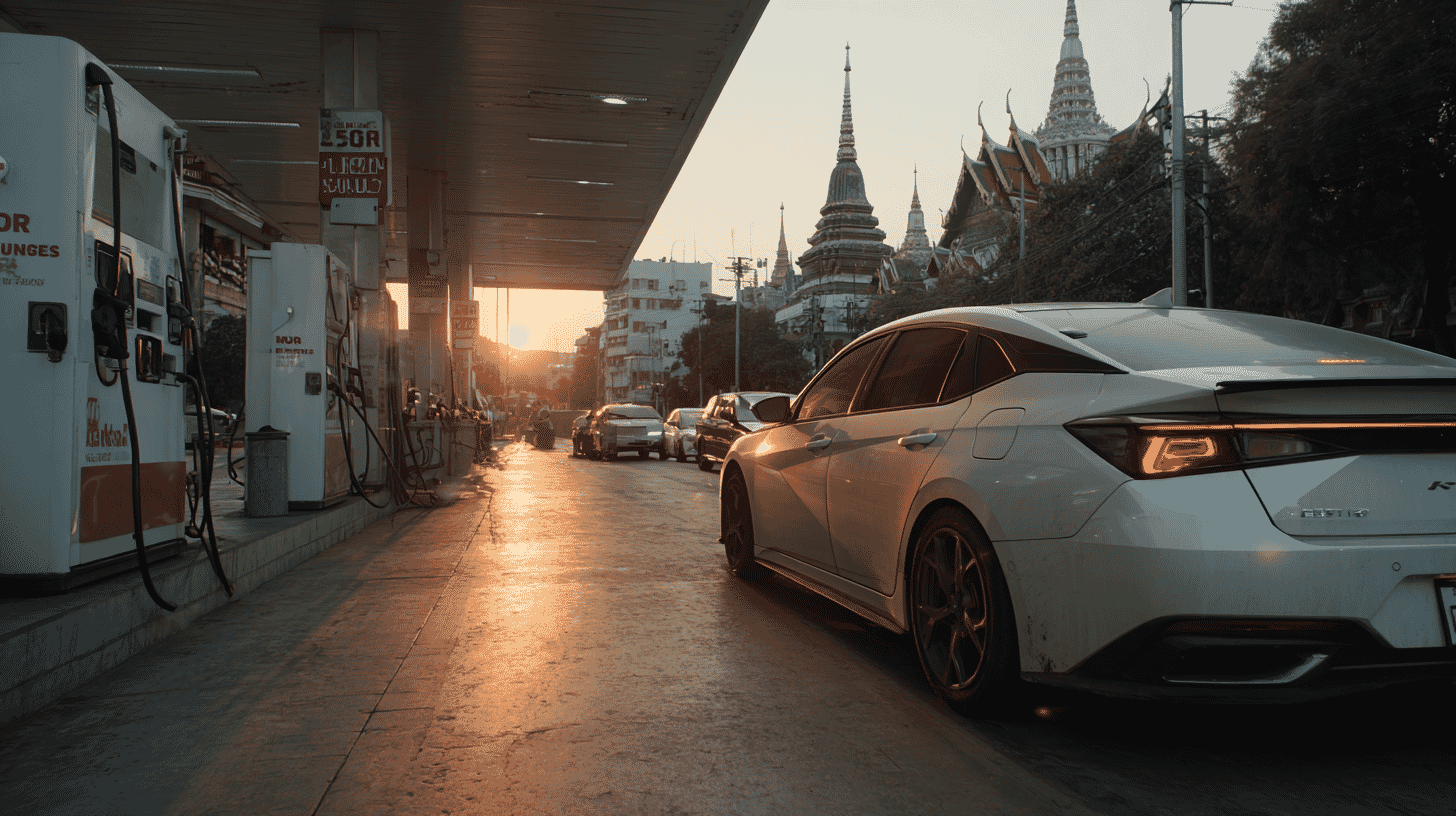
In 2022-2023, Bangkok's streets were flooded with Chinese EVs. BEV registrations exploded roughly eightfold, and headlines declared "Japan's automotive stronghold is crumbling." Then in 2024, BEV sales turned negative, while hybrid vehicle sales from Toyota and Honda surged nearly 50%. This isn't just a Thai story. From China to Europe, the same "reality check" is unfolding worldwide. What went wrong with the EV fever, and why is the world giving Japanese automakers a second look?
Why Thailand's EV Fever Stopped
Between 2022 and 2023, Thailand's car market ran a fever. The government's "EV3.0" policy paid up to 150,000 baht (about $4,300) per battery electric vehicle (BEV), and Chinese manufacturers piled in. BEV registrations jumped from roughly 1,900 units in 2021 to about 75,000 in 2023.
Bangkok's boulevards filled with BYD Dolphins, MG4s, and Neta Vs. Media outlets worldwide hailed Thailand as the proving ground for Southeast Asia's electric future.
But the party didn't last.
According to Thailand's Department of Land Transport, BEV passenger car registrations fell 8.1% year on year in 2024, to about 70,000 units. Hybrid (HEV) sales rose 49.5%, to roughly 127,000. In the market held up as the region's EV showcase, buyers were answering with their wallets, and the answer was hybrid.
The Resale Value Problem
For the average Thai buyer, resale value is the heaviest factor in the decision. A car is transport, but it is also an asset you can sell when times get tight.
BEVs disappointed on exactly that point. Krungsri Research found that 2021-model BEVs in Thailand had lost an average of about 18% of list price by 2024. The faster the technology moves, the faster a three-year-old car looks old.
Chinese price wars made it worse. At Thailand's 2024 Motor Expo, the BYD Seal was cut by roughly 19% and the Neta VII by about 21%. Every cut on the new car drags down the used one sitting in the driveway.
According to an Ipsos Thailand survey, 42% of consumers considering an EV cited resale value concerns as a barrier to purchase, alongside inadequate charging infrastructure (50%) and safety concerns (54%).
The Charging Infrastructure Gap: Bangkok vs. the Countryside
The second obstacle is charging. Central Bangkok has a workable network; the rural areas that make up most of the country do not. For people in provincial towns and farming communities who drive long distances routinely, a BEV is not a practical first car.
Thailand still targets making 30% of domestic vehicle production electric by 2030, but the mid-2024 slowdown forced a correction. In July 2024 the government introduced excise tax incentives for hybrids and cut taxes on plug-in hybrids (PHEVs) and mild hybrids (MHEVs). The message: keep more than one road open.
China's Market Tells the Same Story
What's happening in Thailand isn't an isolated phenomenon. The world's largest EV market, China, is experiencing a remarkably similar trend.
Data from the International Energy Agency (IEA) shows that BEVs' share of China's new energy vehicle (NEV) sales fell from 80% in 2020 to below 60% in 2024. The gap has been filled by PHEVs, whose share grew to approximately 30%, and extended-range EVs (EREVs), which now account for over 10%.
In the first nine months of 2025, China's PHEV market grew 21% year on year to about 3.86 million units, a sharp deceleration from 35.7% in the first half. BEV sales over the same period rose 37.4%. What is happening is recalibration, not collapse.
China's PHEV sales then turned negative in the second half of 2025 and fell for six straight months through December. The era in which anything electric sold is over, even here.
Chinese buyers, like Thai ones, are prioritizing practicality. BEVs dominate cities with dense charging networks; in the suburbs and the countryside, the ability to fall back on gasoline is what sells PHEVs and EREVs.
Europe: When Subsidies Disappear, So Do Sales
Europe's EV landscape has also undergone significant upheaval.
Germany abruptly terminated its EV purchase subsidies at the end of 2023, and BEV registrations fell 18.2% in 2024. The rebound was a new €3 billion ($3.3 billion) programme covering vehicles newly registered from January 1, 2026 through 2029, roughly 800,000 of them. The base grant is €3,000 for a BEV and €1,500 for a qualifying PHEV or EREV, rising to a maximum of €6,000 ($6,600) for households with children and taxable income at or below €45,000. It is means-tested rather than universal, and it is open to vehicles regardless of where they were built, so Chinese brands qualify.
France slashed its EV subsidy budget from €1.5 billion to €1 billion for 2025, reducing the maximum per-vehicle bonus from €7,000 to €4,000. The country is also tightening environmental scoring for subsidy eligibility, effectively penalizing vehicles with higher manufacturing carbon footprints.
Brussels is pulling the other way. On March 4, 2026 the European Commission published its Industrial Accelerator Act (IAA) proposal, which would attach a "made in the EU" condition to purchase subsidies and public procurement. For EVs, a 70% domestic-content threshold is under discussion, though the figure sits in square brackets in the draft and the law has not been adopted. If it passes, most Chinese-built EVs would fall outside Europe's subsidy perimeter.
The underlying lesson is blunt. Adoption models built on subsidies are fragile: when the money stops, so does the demand. BEVs have not yet reached cost competitiveness with conventional cars without help.
Toyota and Honda's "Multi-Pathway Strategy" Gets a Second Look
Against this backdrop of global recalibration, a strategy that was once dismissed as "too cautious" is gaining new respect: the multi-pathway approach championed by Toyota and Honda.
Rather than going all-in on BEVs, it means offering a full spectrum of powertrains, HEVs, PHEVs, BEVs, fuel cell vehicles (FCEVs), hydrogen combustion engines and e-fuels, matched to the infrastructure and needs of each regional market.
Toyota President Koji Sato reaffirmed the commitment at the company's May 2025 earnings briefing, saying that the path and pace of electrification differ considerably depending on the type of fuel or energy involved.
In Thailand, Toyota held the market lead with a 38.5% share in 2024. It added a hybrid version of the Yaris Ativ sedan and began local BEV production in 2025. Both, not either.
Honda has likewise thickened its hybrid lineup across Asia while accelerating EV development where demand warrants it, as in China.
EV Adoption Rates: A Global Snapshot
A comparison of BEV market shares across regions reveals just how uneven the electric transition remains.
Norway is the global outlier, with roughly 88% of new car sales BEV. China's NEV penetration has reached about 50%, but around 40% of that is PHEV and EREV, putting pure BEV share closer to 30%. Europe-wide BEV share has stalled at around 20%. Thailand hit a monthly peak of roughly 25% in June 2025, though annual figures swing widely. Japan sits at about 1.7%.
The world is nowhere near a BEV-only future. Energy mix, infrastructure maturity, income levels and used-car dynamics differ, so the optimal answer differs too.
Four Traps Thailand Walked Into
Subsidies can create demand, but when they stop, the demand goes with them. Continuous price cuts on new vehicles destroy used values and erode trust. Pushing sales without building charging infrastructure banks owner frustration. And leaning on financially fragile startup brands creates after-sales vacuums: Neta's Thai market share collapsed from 12% to 4%, and it closed 20 of its 60 showrooms.
Hybrids need no charging infrastructure, refuel anywhere, and hold their resale value reasonably well. For buyers who weigh reality over ideals, the reasons stack up.
So, What Does Japan Think? And What About Your Country?
In Japan, the multi-pathway strategy long drew the charges of being too cautious and of falling behind in the EV race. As booms cool elsewhere, the view that the measured approach was right has gained ground.
EVs remain a crucial pillar of future mobility. But the pace of adoption is bounded by local conditions: infrastructure, economics, consumer psychology. Thailand compressed that lesson into a few years.
How far along is the EV transition in your country? Are hybrids part of the picture? Is charging infrastructure adequate? We'd love to hear about the situation where you live.
Update: For full-year 2025, BEVs accounted for 61.5% of China's EV market, up 4.9 percentage points, while PHEVs slipped to 38.5%. PHEV sales fell year on year for six straight months through December. BYD's China sales dropped 9.9% as it shifted focus to exports, costing it 7.3 points of domestic share. Germany's new EV subsidy took effect on January 1, 2026. The EU's Industrial Accelerator Act remains a proposal published on March 4, 2026; neither its adoption date nor the final domestic-content threshold has been fixed. (As of August 2026)
References
- https://www.jetro.go.jp/biznews/2025/01/c1300ac967552b2d.html
- https://www.marklines.com/ja/report/rep2833_202504
- https://www.iea.org/reports/global-ev-outlook-2025/trends-in-electric-car-markets-2
- https://www.krungsri.com/en/research/research-intelligence/used-bevs-2024
- https://newsroom.toyota.eu/toyota-reinforces-its-multi-pathway-approach-and-its-commitment-to-customer-focused-innovation/
- https://alternative-fuels-observatory.ec.europa.eu/transport-mode/road/france/incentives-legislations
- https://restofworld.org/2025/chinese-ev-thailand-neta-backlash/









Global Discussion
15 comments