
In the world's 3rd largest auto market, 1 out of every 2 new cars sold is a Japanese brand. Maruti Suzuki commands 40% of India's passenger car market, a dominance no other Japanese automaker enjoys anywhere else on Earth. Toyota, Honda, and Nissan also share in this "Japanese paradise." But beneath the surface, cracks are forming, homegrown giants Tata and Mahindra are rising fast, SUVs are reshaping consumer taste, and the EV wave is about to crash onto shore. Suzuki is betting ¥1.3 trillion (~$8.3 billion) on expanding production to 4 million units annually by 2030. Is it enough?
India: The "Japanese Car Paradise"
India overtook Japan in 2022 to become the world's third-largest auto market. In fiscal year 2025 (April 2024–March 2025), the country sold roughly 4.3 million passenger vehicles, and analysts expect the milestone of 5 million annual units to be breached during 2026. And in this massive market, about half of all new cars sold carry a Japanese badge.
According to JATO Dynamics, Japanese brands held 51.6% of India's passenger vehicle registrations in January 2026, followed by Indian brands at 25% and Korean manufacturers at 19%. Combined sales of the top five Japanese players (Maruti Suzuki, Toyota Kirloskar, Honda, Nissan, and Isuzu) have hovered around 50% of the market for years, according to JETRO data.
This dominance exists nowhere else in the world. In the United States, Japanese brands account for roughly 38% of new car sales. In Europe, the share is below 20%. In China, the combined share of Toyota, Honda, and Nissan has collapsed from a 23.1% peak in 2020 to under 9% in 2025. Only India remains a "Japanese 50% kingdom", and that's precisely why the stakes are so high.
Maruti Suzuki: Four Decades of Dominance
The cornerstone of Japanese dominance in India is Maruti Suzuki India, a subsidiary of Japan's Suzuki Motor. In FY26 (ending March 2026), Maruti sold approximately 1.86 million vehicles for a market share of 39.71%. That's more than triple the second-place players, Tata Motors (13.4%), Mahindra (13.4%), Hyundai (12.3%), and Kia (6.5%) trail far behind.
Maruti Suzuki's origins trace back to 1981, when the Indian government partnered with Suzuki to produce affordable cars for a rising middle class. The 1983 launch of the Maruti 800, a tiny, fuel-efficient hatchback priced at just a few months' salary, transformed car ownership from a luxury into a realistic dream for millions of Indian families. For decades, "Maruti" and "car" became synonymous in India.
Even after India's 1991 economic liberalization opened the market to global automakers, Maruti's lead only expanded. By the time competitors arrived, Maruti had already built a nationwide dealer and service network that rivals couldn't easily replicate. Today, Maruti operates roughly 4,000 sales and service outlets across India, about one sales/service point every 17 miles (27 km) nationwide.
Why Japanese Cars Win in India
Four factors explain why Japanese brands have dominated India so thoroughly.
First, expertise in small-car engineering. Indian consumers' disposable incomes remain modest; the heart of the market sits below ₹20 lakh (roughly $24,000 / ¥3.8 million). In that price band, fuel efficiency, reliability, and the ability to build cheap-yet-durable small cars matter more than anything else. Japanese automakers have decades of experience doing exactly this, from Japan's kei cars to compact hatchbacks. Suzuki's Alto, Swift, and Wagon R, and Toyota's Grand Vitara, are all engineered for the narrow lanes, potholes, and bumper-to-bumper traffic of Indian cities.
Second, deep localization of production. Maruti Suzuki now operates four plants, two legacy sites in Haryana (Gurgaon and Manesar), a Gujarat plant (Hansalpur) opened in 2017, and a new Kharkhoda facility that began production in February 2025. Combined capacity is about 2.6 million units annually. More than 90% of parts are locally sourced, keeping the cost structure deeply aligned with Indian price sensitivity.
Third, a reputation for reliability. JATO Dynamics notes that Indian consumers associate Japanese brands with "long service life and lower downtime in demanding operating conditions." Japanese cars have earned a reputation for handling taxi duty, ride-share abuse, and rough roads without breaking down. That word-of-mouth has compounded over generations.
Fourth, the first-mover advantage in sales networks. New entrants can open dealerships in major cities, but covering India's countless small towns and rural areas is a different challenge entirely. This is why Chinese BYD and Vietnam's VinFast have struggled to make meaningful inroads, it's not the product, it's the 3,000-outlet moat the Japanese built decades ago.
The Cracks Begin to Show
Yet something is shifting. Maruti Suzuki's market share has slipped from 40.9% in FY24 to 39.44% in a single month (April 2025) and closed FY26 at 39.71%. One or two percentage points may seem trivial, but for a company that has held 40%+ for four decades, it's a meaningful inflection point.
The challenger isn't Korea or China, it's homegrown Indian automakers.
Tata Motors posted March 2026 sales of 66,192 units, up 28% year-on-year. Armed with the Nexon compact SUV and a commanding lead in India's EV market, Tata has parlayed its parent group's ownership of Jaguar Land Rover into genuine engineering capability for domestic models.
Mahindra & Mahindra sold 60,272 units in March 2026, up 25% year-on-year. Its traditional rugged SUVs (Scorpio, XUV700) are selling strongly, and its new EV lineup (BE 6, XEV 9e) plus a partnership with Volkswagen on electrical components has given the brand a technology halo it didn't have five years ago. Mahindra is winning the mid-to-large SUV segment that Indian consumers increasingly desire.
The bigger story is a category shift: India is moving from a "small hatchback kingdom" into an "SUV kingdom." SUVs accounted for roughly 65% of passenger vehicle sales in 2024–2025, up from 60% the year prior. Hatchbacks and compact sedans, Maruti's historical strength, are in structural decline. Maruti has been frantically expanding its SUV lineup (Grand Vitara, Victoris, Brezza) to catch up, but the momentum is clearly with Tata and Mahindra.
Interestingly, Korean brands are feeling the pressure first. Hyundai slipped to fourth place in FY26 with market share dropping from 13.9% to around 12%. Kia is stuck in fifth. It turns out that Japanese cars' traditional Korean rivals have been more vulnerable to the Indian domestic surge than the Japanese themselves.
The EV Wave: India's Government Pushes Hard
The defining theme of India's auto market for the next decade is the EV transition. The Modi government is running multiple policies in parallel.
PM E-DRIVE (active October 2024 through March 2026, extended to 2028) is a ₹10,900 crore (~$1.3 billion / ¥205 billion) program covering purchase subsidies, a rollout of 72,300 chargers, and electric ambulance deployment.
Auto PLI, ₹25,938 crore budget, offers production-linked incentives of up to 18% for advanced automotive technology, including EVs and electric components.
ACC PLI, ₹18,100 crore budget for battery cell manufacturing, targets 50 GWh of domestic cell capacity. The catch: current progress is only about 2.8% of target. This is arguably the weakest link in India's EV policy chain.
The GST lever, This is the most powerful tool. Goods and Services Tax on EVs is 5% versus 28% on internal combustion vehicles. That 23-point structural tax advantage is directly reflected in retail prices.
Modi's government targets 30% EV penetration by 2030. Given current penetration of just 2% for passenger cars, that goal is ambitious, but the policy machinery is unquestionably aligned.
Suzuki's Contrarian Strategy: Hybrids First, EVs Patient
Where most global automakers have rushed into EV-only roadmaps, Suzuki is deliberately walking a different path. The company aims for hybrids to account for 25% of its sales by fiscal 2031, a clear contrast to EV-everything strategies.
Suzuki's logic is straightforward. India's government has notably declined to set an end-date for internal combustion engines, unlike Europe. Most Indian consumers live in regions with sparse charging infrastructure. EVs remain expensive. Given this reality, a multi-pathway strategy, CNG (compressed natural gas), biofuels, hybrids, and EVs developed simultaneously, is more commercially sensible than an EV-or-bust bet.
Suzuki has even diverged from Toyota on hybrid technology. Toyota's sophisticated "series-parallel" hybrid system is complex and expensive. Suzuki is developing a simpler "series" hybrid architecture that can be cost-engineered into small cars. Toyota's system will be reserved for larger SUVs and MPVs, while Suzuki's in-house system powers the compact cars. The partnership plays to each company's strengths.
On EVs, Maruti Suzuki finally launched its first dedicated EV, the e VITARA, in India in January 2026. Built at the Hansalpur plant in Gujarat, the e VITARA offers 49 kWh and 61 kWh battery options, up to 543 km range, and earned a 5-star Bharat NCAP safety rating. Pricing uses a "Battery-as-a-Service" (BaaS) model: the vehicle alone starts at ₹10.99 lakh (~$13,000 / ¥2.05 million), with battery usage charged at ₹3.99 per kilometer.
Notably, Suzuki exported more than 6,000 units of the e VITARA to European markets in late 2025, before Indian domestic sales even began. India is being positioned not just as a market, but as Suzuki's global small-EV export hub. The original plan of six EVs by 2030 has been trimmed to four, reflecting a more calibrated reading of EV demand. Cautious, deliberate, classic Suzuki.
The $8.3 Billion Bet: Suzuki's Path to 4 Million Units
While Suzuki is pacing itself on EVs, it is unambiguously aggressive on production capacity. Suzuki's parent company has announced investments of roughly ₹70,000 crore (~$8.3 billion / ¥1.3 trillion) over five years in India, with a target to reach 4 million units of annual production capacity by FY31, 3 million for domestic sales, 1 million for export.
Two investments anchor the plan:
A new Gujarat plant at Khoraj, announced in January 2026 at a cost of ₹35,000 crore (~$4.2 billion / ¥660 billion), with annual capacity of 1 million units.
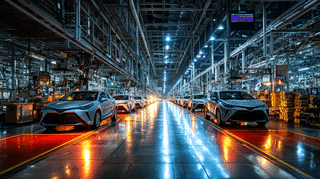
The Kharkhoda plant in Haryana, operational since February 2025, initially at 250,000 units per year, to be expanded through four production lines to 1 million units. Toyo Keizai's April 2026 on-site report describes the scale of construction there as unprecedented in Indian auto history, with one of Asia's largest manufacturing campuses taking shape.
That said, Suzuki has tempered expectations. In February 2025, it revised Maruti's long-term sales target down 15%, from 3 million to 2.54 million units by FY31, citing intensifying competition. The company added that it "will not rush to achieve 4 million units by 2030 at any cost; we will implement this plan at the appropriate timing, considering market conditions." Ambition is being balanced with discipline.
Toyota: The Quietly Rising Second Force
Often overshadowed by Maruti, Toyota Kirloskar Motor has been climbing steadily. Its FY25 share was 7.2%, and monthly figures in FY26 have pushed into the 8% range. Year-on-year sales growth has consistently exceeded 20%.
In January 2026, Toyota began operations at a new EV and hybrid plant in Maharashtra, a $2.5 billion (~¥395 billion) investment on an 827-acre (335-hectare) site. The plant focuses on electrified vehicles for both domestic and export markets.
Toyota's lineup strategy capitalizes on its capital alliance with Suzuki. Toyota owns roughly 5% of Suzuki, and Suzuki owns about 0.2% of Toyota. Toyota's first India EV, the Urban Cruiser EV launched in early 2026, is essentially a rebadged Maruti e VITARA, shared development costs, shared platform. On hybrids, Toyota's Hycross and Urban Cruiser Hyryder are well-established, giving it a head start as Nissan, Honda, and Renault rush to launch their own new hybrid SUVs in 2026.
Honda and Nissan: The Struggling Japanese Brands
Not every Japanese brand is thriving in India. Honda and Nissan face deep challenges.
Honda Cars India sold just 5,507 units in March 2026, a market share of around 1.2%. This is a shadow of the brand that once dominated the premium sedan segment with the Honda City. Honda plans to launch multiple new models between 2026 and 2027, including a hybrid version of the Elevate, a new three-row SUV, and an India-dedicated EV. But the path to recovery is unclear. Honda's parent company posted a massive loss in North American EV operations in March 2026, making Indian market recovery a strategic imperative for corporate turnaround.
Nissan, through its alliance with Renault, has committed roughly $600 million (~¥95 billion) in additional Indian investment since 2023 and plans to launch a new SUV "Tekton" with hybrid powertrain in 2026. But monthly sales remain below 3,000 units, placing Nissan near the bottom of the Japanese five.
Are the Chinese and Vietnamese Really a Threat?
Many Japanese automakers privately worry most about Chinese BYD and American Tesla disrupting India. Reality has been less dramatic.
According to a report by Anand Rathi Securities, the medium-term impact of BYD and Tesla on Indian domestic manufacturers is "limited," for four reasons:
- India's EV policy strongly favors local manufacturing; imported EVs face high tariffs
- Chinese firms face stringent political hurdles in obtaining Indian investment approvals (in part due to the 2020 border conflict)
- The EV market itself is still only 2% of total sales
- Global automakers need 2–4 years to properly localize products
BYD sold only 237 units in India in December 2025, its premium-price strategy simply doesn't generate volume. JSW MG (formerly MG India) holds just 1.5% of the market despite Chinese backing.
The more interesting newcomer is Vietnam's VinFast. Production began at a Tamil Nadu plant in October 2025, and the VF6 (from ₹17.29 lakh / ~$20,000) and VF7 (from ₹21.89 lakh / ~$26,000) electric SUVs were launched. By December 2025, VinFast was selling 375 units per month, outpacing BYD (237), BMW EVs (343), Kia EVs (313), and Hyundai EVs (262) in that segment. VinFast is emerging as a credible "Asian-priced" challenger that Japanese automakers should watch carefully.
What India Means for Japan's Auto Industry
India is rapidly becoming a lifeline for Japan's auto industry.
In China, the combined share of Toyota, Honda, and Nissan has crashed from a 23.1% peak to under 9%. In the United States, Trump tariffs blew a ¥1.5 trillion (~$9.5 billion) hole in Japanese automakers' first-half FY26 profits. Europe is under pressure from Chinese EV imports. Against this grim backdrop, India remains one of the few major markets where Japanese brands still hold 50% share.
Moreover, India is evolving beyond a sales market into a global export hub. Suzuki's e VITARA will ship to more than 100 countries, including Europe, Japan, and ASEAN. Toyota's new plant is positioned as an export base. Maruti Suzuki's exports hit a record 330,000 units in 2024 (+21%) and are expected to exceed 400,000 in FY26. India is becoming a critical node in Japan's global auto logistics.
The risks are real too. Missing the SUV wave, mistiming the EV transition, or ceding ground to domestic Indian makers, any single misstep could shave Maruti's share from 40% down to low 30s within a few years. How Suzuki, Toyota, Honda, and Nissan each navigate the next decade in India may well determine the shape of Japan's entire auto industry.
In Japan, opinions are divided: "Suzuki is holding up admirably," "Toyota's multi-pathway strategy was right all along," or "Honda's position in India is already lost." There's also real debate about whether continued massive Japanese investment in India makes sense. What's your country's auto market like, where do Japanese brands stand? And which rivals do you think are rising fastest to challenge Japanese dominance in markets like India? We'd love to hear your perspective.
References
- https://toyokeizai.net/articles/-/941430
- https://www.jetro.go.jp/biz/areareports/2025/aac0eddbbc5c1638.html
- https://www.autocarindia.com/car-news/february-2026-car-sales-mahindra-closes-in-on-tata-motors-in-second-spot-439123
- https://www.autocarpro.in/news/indias-passenger-vehicle-market-posts-record-february-sets-course-for-5-million-units-in-2026-131535
- https://www.globalfleet.com/en/shared-mobility/others/features/indias-passenger-vehicle-market-hits-record-high-january-2026
- https://www.marutisuzuki.com/corporate/media/press-releases/2026/february/india-goes-electric-with-maruti-suzuki-e-vitara-introductory-baas-price-starts
- https://www.globalsuzuki.com/globalnews/2024/0110a.html
- https://diyguru.org/india-ev-policy-2030-roadmap/








Global Discussion
14 comments