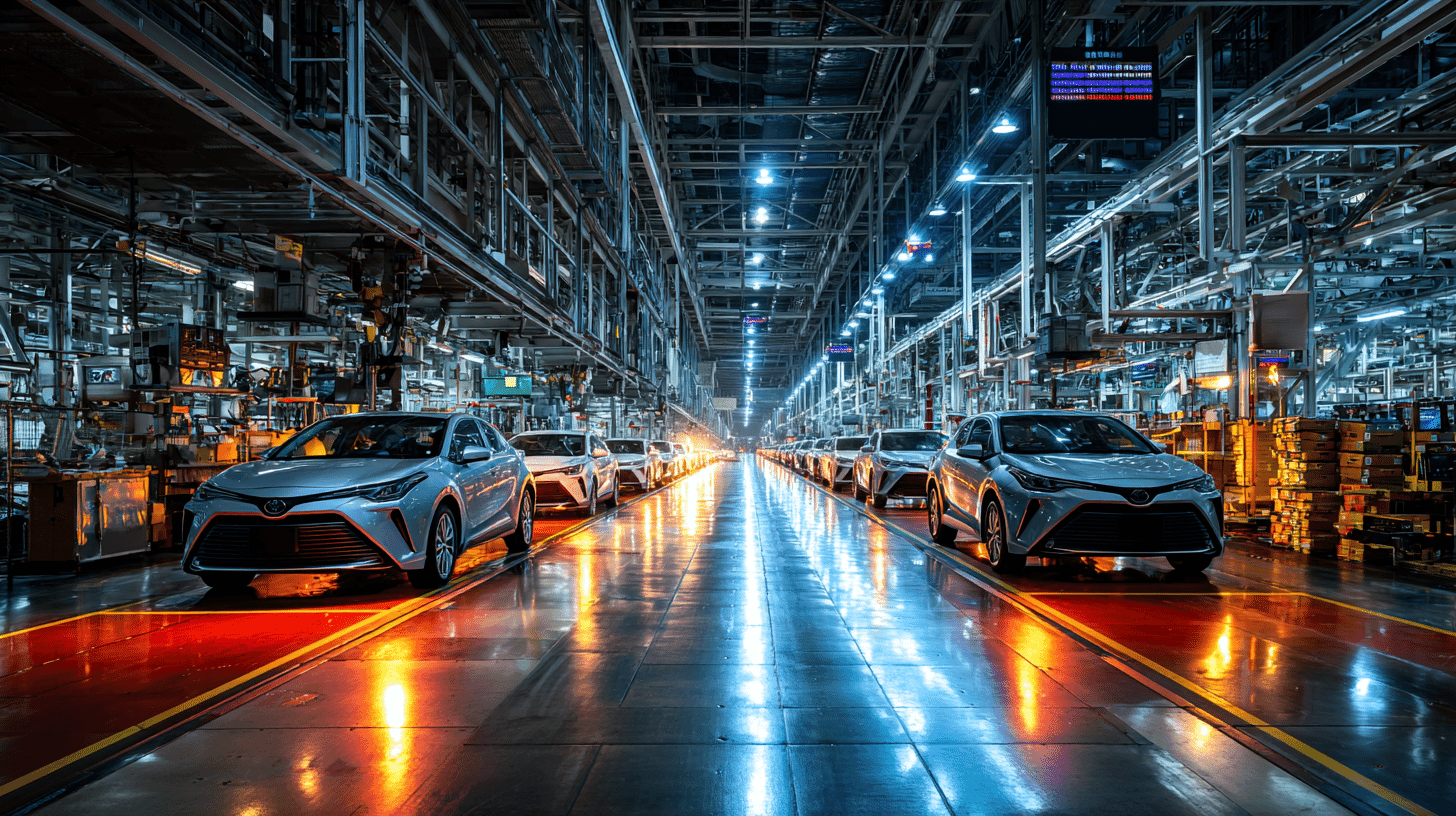
Trump's auto tariffs were projected to cut a combined ¥2.5 trillion (about $17 billion) from the full-year profits of Japan's seven major automakers. Mazda posted its first loss in five years, and Honda's car division hit a record deficit. Yet in the latest quarter, with the tariff rate cut to 15%, signs of a turnaround are emerging. Here's how Japan's most important industry is fighting to survive.
Trump Tariffs Shake Japan's Auto Industry to Its Core
2025 was a year of reckoning for Japan's automakers. The sweeping tariffs imposed by the Trump administration in April on imported vehicles have struck at the heart of what many consider Japan's most critical industry.
The fiscal third-quarter earnings (April–December 2025) for all seven major Japanese automakers, Toyota, Honda, Nissan, Suzuki, Mazda, Subaru, and Mitsubishi Motors, were released by early February, and the picture is stark. Every single company reported declining profits, with Nissan, Mazda, and Mitsubishi falling into the red. It was the first simultaneous profit decline across all seven since the COVID year of 2020.
How the Tariffs Evolved
Previously, Japanese passenger cars exported to the U.S. faced a modest 2.5% tariff. Under Trump's additional auto tariff, a 25% surcharge was added in late April 2025, bringing the total to 27.5%, about ten times the previous rate.
Following negotiations between the Japanese and U.S. governments, the rate came down to 15% effective September 16. That is a meaningful cut from the peak, but still six times the original rate.
Importantly, the 25% tariff between the U.S., Canada, and Mexico remains in place, creating an additional burden for automakers who manufacture in Mexico for the U.S. market.
How Each Automaker Fared
Mazda: Export Dependence Backfires
Mazda posted a net loss of ¥14.7 billion ($100 million) for April–December 2025, its first loss for this period in five years.
The U.S. accounts for about 30% of Mazda's global sales, but roughly 80% of those vehicles are shipped from Japan and Mexico. Tariffs alone eroded ¥119.2 billion ($800 million) in profit, producing an operating loss of ¥23.1 billion ($160 million) for the nine months.
In the October to December quarter, after tariffs dropped to 15%, Mazda returned to operating profit for the first time in three quarters. CEO Masahiro Moro noted that "achieving quarterly profitability while absorbing approximately ¥10 billion per month in tariff costs is something we view positively." Mazda is targeting full-year operating profit of ¥50 billion ($340 million) and net profit of ¥20 billion ($140 million).
Honda: Car Division Hits Record Loss
Honda's net profit fell 42.2% year-on-year to ¥465.4 billion ($3.1 billion) for April–December. The automobile division posted an operating loss of ¥166.4 billion ($1.1 billion), the largest in company history and its first since Honda adopted international accounting standards.
Tariffs accounted for ¥289.8 billion ($1.9 billion) in profit reduction, compounded by ¥267.1 billion ($1.8 billion) in one-time EV-related charges.
Honda's motorcycle business posted record profits, which kept the company in the black overall at that point. For the full year, Honda expected to cut its tariff impact from the initially projected ¥450 billion ($3 billion) to ¥310 billion ($2.1 billion) through local parts sourcing and production shifts, including moving Civic 5-door hybrid production to the U.S.
Toyota: Down but Still Dominant
Toyota's revenue climbed 6.8% to ¥38.09 trillion ($253.9 billion) for April–December, putting it on pace to become the first Japanese company to reach ¥50 trillion in annual sales. But net profit fell 26.1% to ¥3.03 trillion ($20.2 billion).
The tariff hit was the largest in absolute terms: ¥1.2 trillion ($8 billion) for the nine months, with a full-year estimate of ¥1.45 trillion ($9.7 billion). Toyota's hybrid strategy proved a powerful buffer. Hybrids accounted for 40% of sales, and Toyota revised its full-year net profit forecast upward to ¥3.57 trillion ($23.8 billion).
Then-president Koji Sato said the company was not in a position where it had to "thrash about," ruling out knee-jerk price hikes. Toyota announced a leadership change in February, and Kenta Kon took over as president in April 2026.
Nissan: Tariffs Meet Structural Woes
Nissan is facing the double blow of tariff impacts and an ongoing corporate restructuring. For April–December, it swung to an operating loss of ¥10.1 billion (from a ¥64 billion profit a year earlier), with the Trump tariffs accounting for a ¥232 billion hit, without them, it would have stayed in the black. Its merger talks with Honda were called off in February 2025, forcing the company to pursue recovery on its own, and weakness in the Chinese market added further pressure.
Subaru: Heavy U.S. Dependence Exposed
Roughly 80% of Subaru's global sales go to the U.S., but it builds only about 350,000 units there against some 680,000 sold, leaving close to half as imports from Japan. It targeted ¥100 billion ($670 million) in full-year operating profit through cost reduction and product strengthening.
Mitsubishi Motors: No U.S. Production, No Shield
Having already exited U.S. manufacturing, Mitsubishi has no domestic production to shield it from tariffs. All its U.S. sales are imports, making the tariff impact direct and unavoidable.
Suzuki: The Exception
Suzuki doesn't sell passenger cars in the U.S., making it essentially immune to Trump's auto tariffs. Strong performance in India and other emerging markets has allowed it to be the only company among the seven to revise its operating profit forecast upward.
The Full Tariff Damage
The estimated full-year tariff impact for fiscal year ending March 2026:
- Toyota: ¥1.45 trillion (~$9.7 billion)
- Honda: ¥310 billion (~$2.1 billion)
- Mazda: ~¥230 billion (~$1.5 billion)
- Subaru: ~¥210 billion (~$1.4 billion)
- Nissan: ~¥232 billion (~$1.6 billion, Apr–Dec actual)
Combined, the seven companies faced well over ¥2 trillion ($13.3 billion) in tariff-related profit erosion.
How They're Fighting Back
Shifting production to the U.S. is the most direct response. Honda is moving Civic hybrid and CR-V production from Japan and Canada to American plants. Toyota announced plans to sell U.S.-built Camry, Highlander, and Tundra models in Japan, a rare reverse-import strategy.
Radical cost restructuring is accelerating. Mazda is targeting ¥80 billion ($530 million) in annual cost reductions through raw material savings and overhead cuts. It has also put a 400-person team on generative-AI-driven operational reform.
Prioritizing profitability over volume has become a shared theme. Automakers are focusing on per-unit margins rather than chasing sales numbers, with hybrid vehicles taking center stage. The global shift back toward hybrids and away from a pure EV strategy has played to Japanese automakers' traditional strengths.
Beyond Tariffs: A Triple Threat
Tariffs aren't the only challenge. Japan's automakers face a convergence of pressures.
In China, domestic EV makers have surged, rapidly eroding Japanese market share. Honda's China sales have plummeted, forcing the company to fundamentally rethink its EV launch timeline there.
Semiconductor shortages persist. A supply disruption from Netherlands-based Nexperia (a Chinese-owned chipmaker) forced Honda to curtail production, creating a ¥150 billion ($1 billion) profit drag.
Currency fluctuations add another layer. While the yen has recently weakened against the dollar (which helps exporters), it was stronger than the prior year for much of the reporting period, squeezing margins.
Signs of Recovery and What's Ahead
Despite the grim headlines, green shoots are appearing.
Mazda's return to quarterly profitability in Q3 surprised the market, and its stock surged 13% on the day of the announcement. The new CX-5 launch was approaching.
Toyota upgraded its full-year profit forecast, evidence that a hybrid-centric lineup holds up under tariff pressure.
Honda, too, supported by the profitability of its motorcycle business and hybrid sales in the US, had made progress in limiting the tariff impact.
Update: What the Full-Year Results Showed
The results that landed in May 2026 confirmed some of these forecasts and upended others.
Toyota's revenue reached ¥50.68 trillion, the first Japanese company past ¥50 trillion, but operating profit fell 21.5% to ¥3.77 trillion and net profit fell 19.2% to ¥3.85 trillion. Tariffs cut ¥1.38 trillion from operating profit. For the year ending March 2027, Toyota guides to ¥3 trillion in operating profit, a third straight annual decline, with Middle East-driven materials costs added to the tariff burden.
Honda posted the first net loss since it went public: revenue of ¥21.80 trillion, an operating loss of ¥414.3 billion, and a net loss of ¥423.9 billion. The cause was not tariffs but EVs. Honda cancelled the launch and development of three EV models planned for North America, and impairments plus supplier compensation brought total EV-related losses to ¥1.58 trillion. Tariffs accounted for ¥346.9 billion; strip out the EV charges and operating profit was ¥1.04 trillion in the black.
Mazda ended with revenue of ¥4.92 trillion, operating profit of ¥51.6 billion (down 72.3%) and net profit of ¥35.1 billion (down 69.2%), beating its own ¥20 billion net guidance despite a ¥154.9 billion tariff drag. Nissan held operating profit at ¥58 billion on revenue of ¥12.01 trillion but booked a net loss of ¥533 billion, its second consecutive annual loss.
The tariffs themselves also shifted. On February 20, 2026, the U.S. Supreme Court ruled the reciprocal tariffs imposed under IEEPA unlawful, and collection stopped on February 24. Auto and auto-parts tariffs, however, rest on Section 232 of the Trade Expansion Act of 1962 and fell outside that ruling. The 15% rate is still in force.
Japan's auto industry supports 5.5 million jobs and roughly 3% of national GDP. Tariffs are a political risk no automaker controls, and the response has come from the shop floor: cost structure, sourcing, product mix.
What comes next depends on the Section 232 negotiations between Tokyo and Washington, and on how far the production realignments show up in the numbers. Honda's year is a reminder that the headwinds are not uniform: its EV write-down cost more than the tariffs did.
How is your country's auto industry handling tariffs and trade tensions? Are car prices rising for consumers where you live? We'd love to hear about the situation in your country, share your thoughts!
This article was published from the April to December 2025 results released in early February 2026. The full-year results announced in May 2026 and the change in tariff law were added as an update.
References
- https://www.nikkei.com/article/DGXZQOUB0485P0U6A200C2000000/
- https://www.nikkei.com/article/DGXZQOUB082CT0Y6A200C2000000/
- https://www.nikkei.com/article/DGXZQOFD057C20V00C26A2000000/
- https://www.nikkei.com/article/DGXZQOCC311Q40R30C26A1000000/
- https://www.jetro.go.jp/biznews/2025/05/18eb10d8b5913fb5.html
- https://car.watch.impress.co.jp/docs/news/2085025.html
- https://bsrweb.jp/article/202082
- https://car.watch.impress.co.jp/docs/news/2108657.html
- https://car.watch.impress.co.jp/docs/news/2107979.html
- https://www.meti.go.jp/tariff_measures/







Global Discussion
15 comments