⏱️ Right now, your brain is keeping time. Not the 24-hour rhythm that tells you when to sleep, but the short kind: the half-second-to-ten-second kind that lets you catch a ball, feel a beat, or sense that a kettle is about to boil. Scientists long pictured this as a single internal stopwatch. A team in Tokyo just found something stranger: the brain runs several of these clocks at once, and they can tick together or drift apart depending on what's needed. The twist is that the puzzle the brain solves here looks a lot like one facing the engineers building the next generation of AI.
One stopwatch, or many?
First, a clarification, because the word "clock" trips people up. This is not about circadian rhythm, the body's roughly 24-hour cycle of sleep, hormones, and jet lag. This is about the brain's sense of elapsed time on the scale of seconds: knowing how long you've been waiting, predicting when the next thing will happen. That ability quietly props up a lot of everyday life: keeping a rhythm in music, timing a sprint, holding a thought in working memory, deciding when to act.
For decades, researchers argued over how the brain pulls this off. One camp imagined a single, central pacemaker, one stopwatch you could start, stop, or reset. Another saw timing as something that emerges from many regions at once, scattered across the cortex with no single master clock. A much-cited 2018 review by Joseph Paton and Dean Buonomano leaned toward that "distributed" picture: timing as a property of whole networks, not one dedicated organ.
What nobody had managed was to watch two of those regions keep time at the same moment and see whether they agreed. That's what Hiroto Imamura, a graduate student at Science Tokyo (the Institute of Science Tokyo), together with Associate Professor Riichiro Hira, Professor Yoshikazu Isomura, and colleagues, set out to do.
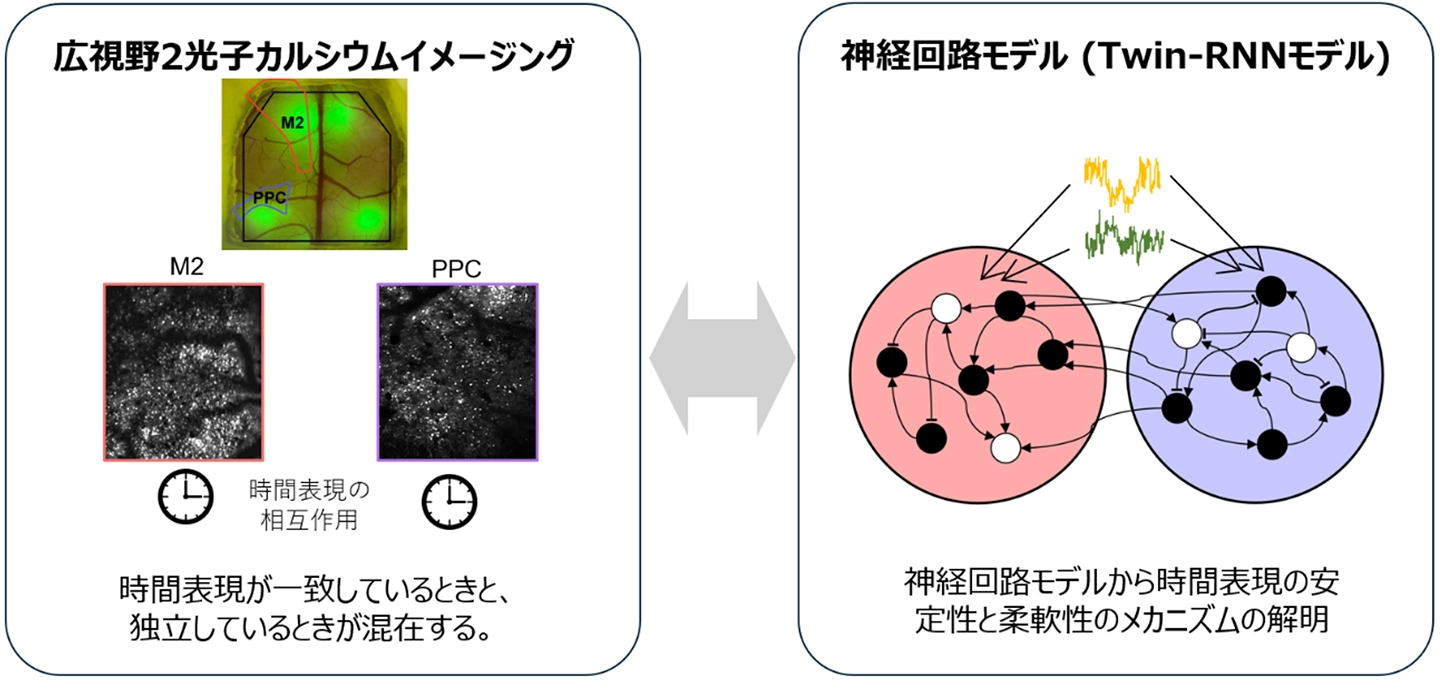
They trained mice on a task with a small wrinkle: rewards arrived on an alternating schedule, six seconds apart and then twelve, over and over. With enough practice, the mice learned to anticipate both, licking in expectation not just at the six-second mark but at the twelve-second one too. While the animals were timing, the researchers used wide-field two-photon calcium imaging (a microscope technique that lights up active neurons) to record thousands of cells at once across two regions: the secondary motor cortex (M2) in the frontal lobe, and the posterior parietal cortex (PPC) in the parietal lobe. Both are known to handle short-interval timing, and both were watched live, together.
When the clocks drift together, and when they drift alone
Both regions, it turned out, were clearly tracking time. As the seconds passed, different neurons fired in sequence, like a row of dominoes laid out along the interval. Read the pattern and you could tell, roughly, "how many seconds in" the brain thought it was.
But the two regions didn't always read the same number. When the team decoded each one's sense of the moment, they found two kinds of mistakes. Sometimes M2 and PPC slipped in the same direction at the same time, a coherent error with both clocks wrong together. Other times only one region drifted while the other held steady, an independent error. The brain's timekeeping, in other words, was neither perfectly fused nor fully separate. It lived in between, sharing a clock when it suited and splitting into two when that suited better.
Source: Science Tokyo press release
A finer analysis sharpened the picture. Using a communication-subspace analysis, they peeled apart the activity the two regions shared, component by component, to see where the timing signal actually lived. It wasn't concentrated in the single biggest shared channel. Instead, time was spread thinly across several smaller, low-variance shared components, easy to miss if you only looked at the loudest signal. That dominant channel, the one carrying the most shared activity, was busy with something else: the behavior itself, like the licking. Time was the quiet tenant in the building, not the one making all the noise.
Sparse wiring, and a useful kind of noise
That left the real question: why would a brain be built this way, half-shared and half-independent? To probe it, the team turned to a model: a "Twin-RNN," two recurrent neural networks wired together, standing in for M2 and PPC. They could then add or remove biological features and watch what happened.
Two ingredients did the trick. The first was sparse coupling: only a thin set of connections linking the two networks. That sparse link pulled them toward agreement, nudging their clocks into step. The second was 1/f noise (a kind of fluctuation, common in biological signals, where slow waves loom large and fast ones fade), spread broadly across the whole system. That shared, drifting noise did the opposite: it gave each network room to wander, to keep a clock of its own. Put both in, and the model reproduced the exact mix of coherent and independent errors seen in the mice. A further analysis confirmed the division of labor: sparse wiring aligns, broad noise liberates.
What this buys the brain is a balance most engineered systems struggle to strike: the stability of regions sharing one reliable clock, and the flexibility of each tracking its own. The paper appeared June 11 (local time) in Nature Communications; the network training and analysis leaned on Science Tokyo's TSUBAME4.0 supercomputer.
When a study about clocks becomes a story about AI
Here's why a paper on mouse timekeeping might matter beyond neuroscience. The problem the brain is solving here, letting several networks share information yet still think for themselves, is almost exactly the problem facing anyone trying to wire multiple AI systems together. Too much coupling and the parts collapse into one rigid unit; too little and they can't cooperate. The brain's answer, a sparse link for coherence and a wash of shared noise for independence, reads like a design hint for "brain-inspired" AI and robot control, where stability and adaptability are both prizes and usually at odds.
It's worth being honest about how far off that is. This is basic research on mice. The authors note their work doesn't study any disease directly; it offers a way to quantify the balance between coordination and independence across brain regions, which could eventually inform how researchers think about psychiatric and neurological conditions where that balance seems disturbed. No therapy, no product, no human brains yet. What there is, is a cleaner picture of something we all do without noticing, and a tidy clue for the people trying to build machines that do it too.
Several clocks, all yours
The next time you're counting down to a deadline, holding a beat, or bracing for a sound you know is coming, there isn't one tidy stopwatch in your head running the show. There are several, trading places, sometimes in lockstep, sometimes each on its own. Japanese researchers happened to catch them in the act in a mouse.
In Japan this landed as a basic-science headline. How does time perception get talked about where you are: in your country's labs, or just in the way people describe a minute that crawls and an hour that vanishes?
References
- Science Tokyo press release (June 12, 2026): https://www.isct.ac.jp/ja/news/1mw4xybmc67d
- Imamura, H., Imamura, F., Hira, R., Isomura, Y., & Hira, R. "Independence and Coherence in Temporal Sequence Computation across the Fronto-Parietal Network." Nature Communications (2026). https://doi.org/10.1038/s41467-026-73999-w
- Paton, J. J. & Buonomano, D. V. "The neural basis of timing." Neuron 98, 687–705 (2018).







Global Discussion
3 comments