
Sweden's defense giant Saab is doubling down on Japan. On March 16, 2026, Saab Technologies Japan named a Japanese executive as country manager and representative director for the first time: Akira Ukaji. His opening pitch is to replace Japan's "flying command post," the E-767 AWACS, with the Swedish-built GlobalEye. Combined with Japan's April 21 abolition of weapons-export restrictions, that could be the first real challenge to America's lock on Japan's airborne early-warning market since the 1990s.
This is the sixth article in our defense series. Earlier installments covered Japan's Mogami-class shipbuilding edge, the Australia FFM contract and export-rule reform direction, and the April 21 cabinet decision abolishing the "Five Categories", all stories about Japan as a seller. Today's piece flips the lens: Japan as a buyer, possibly looking beyond the United States. The primary source is a May 6, 2026 Norimono News interview by aviation journalist Seizo Sagara.
Source Notice
This article is a contextual explainer based on a single interview published by Norimono News (carried on Yahoo! News Japan) on May 6, 2026. The interview was conducted by aviation journalist Seizo Sagara, not by kantenna.com. We did not interview Mr. Ukaji or Saab independently. All statements attributed to Mr. Ukaji originate from the original article; for exact wording and nuance, please consult the source.
Original article: https://news.yahoo.co.jp/articles/13ee3455a65ff459a2345583ac846a63bf30afe4
What Just Happened: A First Japanese Country Manager
On March 16, 2026, Saab Technologies Japan announced that Akira Ukaji had been appointed country manager and representative director, the first Japanese person to hold that role since the subsidiary's establishment.
Saab is a Swedish defense and aerospace conglomerate whose product lineup spans the JAS39 Gripen fighter, the GlobalEye AEW&C aircraft, the Carl Gustaf M4 recoilless rifle (a familiar piece of kit in Japan's Ground Self-Defense Force, where troops affectionately nickname it "Karl-kun"), the NLAW anti-tank missile, and the RBS70 surface-to-air missile system.
In the original interview, Mr. Ukaji frames the appointment as a signal that Saab and Sweden are committing to Japan more deeply and over the longer term. He emphasizes that Saab Japan is structured as a kabushiki kaisha (a stock corporation under Japanese law), not a mere local representative office, a distinction meaningful to Japanese readers because it implies legal substance and intent to stay.
In foreign defense procurement, "commitment" is more than a buzzword. Defense systems are bought once but sustained for decades: spare parts, maintenance, upgrades, training pipelines. The willingness of a foreign supplier to invest in long-term local presence is the single biggest risk factor for any importing country.
The Pitch: GlobalEye
The product Mr. Ukaji singled out, the one he reportedly described with the word kakugo ("resolve"), is Saab's flagship airborne early warning and control aircraft, GlobalEye.
What GlobalEye Is
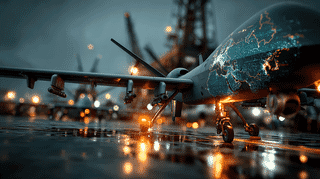
GlobalEye is Saab's latest-generation Airborne Early Warning & Control (AEW&C) platform. The airframe is a Canadian-built Bombardier Global 6500 business jet, onto which Saab mounts its Erieye ER (Extended Range) AESA radar. The Erieye ER uses gallium nitride transmit/receive modules, which Saab credits with delivering roughly a 70% increase in detection range over earlier Erieye variants. According to Saab, the radar can detect airborne targets at ranges exceeding 350 nautical miles (around 650 km) when operating at 35,000 feet, and the aircraft can stay aloft for over 11 hours per mission.
The Bombardier business-jet airframe is a deliberate choice. Compared with airliner-based competitors like the E-767 or E-7 Wedgetail, the GlobalEye is smaller, cheaper to fuel and maintain, and can operate from runways as short as roughly 6,500 feet, a point that becomes important later.
GlobalEye's customer list is gradually expanding:
| Country | Aircraft | Status |
|---|---|---|
| UAE | 5 | First export customer; in service |
| Sweden | 3 | Domestic; Sweden donated older Saab 340 AEW&C aircraft to Ukraine |
| France | 2 (+2 option) | Contract signed Dec 30, 2025, valued at SEK 12.3 billion (~$1.3 billion). Deliveries 2029–2032. Replaces aging E-3F Sentry fleet |
Saab CEO Micael Johansson described the France deal as reinforcing France's commitment to sovereignty and Europe's overall protection. France is the second export customer after the UAE and the first NATO member to order the type. In September 2025, Germany's defense minister named GlobalEye the leading candidate for his country's next AEW&C aircraft.
Why Now for Japan
The short answer: Japan's E-767 fleet is aging.
In the original interview, Mr. Ukaji offers a cautious estimate that "if a replacement program emerges, it will likely be within the next ten years," a reasonable hedge for a sitting executive. But independent reporting goes further. Military journalist Osamu Takeuchi, writing for Norimono News in June 2025, said internal industry documents he had been shown listed 2035 as the target replacement year for the E-767. That timing aligns precisely with the F-2 fighter's planned retirement and the targeted entry into service of the GCAP (Global Combat Air Programme) sixth-generation fighter in 2035, a convergence dubbed "the second 2035 problem" for Japan's air defense.
What the E-767 Actually Is
The E-767 is a Boeing 767-200ER airliner converted into an Airborne Warning and Control System (AWACS) platform: the iconic "rotating dish" design of an E-3 Sentry, mounted on a 767 fuselage. Specifications:
- Length 48.51m, height 15.85m, wingspan 47.57m
- Maximum takeoff weight ~175 tonnes
- Range ~10,370 km
- Detection range 350+ km
- Crew of 21 (2 pilots + 19 mission operators)
- Unit cost over ¥50 billion (~$310 million at the historical rate of ~¥160/USD)
Only four were ever built, and Japan operates all four. The aircraft entered service with the JASDF in 2000. American servicemembers reportedly call it "J-WACS" to distinguish it from the E-3 Sentry.
Its role is more than radar coverage. The E-767 is a flying command post that prioritizes incoming threats and vectors fighters like the F-15J/DJ to intercept. Ground radar sites are easy missile targets; an airborne version is much harder to kill.
The E-767 has two structural problems:
Problem 1: System obsolescence. The mission system was ported from the late-production E-3 Sentry. The U.S. Air Force has been planning to retire the E-3, which means there will be no further capability upgrades to the underlying system. If E-3 upgrades stop, the E-767's upgrade pathway closes too.
Problem 2: Airframe obsolescence. The Boeing 767-200ER variant is no longer in production. After 25+ years of service, both the airframe and its supporting industrial base are aging.
Japan needs to think seriously about a successor. Not next year, but soon enough that decisions made now will matter.
Saab's Pitch: Distributed Operations
Another keyword Mr. Ukaji emphasized was "distributed operations" (bunsan unyo), and he made the point with a vivid recent example.
On February 28, 2026, the United States and Israel launched coordinated strikes on Iran. Iran retaliated with hundreds of missiles and drones aimed at Saudi Arabia, the UAE, Qatar, Bahrain, and other Gulf states hosting U.S. assets. At Prince Sultan Air Base in Saudi Arabia, an Iranian missile destroyed a U.S. E-3 Sentry and at least one KC-135 tanker on the ground.
Mr. Ukaji notes in the interview that during the same period, Saudi Arabia's Saab-built early-warning fleet was not destroyed, because the aircraft were dispersed across multiple bases. That, he argues, is the practical advantage of Saab's design philosophy.
GlobalEye supports this kind of multi-site operation: short-runway capability (around 6,500 feet), compact ground support equipment, and operationally light maintenance footprint. An airliner-sized E-767 is harder to redeploy this way.
Sweden's population is around 10 million, far smaller than Japan's. With a limited defense budget, Saab has long emphasized simple, efficient, easy-to-use systems, a philosophy visible across its product line. The Gripen fighter, for instance, was designed from the start to use highway segments as runways and can be rearmed and refueled in 15 minutes by a 5–6 person ground crew.
That "survive in the field" ethos has become more relevant, not less, as the Russia-Ukraine war has shown that AEW&C aircraft are increasingly targeted by long-range air-to-air missiles such as Russia's R-37 and China's PL-15.
How April 21 Changes the Math
Layering Japan's regulatory shift on top makes Mr. Ukaji's pitch more interesting.
As our previous article covered, on April 21, 2026, the Takaichi cabinet revised the Three Principles on Defense Equipment Transfer, abolishing the "Five Categories" restriction and easing rules on outbound investment in foreign defense companies. That story is mostly about Japan as a seller, but it has a flip side: Japan as a buyer can also diversify its procurement sources more freely.
Mr. Ukaji's other repeated phrase, "Partnership First", slots into this opening. Saab has historically built local partnerships in markets it enters rather than going it alone, and is explicitly pursuing regional supply chains outside Europe to spread geopolitical risk. The interview did not name specific Japanese partners, but Saab already maintains a Tokyo office at Ark Hills Sengokuyama Mori Tower, and could plausibly extend the same model that's working with French maintenance provider Sabena Technics for the GlobalEye program.
What the Interviewer Concluded, and What to Watch
In his closing observations, Sagara, who has covered Saab for years, offers a sharp framing: Saab rarely becomes the headline-grabbing star in foreign markets, but it tends to become "an indispensable presence" through quiet, persistent partnership. Appointing a Japanese president, he reads, signals that Saab wants to become indispensable to Japan too.
He closes with a striking line: when E-767 replacement talks heat up, how Saab Japan moves will be a leading indicator of how far Japan has actually gone in deepening ties with non-U.S. partners.
This is broader than one product procurement. The U.S.-Japan alliance remains the foundation of Japan's regional security posture, and Mr. Ukaji explicitly says so. The GlobalEye discussion isn't anti-American; it's about whether European platforms can become complementary options. That distinction matters.
Real movement on E-767 replacement will probably surface around 2030. Where Japan stands then is not knowable today. But several developments point the same way.
The Pentagon did propose cancelling E-7 Wedgetail procurement in its FY2026 budget request, which surfaced publicly in June 2025. Congress blocked it. The FY2026 defense authorization and appropriations acts prohibited terminating the program and put roughly $1.1 billion into prototypes, and in March 2026 the Air Force re-awarded E-7 contracts and moved the program into engineering and manufacturing development. The American E-7 survived.
The real shift happened on the European side. NATO abandoned its plan to buy a collectively operated E-7 fleet and turned toward a European solution. France picked GlobalEye, Germany lists it as a front-runner, and Japan's April 21 reform lowers the legal friction around sourcing outside the United States. The accurate summary is not that American AEW&C is collapsing, but that it is no longer the automatic answer.
How is the question of replacing legacy U.S.-supplied airborne radar handled in your country? Is the balance between American defense procurement and diversification a topic where you live? Tell us in the comments.
References
- https://news.yahoo.co.jp/articles/13ee3455a65ff459a2345583ac846a63bf30afe4 (original interview / Seizo Sagara)
- https://trafficnews.jp/post/559835 (E-767 2035 replacement issue / Osamu Takeuchi)
- https://www.saab.com/products/globaleye
- https://en.wikipedia.org/wiki/GlobalEye
- https://en.wikipedia.org/wiki/Boeing_E-767
- https://www.armyrecognition.com/news/aerospace-news/2025/france-signs-1-34bn-contract-for-two-saab-globaleye-airborne-early-warning-aircraft
- https://en.wikipedia.org/wiki/2026_Iranian_strikes_on_Saudi_Arabia








Global Discussion
14 comments