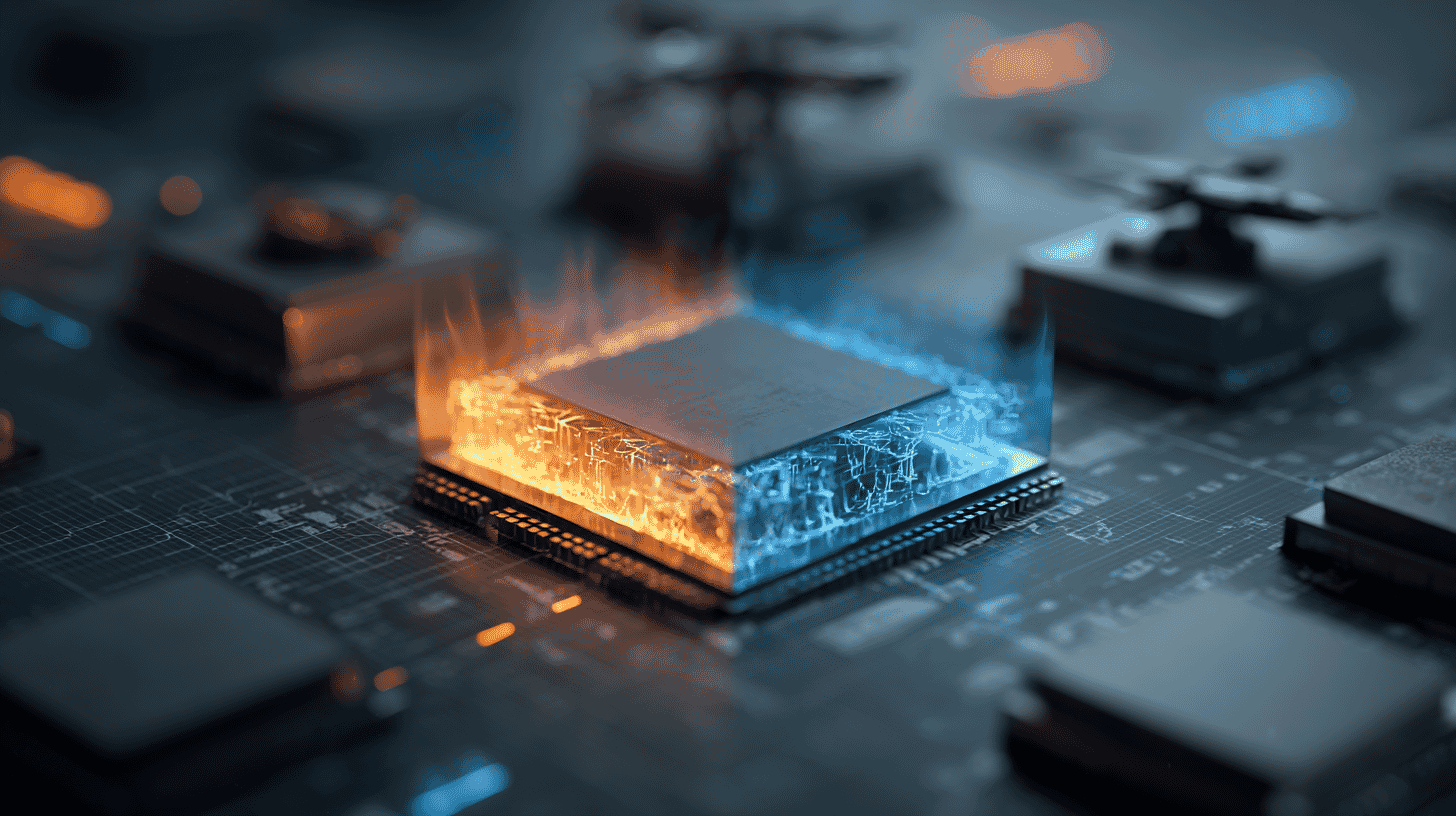
Fujitsu just announced a dual-band T2SL infrared sensor with "world first," "over 1 million pixels," and "temperature differences of 0.05°C" plastered all over the press release. But how much better is it, actually? If you're used to a typical thermal camera, the leap is roughly like going from vision 1.0 to vision 2.0. That said, Fujitsu is not winning everywhere: on mass production and combat heritage, Western giants still dwarf them. In this article, we break down infrared sensor performance into three axes and go head-to-head with Fujitsu, US-based FLIR, Raytheon, L3Harris, Northrop Grumman, and Sweden's IRnova.
Our previous article "Dual-Band Infrared Breakthrough: Fujitsu's 1-Megapixel T2SL Sensor Challenges Global Defense Tech Leaders" covered the policy context, dual-use strategy, and Japan's defense industry pivot. This follow-up focuses on the technical performance benchmarks, with concrete comparisons to specific commercial products: just how impressive is this sensor, really?
What Determines Infrared Sensor Performance, Really?
Infrared sensor performance comes down to three axes. Let's use a regular camera as an analogy to keep things concrete.
Axis 1: Resolution (pixel count)
Just like saying a smartphone has "48 megapixels." More pixels mean you can resolve distant objects in finer detail. Phone cameras routinely hit 12–48 megapixels today, but the cooled infrared sensor world is a completely different universe.
Because infrared wavelengths are more than ten times longer than visible light, shrinking each pixel runs into fundamental diffraction limits. For decades, the industry standard has been 640×512 pixels (about 327K pixels), the so-called "VGA class." In recent years, 1280×1024 pixels (about 1.3 megapixels), the "HD class", has started appearing, but only at the high end.
Fujitsu's sensor clears that HD threshold while simultaneously detecting two wavelengths. In visible-camera terms, this is like jumping from VGA to Full HD resolution.
Axis 2: Sensitivity (NETD)
The technical term is NETD (Noise Equivalent Temperature Difference), measured in millikelvin (mK). It's the smallest temperature difference the sensor can distinguish, lower is better.
Consumer uncooled thermography sits around 40–60 mK. High-end cooled sensors reach 20–30 mK. Elite specialty products push down to around 10 mK. Fujitsu's "0.05°C or less" spec translates to under 50 mK. On the raw number alone, IRnova's commercial T2SL product (Oden MW) reaches 20 mK, so Fujitsu isn't the absolute sensitivity champion.
But there's an important catch: achieving sub-50 mK while simultaneously running dual-band detection at megapixel resolution is dramatically harder than hitting 20 mK on a single-band VGA sensor. Smaller pixels typically degrade sensitivity, and dual-band element structures are more complex than single-band. Fujitsu clearing all three criteria at once is what earns the "world first" label.
Axis 3: Wavelength band (which "color" of infrared)
Infrared bands see different things, almost like different colors.
- MWIR (Mid-Wave, 3–5 μm): Sharp at hot objects (engines, machinery, fires). Handles high humidity well.
- LWIR (Long-Wave, 8–14 μm): Good at room-temperature objects (human bodies, vehicles, buildings). Sees through fog, smoke, and sandstorms.
Most traditional sensors detect only one band. Dual-band detection lets you pull targets out of background noise that single-band would miss, and distinguish thermal decoys from real vehicles. For military counter-deception, this is decisive.
Head-to-Head With the Global Players
So how does Fujitsu stack up against specific products from the world's top makers?
Teledyne FLIR (USA): Overwhelming Volume and Breadth
Teledyne FLIR is the only vertically integrated IR hardware stack provider in the world, designing and manufacturing ROICs, detectors, cryocoolers, MWIR/LWIR camera modules, and CZ optics all in-house. FLIR manufactures both InSb and T2SL focal plane arrays through their commercial foundry at very high volumes, and recently launched the Tura automotive-qualified thermal camera module.
Their flagship Neutrino series offers multiple MWIR pixel pitches with CZ lens options. FLIR's strength is mass production and product breadth, shipping tens of thousands of modules weekly, with deep deployment across defense, industrial, automotive, and consumer markets. No publicly disclosed FLIR product matches Fujitsu's single-element dual-band + megapixel combination, however.
Versus Fujitsu: FLIR wins on a diversified portfolio optimized for many use cases. Fujitsu pursued a single-element peak-spec research approach. Different races, really.
Raytheon (RTX): The Invisible Eyes of the F-35
Raytheon has been producing the F-35's AN/AAQ-37 Distributed Aperture System (DAS) since 2023 for Lot 15 aircraft onwards, after Northrop Grumman chose not to participate in the follow-on competition. DAS uses six IR sensors around the airframe to provide 360-degree spherical situational awareness.
DAS sends real-time, high-resolution imagery from six infrared cameras mounted around the aircraft to the pilot's helmet-mounted display, giving F-35 pilots unprecedented situational awareness and survivability. Raytheon's derivative RDAS employs multiple high-resolution infrared sensors mounted around a platform to produce 360-degree spherical imagery for fixed-wing and VTOL aircraft.
Versus Fujitsu: Raytheon's game is system integration. The value isn't just the sensor spec, it's orchestrating six units into spherical awareness, processing with AI, and delivering it intuitively to the pilot. Fujitsu is a sensor-only supplier today, with no fighter-scale integration record.
L3Harris: The Missile Seeker Specialist
L3Harris's DBI²E (Dual-Band Infrared Imaging Engine) provides advanced technology to detect and engage the enemy. Fully reticulated long-wave infrared pixels deliver superior imaging performance even in dirty battlefield conditions where burning barrels and other very hot targets could cause blooming in mid-wave infrared detector systems. L3Harris provides missile seeker detectors for the DoD and international customers.
Versus Fujitsu: L3Harris is focused on hot-target discrimination and battlefield robustness. Their products are combat-deployed with accumulated operational data. Fujitsu can match on dual-band spec in theory, but has zero combat data.
Sweden's IRnova: The Commercial T2SL Pioneer
Less well-known in Japan, but Sweden's IRnova is a pioneer in commercial T2SL. Their flagship Oden MW delivers 640×512 pixels at 15 μm pitch, with temporal NETD of 20 mK and spatial NETD of 5 mK at 110K operation. HD (1280×1024) development is in progress, extending into LWIR and very long wave infrared (VLWIR).
Versus Fujitsu: IRnova is leading on single-band MWIR and working toward HD. Fujitsu aimed straight at the hardest target, "dual-band × HD", going for the steepest climb first.
The Honest Verdict: Where Does Fujitsu Actually Stand?
On "simultaneously meeting three criteria," Fujitsu unquestionably holds the world-first spot. But the quality of that lead needs honest scrutiny.
| Evaluation Axis | Fujitsu's Position |
|---|---|
| Single-element dual-band × 1-megapixel feasibility | World first (undisputed) |
| Single-axis NETD (sub-50 mK) | High-end, but IRnova's 20 mK in single-band is lower |
| Mass production capacity | Research prototype stage (decades behind FLIR) |
| System integration (sensor → software → AI) | Mostly sensor-only supplier (far behind Raytheon, Northrop) |
| Combat / field deployment record | Yet to come (L3Harris, Raytheon products already on fighters and missiles) |
| Satellite deployment | None yet (Leonardo DRS has won the US SDA constellation contract) |
In short: Fujitsu is the valedictorian with zero field experience. The spec sheet looks world-class, but the second half of the game, building mass production reliability and operational credibility, hasn't started.
What You Actually See: Real-World Scenarios
The spec talk is abstract, so let's get concrete. Here's what changes when you swap a conventional VGA single-band IR sensor for Fujitsu's 1-megapixel dual-band.
Conventional VGA single-band IR: People several km away appear as fuzzy points. Fog or smoke blocks you. Decoys fool you easily.
Fujitsu's 1-megapixel dual-band sensor, mounted on surveillance equipment:
- 2–3x identification distance: Triple the pixel count means finer resolution of distant targets through the same optics. Identification ranges for people and vehicles extend significantly.
- Harder to fool with thermal decoys or flares: MWIR and LWIR produce different signatures, letting real vehicle engines be distinguished from burning decoys.
- Maintains visibility in fog, smoke, sandstorms: LWIR wavelengths pass through large-particle obscurants where MWIR fails.
- Detects earthquake survivors day and night: A 0.05°C body-heat delta under rubble becomes potentially detectable.
- Catches wildfires at the ignition stage from satellite: MWIR tracks ignition points while LWIR maps smoke spread, simultaneously.
- Non-destructively finds microcracks in bridges and tunnels: Interior voids in concrete create subtle surface temperature variations that 0.05°C sensitivity can capture.
The deep dual-use value extending far beyond defense is the core story of this sensor.
The Commercialization Roadmap and What Fujitsu Has to Win
Fujitsu announced plans to develop products based on this manufacturing technology from fiscal year 2026 (April 2026 – March 2027) onwards, with broad sales to surveillance and observation camera markets.
Fujitsu's IR sensor business actually goes way back, they've supplied Japan's defense agency since the MCT era. Japan's ATLA publicly disclosed that they had openly solicited bidders with the technical knowledge and skills required for T2SL-based infrared sensors including satellite-mounted applications, but that only Fujitsu met the requirements, leading to a sole-source contract (Article 29-3 Paragraph 4 of the Accounting Act). The "only one in Japan" status is strength on the domestic front but means Fujitsu will need international partners to win globally.
Three critical battles lie ahead.
Battle 1: Establishing mass production
InAs/GaSb superlattice crystal growth is extraordinarily delicate, it requires nanometer-precision temperature control and composition management via molecular beam epitaxy (MBE). Making a 1-megapixel prototype is one thing; making them at scale with good yields is another. This is where decades of wafer production history at FLIR and L3Harris become a massive moat.
Battle 2: Becoming a system integrator, not just a component vendor
A sensor alone won't move markets. You need camera housings, optics, ROICs, cryocoolers, image processing software, and AI analysis wrapped into a complete solution. That ecosystem is what Raytheon and FLIR built over decades, and Fujitsu will need a serious partner strategy to close the gap.
Battle 3: Opening civilian markets fast
The "surveillance and observation camera" sales plan for fiscal 2026+ is the litmus test for whether a revenue base independent of defense budgets can emerge. Satellite-based Earth observation and environmental monitoring, automotive (pedestrian detection and adverse-weather driver assistance), infrastructure inspection (non-destructive testing), and medical (inflammation detection) are all big civilian addressable markets.
Japan's Bid in "Seeing the Invisible"
Fujitsu's T2SL infrared sensor has, on spec, legitimately cleared the highest bar by simultaneously meeting all three performance axes.
But sensor industries aren't settled by spec alone. Production yields, integration know-how, combat/space/commercial track records, supply chain depth, on all of these, Western giants hold overwhelming leads.
Still, Japan owning an independent infrared technology base matters. For economic security and as a foundation for civilian innovation, T2SL-scale advanced semiconductor capability is a strategic national asset. Watching Fujitsu's sensor advance from research prototype to commercial deployment across 2026 and beyond will be a key test of whether Japanese manufacturing can compete globally on "seeing the invisible."
Which country or company leads the infrared sensor race where you are? Does your country have domestic cooled high-sensitivity sensor capability? How do you feel about Japanese technology entering international markets? We'd love to hear your perspective.
References
- https://global.fujitsu/ja-jp/pr/news/2026/03/27-01
- https://edn.itmedia.co.jp/edn/articles/2604/15/news052.html
- https://xtech.nikkei.com/atcl/nxt/column/18/00001/11670/
- https://www.teledyne.com/en-us/news/Pages/teledyne-flir-oem-advances-state-of-the-art-in-infrared-imaging.aspx
- https://www.rtx.com/raytheon/what-we-do/air/eodas
- https://www.l3harris.com/all-capabilities/dual-band-infrared-sensor
- https://nanolithography.spiedigitallibrary.org/profile/Erik.Trybom-4197954
- https://en.wikipedia.org/wiki/AN/AAQ-37_Distributed_Aperture_System
- https://www.mod.go.jp/atla/data/info/ny_kenkyu_shinsedai/pdf_ichiran/r06/06-ekimu-zuikei-shi-10.pdf
- https://kantenna.com/topic/fujitsu-dual-band-t2sl-infrared-sensor-megapixel-defense








Global Discussion
14 comments