A Science Tokyo team finds that the brain runs multiple clocks for elapsed time, shifting between coherence and independence. From M2 and PPC recordings to the Twin-RNN model and a clue for brain-inspired AI, here's what they saw in a mouse.
Researchers in Japan made a four-micrometer sphere of chiral polymer that lases in a flat ring, like Saturn. The molecules self-assembled into a surface swirl that gives the light a direction. A clear look at the first angle-selective lasing from a sphere, driven by its own surface chemistry.
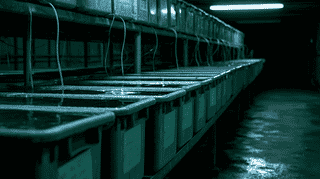
Aquaponics rarely pays as a standalone farm. So how does Aomori's closed-school project plan to make money? By monetizing the cafe, tours, education and welfare work around the tank, backed by public funds.
αGEL is the Japanese gel that keeps a raw egg intact after an 18-meter drop. The same material hides in mechanical pencils, G-SHOCK watches and ASICS shoes, and now damps drone vibration.
A team led by Japan's QST has shown, for the first time, a magnetic memory that writes with a laser pulse instead of current — and made it work on CoFeB, the alloy already inside commercial chips. Here's how, and why it matters for data-center power.
Discovered by accident during a COVID-era experiment, a University of Tokyo and Navarra study found about 65% of people drift counterclockwise when walking freely. Handedness and culture don't explain it, and even five-year-olds do it.
Kyoto and Hiroshima University researchers found that grains Hayabusa2 brought back from asteroid Ryugu begin altering within weeks on Earth. Here is how the decay starts with an iron sulfide, what it means for Bennu and Phobos samples, and how Japan is reacting.
JAXA's H3 rocket No. 6 reached orbit on June 12, 2026, debuting the booster-less, lowest-cost Type 30 and resuming flights after a six-month grounding. But an object seen falling near the engines is now under investigation.
Japan's Defense Ministry has quietly hired Space Compass to study a homegrown stratospheric platform. Roughly 20 km up, between airliners and satellites, the US, UK, China and India are already racing for a sensor that never blinks. Here is the military picture of the near-space contest.
Kyoto University's Takuji Hatakeyama and colleagues linked multiple-resonance units to reach a 5.5nm emission band in solution, pushing spontaneous emission toward laser-like color purity. Published in Science, it points to purer, more efficient next-gen displays.
A Japanese biotech threaded a catheter into a failing heart and delivered iPS-derived muscle without opening the chest. Inside the world's first trial of its kind.