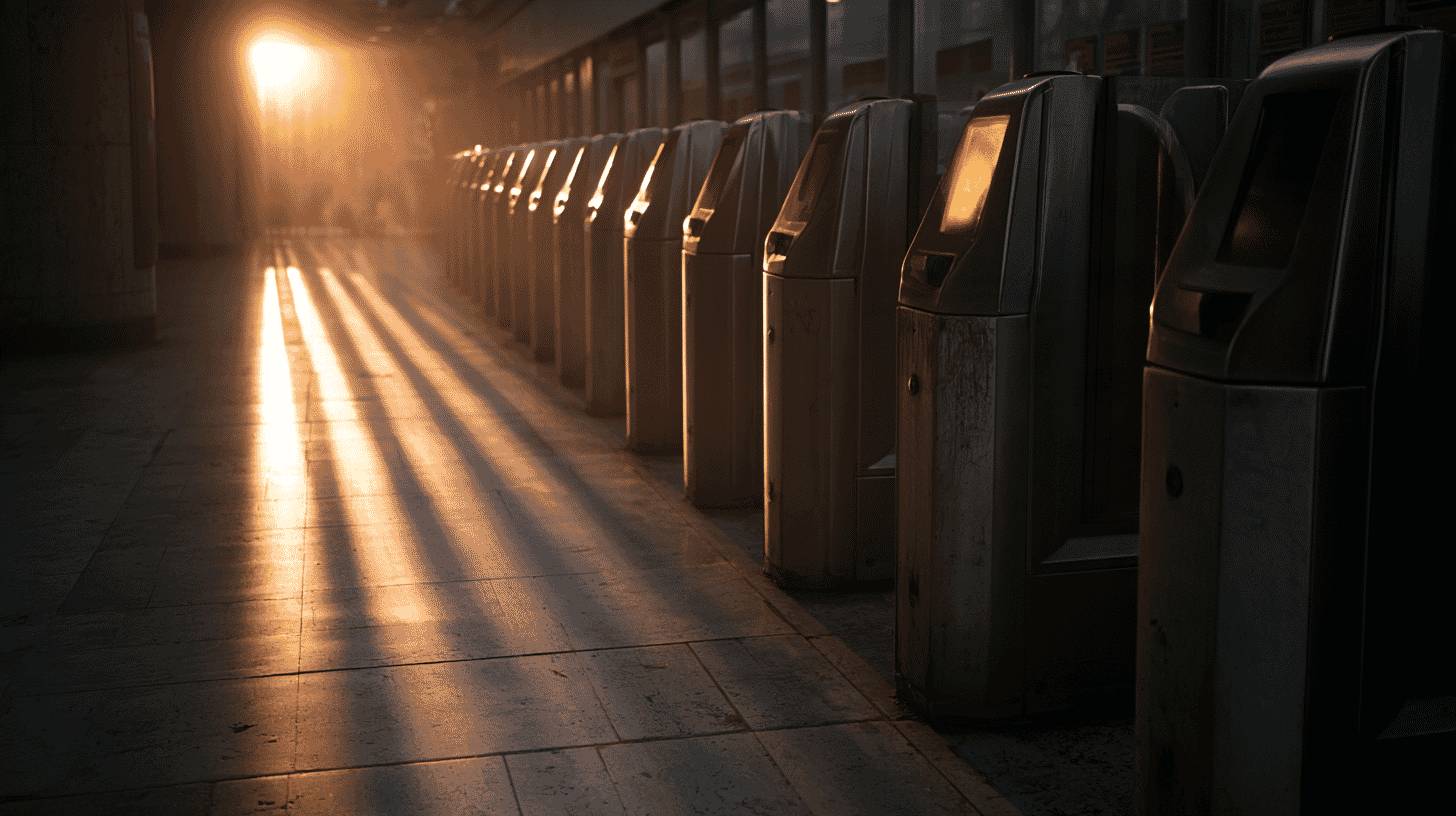
🚉 A Japanese train ticket is a storage device. It began as a pattern of punched holes. Then it held a magnetic stripe, then a larger one that could describe a journey across several railway companies. From spring 2027, the short-distance ticket stops holding much of anything.
The hard part was never the turnstile
Automatic gates reached Japan long before 1967. When the Tokyo Underground Railway, today's Ginza Line, opened between Ueno and Asakusa on December 30, 1927, it installed turnstiles copied from the New York subway. Drop a ten-sen coin in the box, push the arm, walk through.
They lasted under four years. The line was extended, the flat fare gave way to a distance-based one, and a machine that only counted coins had no way to know where you were going. Kenichi Kawabe, a transport-technology writer, notes that most other Japanese railways had already gone distance-based, and that every extension of the network multiplied the number of possible fares. Japan then spent decades with no automatic gates at all.
The obstacle was the fare system. A Japanese commuter pass is valid to board or alight at any station along its contracted route. A machine that wants to judge it has to hold that whole route somewhere and check, in a fraction of a second, that both ends of your trip sit on it.
Work restarted in February 1964, when Kintetsu set up a research group with Osaka University. Tateishi Electric, today's Omron, joined that September. In 1966 Kintetsu had to suspend its own rollout when arrangements over passes shared with the national railway stalled. Tateishi kept building and found a buyer in Hankyu instead.
On March 1, 1967, Keihanshin Kyuko Electric Railway, now Hankyu Railway, extended its Senri Line and opened Kitasenri Station in Suita, on the northern edge of Osaka. Ten gates by Tateishi Electric went in with it. Hankyu still calls them the world's first.
Machines that read a ticket were not new. On 5 January 1964 the London Underground installed the first automatic ticket barrier anywhere on its network, at Stamford Brook, a device that optically scanned a code printed on the ticket to see whether it was valid. What Hankyu calls a world first is not one machine but a whole station automated at once, with commuter passes and their route checks fed through it.
The design targets were 60 to 80 people a minute in a continuous stream, and a ticket carried from the slot to the return tray in 0.6 seconds. Senri New Town's local history archive records the absolute condition: the machine must not process people more slowly than a member of staff doing it by hand.
A standard, and then it spread
Nobody had yet worked out how to run a commuter pass and a ticket, which were different widths, through the same slot, so three kinds of gate stood side by side at Kitasenri: one for passes, one for tickets, and a staffed lane for everything the machines could not read. Passes were thick punched cards, and the machine read the holes optically. Tickets were hard stock with a magnetic barcode.
The unlock was agreement rather than engineering. In May 1971 the Japan Railway Cybernetics Council, the forum where operators settle common technical standards, issued a magnetic format. Manufacturers finally had something to build against. The separate pass gate and ticket gate were eventually combined into one machine, and by around 1973 a common magnetic format was established.
By the end of 1975 every major private railway in Kansai, plus the Osaka municipal subway, had automatic gates. Kanto did not follow. Tokyo's railways are a denser tangle of operators, and trains routinely run off one company's tracks and onto another's. A ticket for that kind of journey has to describe a path through more than one network, and until the 1990 revision there was not enough room on the paper to write it down.
More memory meant you could change companies
That changed in 1990, when the council issued a new magnetic standard with far more storage. Passes and tickets valid across different lines and different operators became possible.
Automatic gates spread widely across the capital around 1990, and thirty years after Kitasenri there were about 20,000 gates in service nationwide.
It amounted to a distributed database with no centre. Everything needed to settle your journey travelled in your pocket, and each gate read and rewrote a few bytes as you walked past. It worked because the paper was the record.
The information leaves the ticket
Suica arrived in the Tokyo area in 2001. An IC card is not pulled into the machine at all; it is read at a short distance while it sits in your hand or your bag. The gate stopped being a device that moves paper and became a device that reads things near it.
On 27 November 2007 the IEEE, the largest professional body for electrical and electronic engineers, awarded a Milestone. The citation reads Railroad Ticketing Examining System, 1965-1971, covering the development period rather than a single day in 1967. The four recipients, Osaka University, Omron, Kintetsu and Hankyu, were recognised together, and the plaque sits at Kitasenri.
By the time the award arrived, the magnetic ticket it honoured was already being displaced in the Tokyo area by a card that never entered the machine.
The 1990 problem, solved again on a server
On May 29, 2024, eight railway operators including JR East announced that magnetic tickets would be replaced with QR-code tickets from the end of the 2026 financial year onwards. JR East set spring 2027 for its own short-distance switchover in a release on June 9, 2026, phasing the magnetic ticket out as it goes. The scope is short-distance tickets only.
Under the joint plan, ticket details and entry and exit status are held on a QR ticket management server shared by all eight operators, and because they run the same system, tickets that cross between companies can be issued from it.
The same problem is now being solved a second way. In 1990 the answer was to put more information onto the paper. From 2027 it is to take the information off the paper and put it somewhere all eight companies can see.
The reading method loops as well. In 1967 a commuter pass was a punched card read by light. Magnetism took over and held the job for half a century. A QR code is read by light again. A columnist at the trade weekly BCN described this as technology developing in cycles.
The first gates opened in March 1967, and the method that replaced punched holes starts being replaced sixty years later, in the same season. What a short-distance ticket will do from then on is point at a record rather than be one. When you pass a gate where you live, does the thing in your hand hold anything at all, or is it just a key to a row in somebody's database?
References
- https://senri-nt.com/column/2020-10-05-jidokaisatsu/
- https://koueki.jiii.or.jp/innovation100/innovation_detail.php?eid=00039&age=high-growth&page=keii
- https://www.hankyu.co.jp/company/news/pdf/4837.pdf
- https://www.moneypost.jp/943803/2/
- https://prtimes.jp/main/html/rd/p/000000858.000017557.html
- https://www.jreast.co.jp/press/2026/20260609_ho03.pdf
- https://trafficnews.jp/post/675374
- https://ethw.org/Milestones:List_of_Milestones
- https://en.wikipedia.org/wiki/Stamford_Brook_tube_station
- https://www.weeklybcn.com/journal/column/detail/20220304_189387.html
- https://trafficnews.jp/post/703376






Global Discussion
4 comments