🥚 Japanese mayonnaise is having its best year abroad. Seasoning exports just set a record, and America's biggest mayonnaise brand has started making a Japanese-inspired version of its own. What travelled was the egg yolk. And Kewpie may have to leave that yolk behind to sell in India.
Seasoning exports set a record, and mayonnaise is in there
On August 4, 2026, Japan's agriculture ministry reported that farm, forestry and fishery exports for the first half of the year came to 897.7 billion yen (about $5.7 billion), up 10.9% and a first-half record for the second year running. Beef, apples, rice, green tea, sauces and mixed seasonings, and yellowtail were among the many categories setting first-half highs. Green tea led the growth at 83.5%, yellowtail followed at 69.0%.
Further down that list sits a less glamorous line: sauces and mixed seasonings at 39.1 billion yen (about $247 million), up 5.1 billion yen (about $32 million) for a 14.9% gain and also a first-half record. Note what the category holds. The ministry defines it as curry preparations, mayonnaise, dressings, vinegar and Worcester-type sauces combined, and vinegar was folded in only from 2025. No figure for mayonnaise alone is published. The ministry credits demand from the United States and Asia for dressings, mayonnaise and Japanese sauces and broths. The single largest destination overall was the United States at 162.6 billion yen (about $1 billion), up 15.3%.
Kansai TV, which built a broadcast around the figures on August 7, put the mayonnaise piece more bluntly: export volume has more than doubled over roughly a decade. The station spoke to JN Global, a trading company shipping Japanese mayonnaise abroad, whose representative Yun Jung-ho said inquiries arrive from South Korea, Mongolia, the United States and Canada, including a single Korean order for around 6,000 bottles of wasabi mayonnaise. He put the demand down to two things: sandwiches and bread eating into more of the world's diet, and people who tried the stuff in Japan going home and hunting for it.
America started making its own Japanese-inspired mayo
When a product stops being a niche import, someone copies it. Early in 2026, Hellmann's, the Unilever brand that has been on American shelves since 1913, put a Japanese-inspired product into US stores. It reached shelves by March. The pitch is tangy and savoury with a boost of umami, recommended for sushi, poke bowls, salads and sandwiches.
The name on the bottle is Japanese-Inspired Mayonnaise Dressing. Not mayonnaise. A dressing.
American food law is unusually strict about that word. Under 21 CFR 169.140, a product may only be called mayonnaise if it is at least 65% vegetable oil by weight, contains an acidifying ingredient such as vinegar, and contains an egg yolk-containing ingredient, with almost nothing outside a defined list permitted. Step outside the standard and you have to call the thing something else, which is the most natural reading of why Hellmann's whole flavoured range, from Chipotle to Dijo-Mayo, carries the Mayonnaise Dressing name.
So in the United States, egg yolk is not a stylistic preference. It is a legal condition for the noun.
And egg yolk is precisely what Kewpie points to when asked why the Japanese version tastes different. Tomomi Nakamura of the company's marketing division told Kansai TV that mayonnaise sold widely overseas tends to use the whole egg, white and yolk, while Kewpie's uses a generous quantity of yolk, giving it the depth, umami and smoothness that struck people abroad as something new.
The same ingredient, the opposite meaning
Which brings us to a country where that logic runs backwards.
On July 9, 2026, Kewpie announced a wholly owned sales subsidiary in India. The tentative name is KEWPIE INDIA PVT. LTD., the registered office goes in the northern state of Haryana, incorporation is planned for September 2026 and sales are not expected until 2027 or later. Capital is 115 million rupees, which the company puts at about 200 million yen and which works out to roughly $1.2 million at early-August 2026 rates (about 158 yen and about 95.2 rupees to the dollar). The business is importing and selling mayonnaise and dressings made by group companies elsewhere in Asia Pacific. A representative office opened in India in 2025 to study the market.
By Kewpie's own standards this is cautious. In Thailand it went in with a local partner in 1987 and runs a plant in Ratchaburi; in Malaysia and Indonesia it built factories. In India it is starting with a sales desk and a shipping container. Nihon Shokuryo Shimbun reports that Kewpie has exported mayonnaise and dressings to India since 2017 and that the new company will handle product made in Malaysia and Thailand.
Packaged food in India carries a small symbol near the brand name. Under the 2020 labelling regulations, a green filled circle inside a green square means vegetarian and a brown mark means non-vegetarian, the latter having changed from a circle to a triangle after concerns that a colour-only distinction was hard for colour-blind shoppers to read. The same regulations classify egg as non-vegetarian. Milk and dairy are excluded.
In the United States, egg yolk is what earns a product the word mayonnaise. In India, egg is what earns it the brown triangle. Same ingredient, same jar, opposite verdicts.
Kewpie's own release says nothing about this. But Shokuhin Shimbun, reporting on the plan in August 2026, wrote that the company is also weighing GREEN KEWPIE for vegetarian demand. That is the plant-based line launched at home in March 2023, and it already contains an egg-free mayonnaise-type seasoning built with the emulsification know-how developed for the original.
So Kewpie may enter one of India's fastest-growing condiment categories with the version that leaves out the very thing Hellmann's was trying to imitate.
The "vegetarian nation" number is slipperier than it looks
Foreign coverage tends to treat India as simply vegetarian. The data is messier.
Pew Research Center's 2021 survey on religion in India found that 39% of adults describe themselves as vegetarian, with the definition left to the respondent and the fieldwork carried out between November 2019 and March 2020. Government health survey data, which asks about actual consumption of fish, chicken and meat rather than about identity, produces a lower share. Ask people who they are and you get one number; ask what they ate and you get another.
The figure that probably matters most to whoever designs the label is a third one. Pew found that 81% of Indian adults follow some restriction on meat: avoiding certain meats, avoiding meat on certain days, or both. A green dot is not only for full-time vegetarians. It is for the much larger group that needs one some of the time.
Geography matters too. Haryana, where Kewpie's Indian office will sit, ranks among the most vegetarian states in government survey data. An analysis by the Indian outlet ThePrint of the NFHS-5 health survey found that nearly 80% of women and more than 56% of men there report never eating meat. Compare men alone, though, and Rajasthan comes out higher: the ranking shifts with the measure. The newer NFHS-6, fielded in 2023-24, released its fact sheets in May 2026 without the adult food-frequency items, so NFHS-5 remains the latest source for a state-by-state comparison.
Kewpie has not explained the choice of location, and the real reason is probably prosaic: Haryana contains Gurugram, the corporate belt outside Delhi, where the domestic sauce brand Veeba is also headquartered.
It has done this before, in halal
There is precedent for rebuilding a product line around a religious dietary standard. Kewpie Malaysia was established in 2009 and began production in Melaka in 2010; every product it makes and sells is halal-certified. Kewpie Indonesia, set up in 2013, has carried certification across its entire range since it started.
Halal and vegetarian are not the same problem, though. Halal mayonnaise can contain egg, because certification governs sourcing, processing and contamination control rather than the core of the recipe. India's green mark goes after the recipe itself.
Supply is the easier half. A new line in 2025 roughly doubled mayonnaise capacity at Kewpie Thailand's Ratchaburi plant to about 36,000 tons a year, and Kewpie Indonesia's Bekasi plant runs at about 19,500 tons. Shipping is the constraint: an import-and-sell model puts tariffs and freight into the shelf price in a market where the incumbents manufacture locally. As of August 2026, Kewpie has announced no Indian factory.
A $500 million market, with a queue forming
India's mayonnaise market is small by world standards and moving fast. Estimates vary by research house. Expert Market Research puts it at about $522 million in 2025, growing at roughly 7.6% a year through 2035; IMARC's figure for the same year is closer to $456 million. The drivers everyone agrees on are quick-service restaurants, cloud kitchens spreading into smaller cities, and the fact that Indians use mayonnaise less as a salad dressing than as a dip and a sandwich spread.
The incumbents are well dug in. Germany's Dr. Oetker bought the local brand FunFoods in 2008 and has led with it in retail on the strength of an eggless veg mayonnaise. Veeba, founded in 2013 by Viraj Bahl, whose family sold FunFoods to Dr. Oetker, went after restaurant supply with eggless and flavoured variants. Del Monte's Indian joint venture, Cremica and Wingreens fill out the field.
Kewpie is also not the only Japanese company heading that way. Nikkei Asia reported in June 2026 that Kikkoman is planning its first Indian plant and that Kagome is expanding local sourcing for pizza sauce production there.
The logic shows up in Kewpie's own accounts. Overseas sales reached 100.3 billion yen (about $630 million) in the year to November 2025, up 8.7%, out of 513.4 billion yen (about $3.2 billion) group-wide. Of 34.6 billion yen in consolidated operating profit, 13.6 billion yen (about $86 million) came from overseas, a heavier contribution than the sales share suggests. The mid-term plan running to November 2028 sets out 600 billion yen (about $3.8 billion) in consolidated sales and double-digit annual growth in overseas sales; Nikkei has reported the final-year overseas target as 180 billion yen (about $1.1 billion). India will not move those numbers by 2028. The bet is on the decade after.
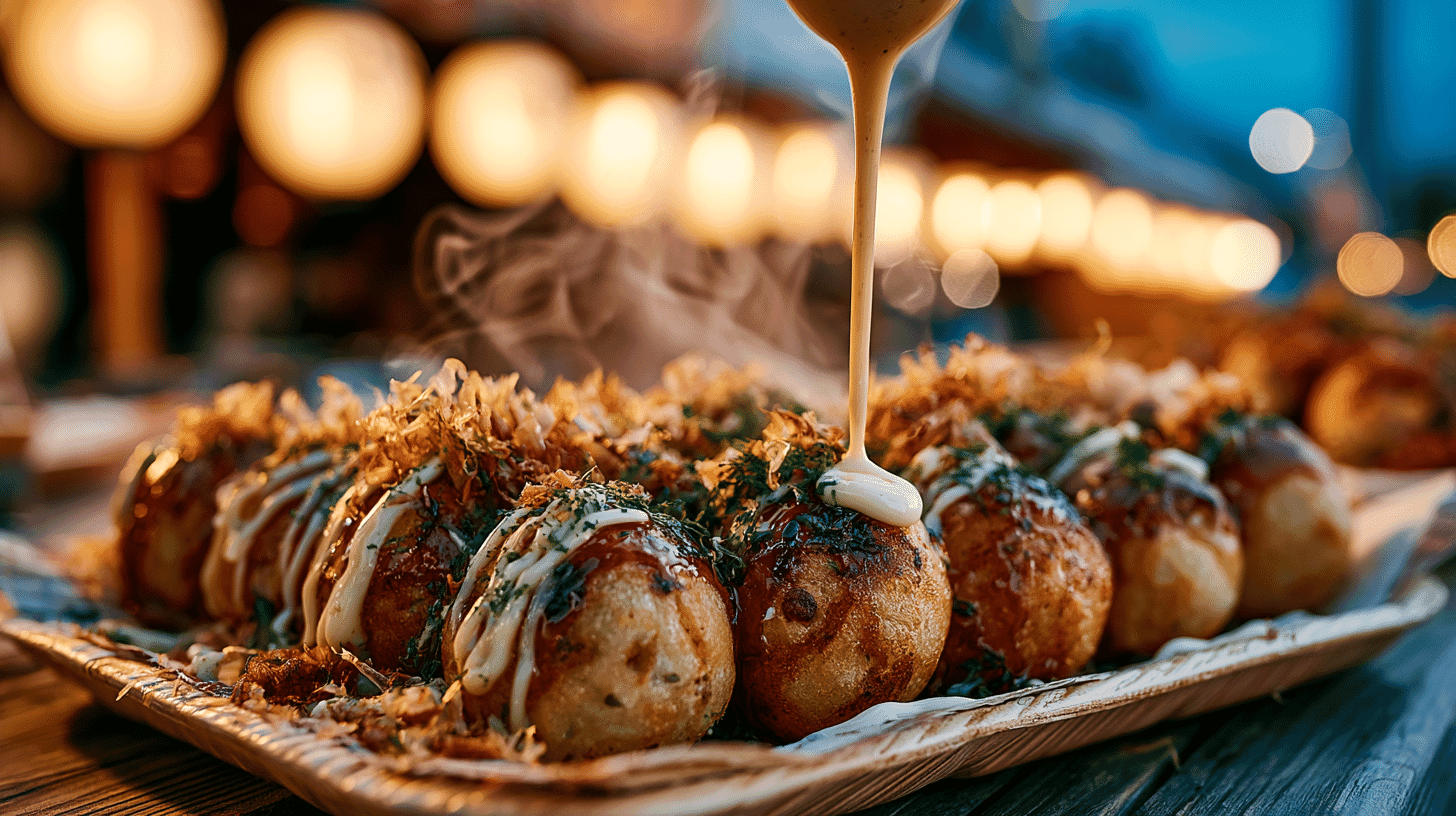
In Japan, mayonnaise asks nothing of anyone. It goes on takoyaki and okonomiyaki as a matter of course, and Kansai TV found a Kobe shop pouring it over mitarashi dango, the sweet soy-glazed rice dumplings. One ingredient can be a legal qualification in one country, a disqualification in another and a dessert topping in a third. So: what goes under the mayonnaise where you live?
References
- https://www.maff.go.jp/j/press/yusyutu_kokusai/kikaku/260804.html
- https://www.maff.go.jp/j/press/yusyutu_kokusai/kikaku/attach/pdf/260804-2.pdf
- https://www.ktv.jp/news/articles/?id=28839
- https://www.hellmanns.com/us/en/p/japanese-inspired-mayonnaise-dressing.html/00048001017900
- https://www.law.cornell.edu/cfr/text/21/169.140
- https://www.kewpie.com/newsrelease/2026/4130/
- https://shokuhin.net/154538/2026/08/05/kakou/choumi/
- https://news.nissyoku.co.jp/news/yokotah20260709045132019
- https://taxguru.in/corporate-law/food-safety-standards-labelling-display-regulations-2020.html
- https://www.pewresearch.org/religion/2021/06/29/religion-and-food/
- https://theprint.in/india/vegetarianism-rules-in-north-india-but-dal-and-paneer-as-proteins-punch-below-their-weight/916827/
- https://data.opencity.in/dataset/nfhs-6-2023-24
- https://www.kewpie.com/newsrelease/2025/3576/
- https://www.kewpie.com/newsrelease/2025/3801/
- https://www.kewpie.com/newsrelease/2020/1894/
- https://www.kewpie.com/ir/pdf/kessan_tanshin/2025/ir_20260114_FY2025q4_tanshin.pdf
- https://www.kewpie.com/ir/management/plan/
- https://www.nikkei.com/article/DGXZQOUC258UQ0V21C24A1000000/
- https://www.expertmarketresearch.com/reports/india-mayonnaise-market
- https://www.imarcgroup.com/india-mayonnaise-market
- https://www.benzinga.com/markets/equities/24/11/41908020/the-secret-sauce-for-veebas-success-how-viraj-bahl-build-the-company-from-ground-up-after-sellin
- https://asia.nikkei.com/business/food-beverage/japan-s-kikkoman-plans-first-india-plant-as-condiment-makers-rush-in







Global Discussion
5 comments