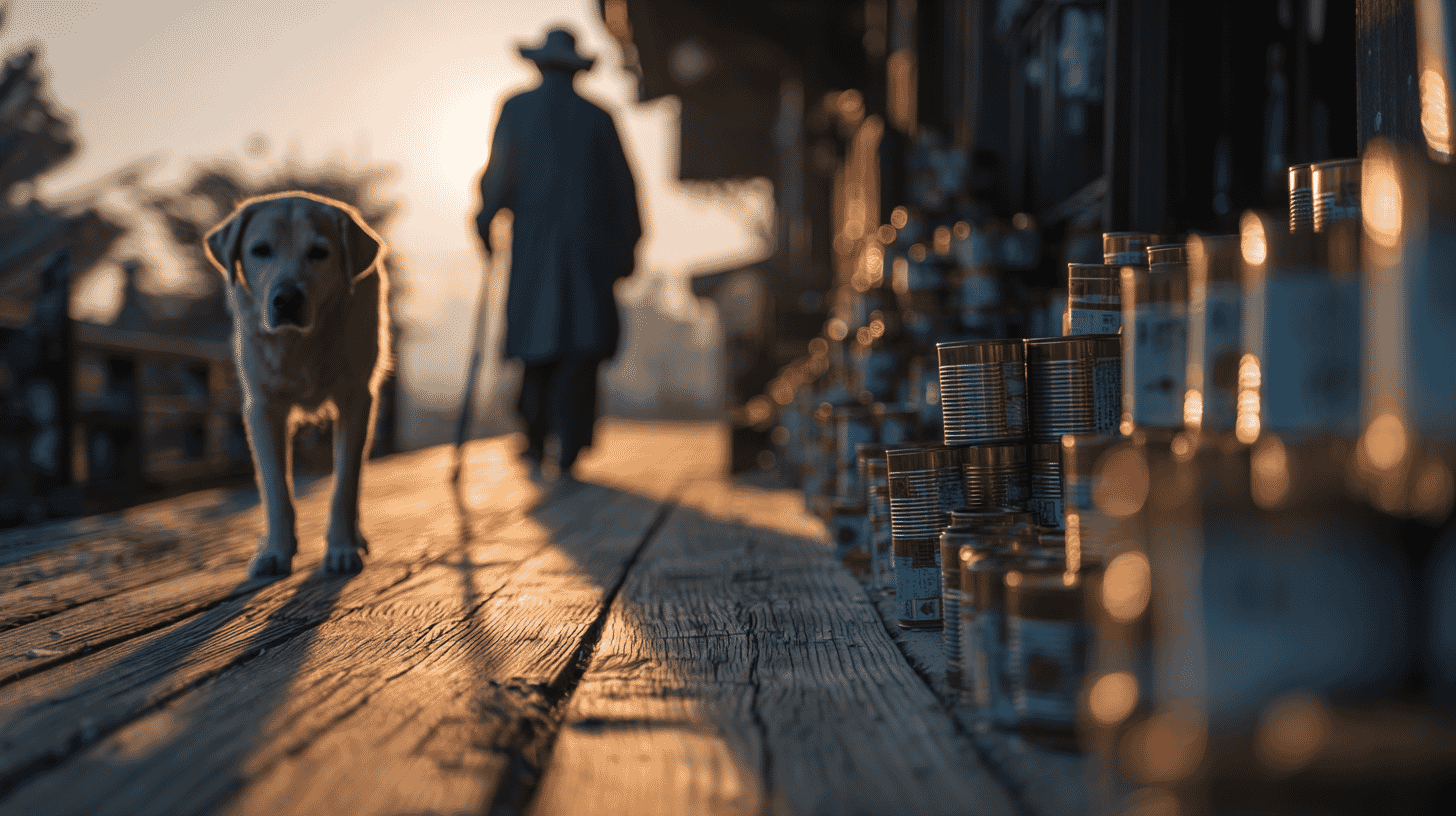
Junior high school students bring empty cans from home. The cans are turned into cash. The cash is donated to train guide dogs. That is the whole activity. One school in Kyoto has been doing it for 30 years, and the running total has crossed 6.18 million yen ($39,000), enough to fund the training of two full guide dogs. What kind of culture sustains a school activity for three decades after every founding student has graduated?
"Grateful, but not something we take for granted"
Daigo Junior High School in Fushimi-ku, Kyoto has been donating to the Kansai Guide Dogs for the Blind Association in nearby Kameoka City for over 30 years. Last year the cumulative total crossed ¥6,188,582 (about $39,400). The association told Maidona News it was grateful the donations had continued so long.
The activity began in 1994. Every year, students collect empty aluminum cans brought from their homes, redeem them at a recycling center, and donate the entire proceeds to the guide dog association.
According to Kansai Guide Dogs, training one guide dog costs roughly ¥3 million ($19,100). By that math, students at Daigo have funded more than two complete guide dogs over three decades, without any individual student ever funding a meaningful fraction of one.
This year's handover ceremony was held at the school on February 25. The donation, covering November 2024 to October 2025, came to ¥28,725 (about $183): a year of student effort, handed over in a single envelope. Kubo Masumi of Kansai Guide Dogs and Morinaga Kae, a guide dog user, received it from the student representatives.
Why "30 years" doesn't translate easily for overseas readers
Consider what 30 years means in the context of a junior high school. A student who entered the first year in 1994 is now around 45 years old. Some are now the parents of the students collecting cans this year. The donation chain runs across generations, from kids who became middle-aged parents to their own children in the same classrooms.
That kind of continuity at a single school doesn't happen by accident. It rests on a mostly invisible feature of Japanese schooling: the culture of collective, sustained civic activity built into compulsory education.
Japanese elementary and junior high students clean their own classrooms and hallways every day, taking turns with brooms and rags. They sort their own trash for recycling, often as a student council or environmental committee duty. Collecting bottle caps, aluminum cans or used postcards as a class fundraiser, then donating the proceeds to a charity, is a standard and unremarkable part of school life. Selling collected caps to recyclers and sending the money to a children's vaccine program is common enough that nobody reports on it.
Japan's aluminum can recycling rate runs above 90% by the industry association's count, among the highest in the world. The collection Daigo runs is one capillary in that nationwide circulatory system. Seen this way, the 30-year story is less an isolated act of heroism than what happens when a built-in civic infrastructure points itself at a single beneficiary, year after year, and nobody decides to change course.
The funding reality on the receiving end: 90% donation-dependent
To understand why this donation matters, look at the financial structure on the receiving side.
The Kansai Guide Dogs for the Blind Association, established in 1980, runs a comprehensive guide dog training center in Sogabe-cho, Kameoka City, Kyoto Prefecture. It is the association that produced Quill, the guide dog behind the film of the same name. By its own account it had placed roughly 460 guide dogs as of 2022, every one of them free of charge to the user.
Here is the structural reality: according to the association's crowdfunding materials, over 90% of operating costs are covered by donations and fundraising. Government subsidies alone cannot raise a single guide dog. Without sustained giving, corporate, individual, and yes, junior high school can drives, the system does not function.
The nationwide picture is no easier. A count by the Japanese Association of Welfare Services for the Blind put the number of working guide dogs at 768 as of the end of March 2025; the Ministry of Health, Labour and Welfare recorded 796 a year earlier. The estimated number of visually impaired people who want a guide dog is roughly 3,000. That is one dog for every four people who want one, and the total has been drifting downward for several years.
Against that backdrop, the ¥6.18 million accumulated at Daigo over 30 years is more than a feel-good number. It is two guide dogs that exist in the world, paired with two users, walking down two streets those users would otherwise navigate alone.
"A road where I can hum a song"
After the handover, Morinaga Kae gave a short talk to the students. As Maidona News reported it, she described catching herself humming a song one day as she walked, and realising the dog had become a treasure precious enough that she could forget she couldn't see.
It is a sentence worth sitting with. Walking blind down a city street normally means full-spectrum concentration: listening for cars, feeling for curbs, counting steps to the next landmark. A trained guide dog turns all of that into a partnership. The road becomes a road where a person can hum.
That description explains why 3,000 people in Japan are still waiting better than any statistic can.
How does Japan's guide dog cost compare globally?
Some overseas readers will look at "¥3 million per dog" and find it hard to calibrate. Globally, that figure sits at the low end.
For comparison, Guide Dogs of America puts the cost of putting one guide dog team into service at about $48,000 (roughly ¥7.5 million). The UK's Guide Dogs for the Blind Association cites figures around £55,000 (over ¥11 million). Most other Japanese associations quote ¥5 to 6 million per dog once full team costs are included: user training, lifetime follow-up, retired dog care and breeding stock management.
Kansai's headline ¥3 million likely covers direct dog-rearing costs only; the total per team is higher. Two patterns hold across countries, though. The dog is given to the user free, and the bill is paid almost entirely by the kindness of strangers.
What does "30 years" actually require?
There is a quiet, easy-to-miss feature of the activity. The students who collect the cans almost never see the result.
Junior high lasts three years. A student who joins the collection in their first year graduates two years later and moves to a high school elsewhere. The money gets pooled and eventually contributes to breeding, raising and training a specific dog, a process that itself takes at least two years. By the time the dog is paired with a user, the student is gone.
So what keeps it going? Not gratitude from beneficiaries the students will meet. Not visible results. It persists because teachers, students and parents have silently agreed it is worth doing for its own sake: contributing to a future you won't witness is a thing humans do, and that is enough.
It is one of the more underdiscussed values in Japanese school culture. Doing something quietly for someone else, for a long time, without seeing the payoff, because that is what the rotation asks of whoever happens to be in the room this year.
In Japan, this kind of multigenerational, school-mediated volunteering has deep cultural roots. What about your country, do schools in your country run long-running fundraising or volunteer activities that hand off across generations of students? And how is guide dog training funded where you live? We'd love to hear in the comments.








Global Discussion
14 comments