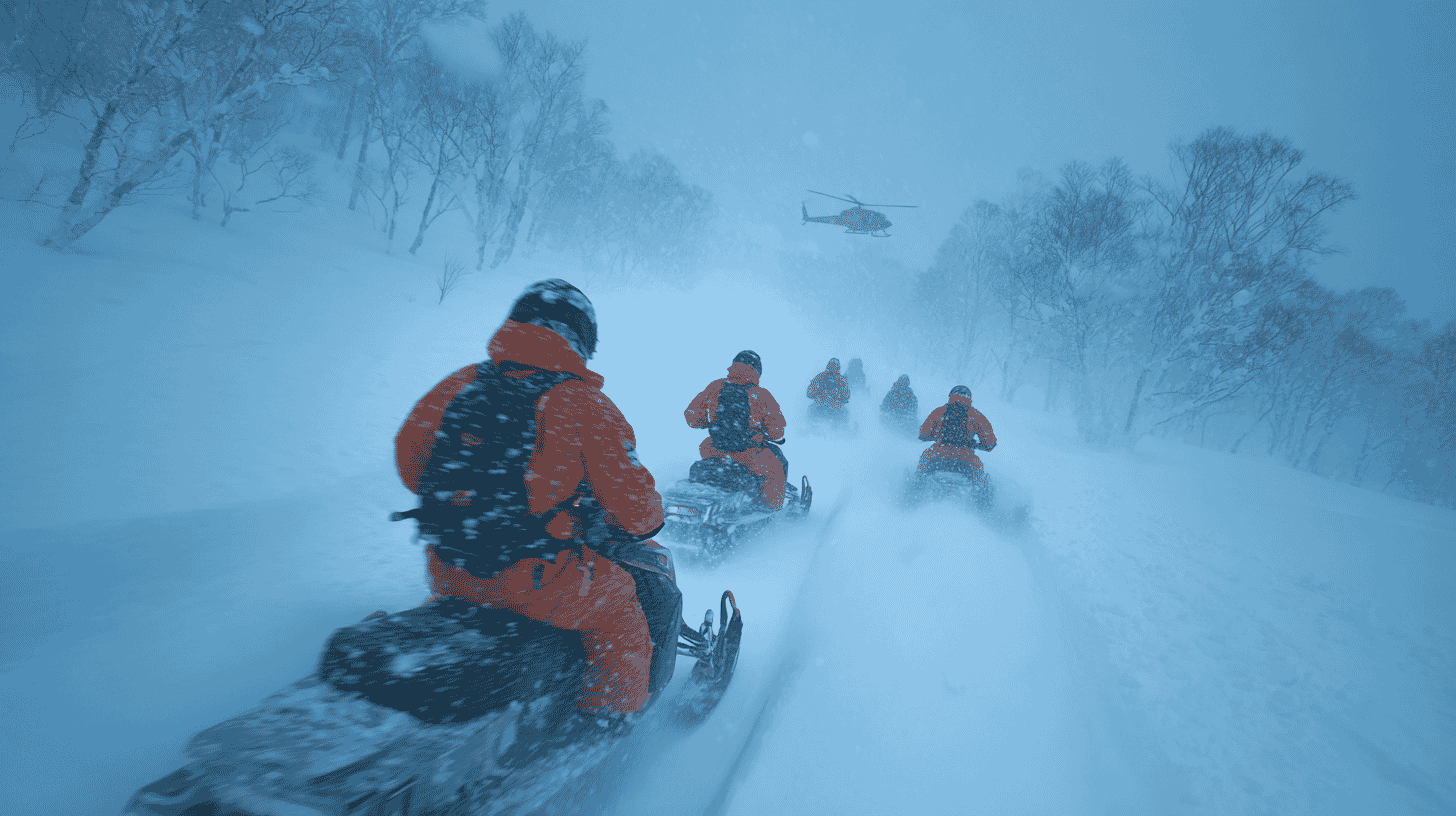
While skiers from around the world flock to Japan seeking legendary powder snow, a serious problem is emerging.
In January 2026, 29 people were rescued in Hokkaido in just three weeks, 90% of them foreign nationals. "I didn't know it was off-piste," they all claim. But authorities respond: "Given that they crossed clearly marked barriers, it's hard to believe they didn't know."
Behind the global allure of "JAPOW" (Japan Powder), what's really happening? Let's explore the cultural gap between Japan's unique mountain safety culture and the expectations of foreign visitors.
The Surge in Backcountry Accidents
Shocking Statistics
Throughout January 2026, backcountry accidents involving foreign tourists have surged across Japan's ski regions. According to Hokkaido Police, between January 1-21, 2026 alone, 29 people required rescue operations, 26 of them (90%) were foreign nationals.
One particularly notable incident occurred at Muikamachi Hakkaisan Ski Resort in Niigata Prefecture. On January 25th, six people, five Chinese nationals and one Taiwanese, became stranded off-piste and called for rescue. Remarkably, these six weren't originally traveling together; they were separate groups and solo skiers who coincidentally converged at the same location off the marked trails and collectively became "six stranded victims."
With the distress call coming late in the afternoon, rescue operations were impossible that night. Police instructed them by phone to dig snow caves for a "bivouac" to survive the cold. The six spent a terrifying night in the snowy mountains before finally being rescued the following morning.
The "I Didn't Know" Contradiction
Rescued foreign tourists invariably make the same claims:
"There were tracks from other skiers, so I thought it was okay to go." "I didn't know it was off-piste."
However, local police offer a different perspective: "The areas have clear nets and barriers marking them as off-limits. These skiers entered through gaps in those barriers. In our experience, they never admit 'I went in deliberately' or apologize."
This suggests not simple negligence, but likely intentional entry despite being aware of the restrictions.
Why Do Foreign Tourists Go Off-Piste?
"JAPOW" as a Global Brand
Japan's powder snow, known as "JAPOW," commands passionate devotion from skiers and snowboarders worldwide. The light, dry snow resulting from Japan's high latitude, combined with abundant snowfall from winter weather patterns, represents "dream snow conditions" for visitors from Europe, North America, and Oceania.
With post-pandemic tourism recovery bolstered by the weak yen, resorts from Niseko to Furano (dubbed "the second Niseko") overflow with international visitors. Reports suggest that approximately 90% of visitors at Niseko are foreign nationals.
Cultural Background Differences
At the heart of this issue lies fundamentally different perceptions of ski resort boundaries.
At many resorts in Europe, North America, and Oceania, off-piste skiing isn't necessarily prohibited, a culture of self-responsibility in backcountry areas has long been established. Japanese ski resorts, however, operate on the assumption that skiing occurs within managed areas, with off-piste zones clearly designated as "no entry."
A Hokkaido Police official stated to media: "Most of these accident victims are dressed as if they're just skiing at a regular resort. They carry no food supplies. From a backcountry professional's perspective, they're completely underestimating winter mountains."
Daisuke Sasaki, an international mountain guide and mountain skier, also warns: "Recently, we're seeing more cases of foreign tourists with insufficient knowledge and preparation venturing outside ski resort boundaries and getting into accidents."
The Reality of Recent Accidents
Major 2026 Season Incidents
The 2025-2026 season has seen backcountry accidents at a record pace.
On January 17, 2026, a Chinese man and woman fell approximately 150 meters down a cliff while backcountry snowboarding in the Niseko area. They had entered a restricted zone and failed to notice the cliff, falling to a precarious position where they couldn't move. They were rescued after approximately 5.5 hours.
In Furano City on March 15, 2026, three separate accidents occurred in a single day: a Canadian man, a Chinese couple, and an Australian father-son pair each became stranded while backcountry skiing at different times. All required helicopter rescue.
In February 2025, an Australian woman in her 20s injured her knee while backcountry skiing on Mt. Yotei. A total of 12 police and fire personnel were deployed for the rescue.
Fatal Accidents
Some accidents have resulted in deaths. On January 13-14, 2026, a 46-year-old man went missing while backcountry skiing near Niseko Moiwa Ski Resort. Poor weather conditions hampered search efforts, and he was found dead approximately one day after the initial rescue request.
At Hakuba Norikura's Tenguppara in Nagano Prefecture, a group of five foreign nationals was caught in an avalanche, resulting in two deaths including a professional skier.
The Reality of Rescue Costs
Who Bears the Burden?
In backcountry accidents, rescue costs are fundamentally the responsibility of the individual, "self-responsibility" applies.
While rescue by public agencies like police and fire departments is generally free, actual rescue operations invariably require cooperation from private rescue teams and ski patrol units. Private rescue team members typically charge 30,000-50,000 yen per day per person, plus fees for snowmobiles and snow groomers. Extended searches can easily reach several million yen.
Helicopter rescue is said to cost "10,000 yen per minute," resulting in substantial expenses.
Past Payment Refusals
In 2005, five South Korean skiers were rescued after becoming stranded at Zao Onsen Ski Resort. The rescued parties refused to pay the 110,000 yen search and rescue costs, claiming "we didn't request a search" and "our names were reported in the media." The fees were ultimately never collected.
In response to such situations, the Hakkoda Mountain Ski Safety Council established the "Mt. Hakkoda Local Rules" in the 2018-2019 season, explicitly stating that rescue costs would be charged to off-piste accident victims. The rules specify amounts for search personnel daily rates, overtime cable car and lift operation fees, and snow groomer operation costs.
Japan's Unique Safety Measures
The Niseko Rules as a Leading Example
Niseko, the holy grail of inbound skiing, has established its own "Niseko Rules." These strictly define prohibited areas, with measures such as lift ticket sales restrictions for violators.
Since skiing in natural terrain is part of Niseko's appeal, the approach isn't complete prohibition but rather "managed access with safety assurance."
Multilingual Education Efforts
Various regions are advancing safety education initiatives for foreign visitors.
Nagano Prefecture has produced the educational video "Staying Safe in the Backcountry" in English, Korean, and two versions of Chinese, available online. Hakuba Happo-one, Tsugaike Kogen, and Nozawa Onsen ski resorts distribute stickers and flyers to raise awareness.
With cooperation from the Australian Embassy in Japan, social media campaigns sharing backcountry risk information have begun. In February 2025, Furano City held its first emergency meeting with police, tourism associations, and other stakeholders to discuss information sharing and the need for clear rules.
Ministry of Land, Infrastructure, Transport and Tourism Initiatives
The Hokkaido District Transport Bureau conducted a verification project for ensuring foreign backcountry skier safety. Surveys revealed that over 10% of backcountry skiers don't carry the essential trio of beacon, shovel, and probe.
Plans include English website development, weather and avalanche information dissemination, and comprehensive guidance covering parking etiquette and respect for local communities.
Understanding Backcountry vs. Off-Piste
A common source of confusion in reporting is the distinction between "backcountry" and "off-piste skiing."
Backcountry refers to skiing in natural, unmanaged terrain outside ski resort boundaries, in principle, anyone can ski there freely. Off-piste skiing within a resort's restricted zones, however, is a clear rule violation.
The problem is that increasing numbers of tourists are "casually" entering backcountry areas adjacent to ski resorts. True backcountry requires the same preparation and knowledge as winter mountaineering, it is not a casual extension of resort skiing and snowboarding.
Enjoying Backcountry Safely
For those who wish to experience backcountry, the following preparations are essential:
The "three essentials" must always be carried: avalanche beacon (rescue transceiver), probe, and shovel. Helmets, emergency food, water, warm clothing, and emergency blankets are also necessary. Filing a mountain registration and purchasing mountain insurance is crucial.
Above all, beginners should hire experienced guides. Always check local weather and avalanche conditions, and avoid solo trips.
What rules exist in your country regarding off-piste skiing at ski resorts? Does the culture around backcountry skiing and mountain safety differ by country?





Global Discussion
16 comments