
A 500-yen sticker sheet (about $3) is causing stampedes in Japanese stores. Adults are shoving past children, staff are quitting, and customers are even chasing delivery trucks over a puffy, candy-like sticker called "Bonbon Drop Seal." Here is the inside story of Japan's wildest consumer craze since the pandemic mask shortage.
Japan's Sticker Mania: When Nostalgia Meets Obsession
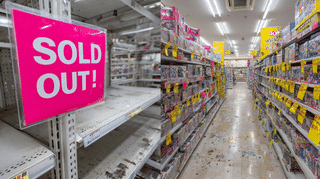
Something extraordinary is happening in Japanese stationery stores. Long before opening time, crowds gather outside shops that sell children's stickers. When doors open, adults rush toward a tiny shelf section, often just two display units wide, grabbing at glossy, three-dimensional stickers as fast as staff can stock them. Store employees have described customers seizing products from their hands mid-shelving, reaching past their faces to grab items, and even following delivery trucks to intercept shipments.
The object of this frenzy is the "Bonbon Drop Seal," a line of puffy, resin-coated stickers produced by Osaka-based stationery maker Qlia. Launched in March 2024, the product has shipped over 15 million sheets as of early 2026, with production scaled up to 300 times its initial output. Each sheet costs around 500 yen (about $3), features candy-like domed stickers with holographic sparkles, and comes in hundreds of designs from Sanrio characters to fruit motifs. But despite massive production increases, supply simply cannot meet demand.
The "Heisei Girl" Effect
To understand why adults are wrestling children for stickers, you need to understand the concept of "Heisei Joshi" (平成女児), literally "Heisei-era girls." This term, nominated for Japan's 2025 Buzzword of the Year, describes women who grew up during the Heisei period (1989-2019) and now embrace the culture of their childhood with adult purchasing power.
In the early 2000s, Japanese elementary school girls collected stickers in binder albums and traded them with friends. It was a defining social activity, your sticker collection reflected your personality, your taste, and frankly, your social standing. Rare stickers meant popularity. Twenty years later, those girls are now mothers in their late twenties to thirties, and the sight of Bonbon Drop Seals triggered a powerful wave of nostalgia.
What started as mothers buying stickers for their daughters quickly evolved into mothers buying for themselves. The phenomenon of "parent-child sticker activities" (親子シール活) became a significant driver of the boom, with Heisei-generation women performing "adult bulk buys" of a product originally designed for children aged 5-12.
"Sticker Patrol" Culture
The craze has spawned its own vocabulary. "Shiru-katsu" (シル活, sticker activities) refers to the broader hobby of collecting and trading stickers. "Shiru-pato" (シルパト, sticker patrol) describes the practice of making rounds to multiple stores hoping to find stock. Social media feeds overflow with posts celebrating successful hunts or lamenting empty shelves.
Sticker albums have become deeply personal expressions. Enthusiasts carefully arrange their collections in transparent binder sleeves, creating curated displays that reflect their aesthetic sensibilities. Popular stickers are traded according to informal "exchange rates", a puffy 3D sticker might be worth three flat ones, and the most sought-after designs command even higher premiums among children.
The trading aspect adds a social dimension that digital entertainment cannot replicate. Sticker exchange is fundamentally a face-to-face activity that requires negotiation, compromise, and social awareness, skills that many parents and educators actually value. Some observers note that children learn to say "yes" and "no" through equal-value exchanges, developing confidence and self-advocacy.
Store Staff Under Siege
Behind the excitement lies a darker reality. Retail workers at stationery shops, variety stores, and chains like Don Quijote are bearing the brunt of the craze, and many are reaching their breaking point.
One shop worker, identified only as "Y-san," told Japanese media that the situation was worse than the pandemic-era rush for face masks. Working in a children's variety shop at a commercial facility near a train station, Y-san described a transformed workplace. Before the boom, the sticker section occupied about 10-20% of floor space on just two small display fixtures, and the store's clientele was mainly children. Now, housewives, office workers on lunch breaks, and grandparents crowd the shop daily. Staff face dozens of inquiries daily asking about sticker availability, plus constant phone calls that have become psychologically overwhelming. A sign reading "Please refrain from sticker-related inquiries" posted inside the store has proven completely ineffective. Some callers skip basic courtesy entirely, demanding to know why the store has no stock.
The physical intimidation is perhaps most alarming. When employees appear on the sales floor, customers fall silent and watch their every move. When staff bring out new inventory, the crowd surges forward. Workers have had stickers grabbed from beside their faces and been physically blocked from leaving the sticker section. Some stores have reported children being injured, pushed, kicked, or knocked over by adults scrambling for stock.
Multiple employees across Japan have taken medical leave or resigned entirely due to the stress. One worker posted on social media that they had taken a week off due to mental health deterioration caused by the sticker rush.
Scalping, Counterfeits, and School Bans
The boom's negative externalities extend beyond retail chaos. On resale platforms like Mercari, sheets that retail for 500 yen are listed at significant markups. Counterfeit products have flooded the market, identifiable by their hollow construction (genuine Bonbon Drop Seals are solid resin that doesn't compress when pressed) and missing official branding.
Some schools have begun banning sticker trading on campus after incidents including physical altercations between students over trades, children being excluded from social groups for not owning premium stickers, and disputes over unequal exchanges. Parent-teacher meetings have devolved into heated debates about whether schools should regulate the activity, with some parents demanding formal trading rules while others argue children should work it out themselves.
The manufacturer Qlia has posted a standing apology on its official X (Twitter) account since November 2025, acknowledging the ongoing stock shortages and asking customers for patience.
The Economics of a Sticker Sheet
Don Quijote's parent company has reported that Bonbon Drop Seal sales alone have matched the revenue of their entire stationery category. Qlia's production has scaled enormously, from modest initial runs to 300 times the original output, yet demand continues to outstrip supply. The broader "sticker economy" extends well beyond the stickers themselves. Binder albums, transparent refill sleeves, display cases, and related accessories have all seen surging sales. Some stores have restructured their entire floor layouts around sticker sections, recognizing that stickers have shifted from an impulse purchase to a primary reason customers visit.
For retailers, this creates a painful dilemma. Ordering large quantities risks being stuck with unsold inventory when the boom inevitably cools. But under-ordering means missing current sales and facing angry customers. As one store employee noted with a grim expression when a customer demanded more stock: the nightmare scenario is ordering big right before the trend peaks.
A Mirror on Japanese Consumer Culture
The sticker craze reflects patterns seen repeatedly in Japanese consumer culture, from the Pokemon card boom to the LABUBU toy frenzy. Each follows a familiar arc: organic interest sparks viral social media amplification, which triggers mainstream media coverage, which brings an influx of trend-followers more interested in participating in the phenomenon than in the product itself.
As one exhausted shop worker observed, many customers seem less interested in the stickers themselves and more invested in becoming "someone who managed to buy stickers", chasing the social media moment rather than the simple joy of collecting. This observation echoes broader concerns about how social media transforms hobbies into performative competitions.
Yet at its core, the sticker boom also represents something genuinely positive: a tactile, analog social activity thriving in an increasingly digital world. Children trading stickers face-to-face, negotiating fair exchanges, and curating personal collections, these activities develop social skills that screen time cannot replicate.
The challenge is ensuring that adult obsession, scalper greed, and social pressure don't poison what should fundamentally be a children's pastime.
Japan's sticker craze shows how nostalgia, social media, and consumer culture can transform a simple children's hobby into a social phenomenon, for better and worse. Does your country have a similar collecting craze that crossed generational lines?







Global Discussion
15 comments