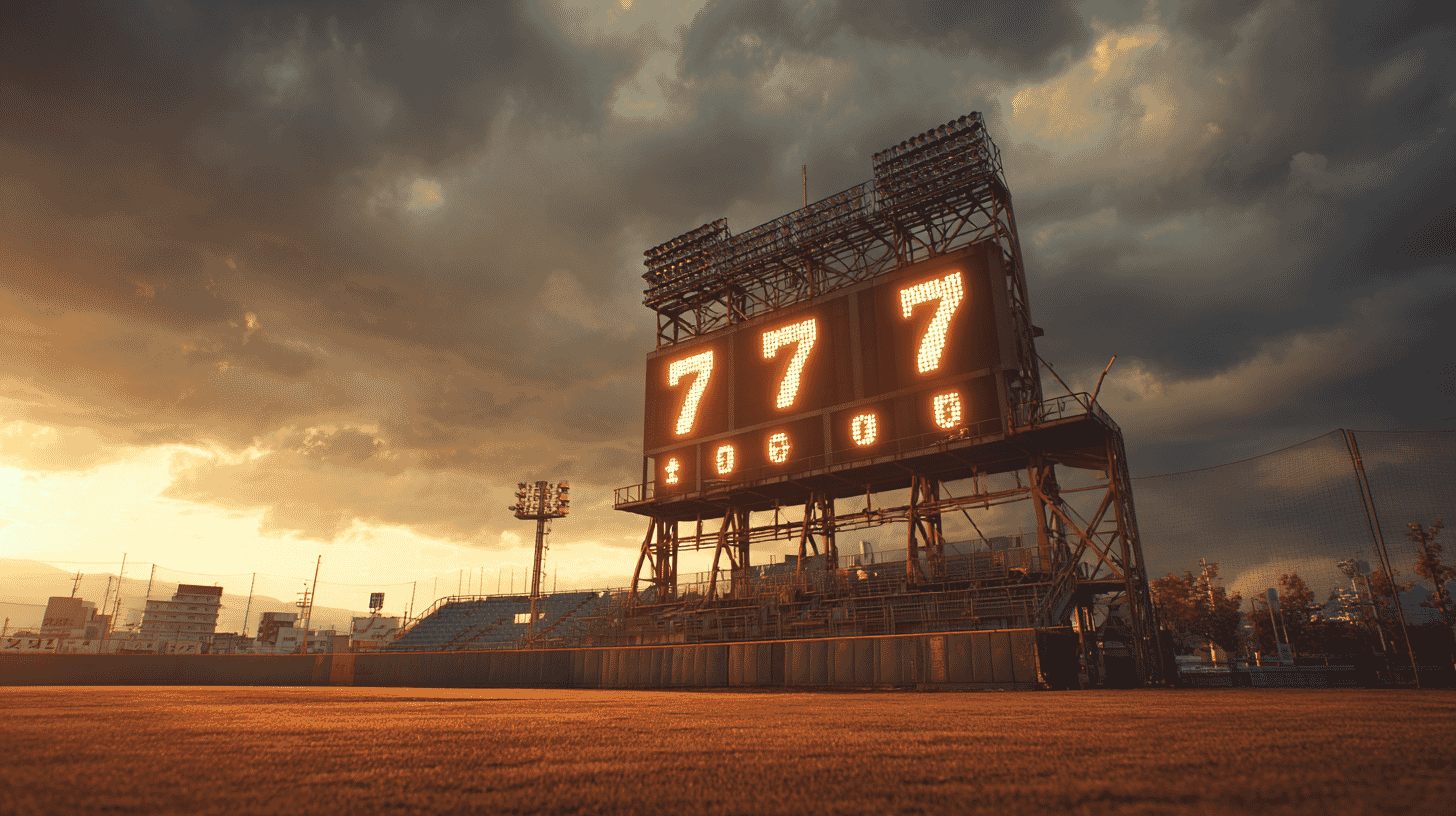
"Baseball is nine innings." That assumption, held for more than a century, is being shaken. Japan's national high school baseball federation is considering a seven-inning format, and 70% of its member schools oppose it. Yet summers grow hotter every year and the health risks to players keep rising. Here is a full look at a sport caught between tradition and safety.
Why Seven Innings, and Why Now?
On December 5, 2025, the Japan High School Baseball Federation held a board meeting in Osaka and received the final report of its study group on seven-inning games and other challenges facing high school baseball. The report recommends adopting seven-inning games from the 100th commemorative spring Senbatsu tournament in 2028 onward.
The study group was launched in January 2025 and met ten times. Behind its discussions lies a combination of problems facing high school baseball.
The first is the worsening heat. At the summer Koshien tournament in recent years, days above 35°C have become common, and the risk of heatstroke for players and cheering sections rises every year. In summer 2025 the split morning-and-evening schedule was expanded to 19 games, but that has not solved the problem.
The second is shrinking and polarising team rosters. With Japan's falling birth rate, the number of high school players keeps declining, and more schools enter tournaments as combined teams because they lack players. For small squads, a nine-inning game is a heavy physical burden.
The third is the reform of teachers' working hours, which cannot be ignored. Long games weigh heavily on coaches and umpires, and a sustainable way of running tournaments is needed.
The Global Trend: Seven Innings Is Becoming the International Norm
Another reason the federation is considering the change is alignment with international standards.
In fact, in baseball-loving countries such as the United States, South Korea, Taiwan and Australia, seven-inning games are common at high school level and below. Under the rules of California's high school sports federation, all high school baseball games are played over seven innings.
The WBSC U-18 Baseball World Cup also uses seven innings. At the tournament held in Okinawa in September 2025, Japan played under that format and finished runner-up after losing the final 0-2 to the United States.
In other words, Japanese high school baseball, with its nine innings, is actually the exception worldwide.
The Case For: "For the Players' Future"
Supporters of seven-inning games mainly cite the following reasons.
Lower heatstroke risk: Shorter games reduce the risk of heatstroke, which tends to strike late in a game. Two fewer innings make a big difference for players under a blazing sun.
Protecting pitchers' arms: High school pitchers today often throw close to 150 km/h, and the risk of injury is clearly higher than in the past. Fewer innings mean fewer pitches, protecting young pitchers with careers ahead of them.
Consideration for small schools: Among schools with 20 or fewer players, support for seven innings is relatively high at 28.2%, showing the benefit for teams playing with few players.
More efficient tournaments: Shorter games also reduce stadium fees, easing the burden on financially stretched regional federations.
Sportswriter Ko Hiroo argues: "People who cling to nine innings just dislike change. Amateur baseball at high school level and below in the US, South Korea and Taiwan has all gone to seven innings. They did it for the players' future."
The Case Against: "The Essence of Baseball Will Be Lost"
Opposition, however, runs deep. In the federation's surveys, 70.1% of member schools and about 90% of the general public who responded opposed seven innings.
Losing late-game drama: Part of high school baseball's appeal lies in dramatic comebacks in the eighth and ninth innings. The drama of a comeback with two outs in the bottom of the ninth becomes harder to produce over seven innings.
Continuity with higher levels: University, corporate and professional baseball all use nine innings. Shortening only high school games raises concern about losing continuity with the next stages.
A break with past records: In a competition with more than a century of history, records built under nine innings could no longer be compared directly with those under seven.
Osaka Toin's head coach Koichi Nishitani has expressed opposition, and Takumi Kajisha, former head coach of Gifu Prefectural Commercial High School, has said that "there are things to do before seven innings. There is plenty to consider, such as introducing mercy rules at Koshien or the designated hitter."
Survey Results Reveal a Gap in Temperature
The three surveys conducted in 2025 show an interesting pattern.
In a general monitor survey by a research company, 35.9% were in favour and 25.0% against, so supporters narrowly outnumbered opponents. Women in every age group were more likely to be in favour, most often citing heatstroke prevention.
Among member schools, however, the result was reversed: 20.8% in favour and 70.1% against. Among strong programmes with 61 to 80 players, 91.1% were opposed, with fewer chances to play the main concern.
The public submissions on the federation's website were even more extreme. Of 8,953 respondents, 768 were in favour and 7,923 against, meaning about 90% opposed.
Commenting on these results, an expert noted that "anonymous opinions tend to swing to extremes, and many respondents answered in binary terms without fully understanding the premises."
The 2025 National Sports Festival "Experiment"
In autumn 2025, the high school baseball event at the National Sports Festival in Shiga Prefecture used seven innings for the first time in history. It was positioned as an "experiment" ahead of full adoption.
In a survey of the participating teams, however, more than 60% said they were opposed, with comments such as "neither the players nor the supporters were satisfied" and "there are fewer chances to play."
On the other hand, tournament operations ran smoothly thanks to shorter games, and the advantages for completing several games in a single day became clear.
Will the Sacred Ground of Koshien Change?
One issue this debate cannot avoid is Koshien Stadium itself, the "sacred ground" of the summer tournament.
Many people suggest simply changing the season to beat the heat, or using the Kyocera Dome. Reality is not that simple.
The federation does not pay to use Koshien Stadium; the tournament is held there through the goodwill of Hanshin Electric Railway. Putting a dome over Koshien or holding the tournament elsewhere would be hard to finance. The co-organisers, the Asahi Shimbun and Mainichi Shimbun, are also shrinking their print businesses and would struggle to make large investments.
The report states that "from a historical and social standpoint, it is desirable to continue holding the spring and summer national tournaments at Koshien," and treats seven innings as a measure that can be taken within that premise.
What Comes Next
At its December 5 meeting, the federation did not reach a conclusion. Chairman Kaoru Takara said the board would "continue to discuss the contents of the report."
Pushing the change through against such strong opposition would cause confusion. Yet heat countermeasures cannot wait, and doing nothing is not an option either.
The report stresses the importance of "widely communicating the intent and effectiveness of adopting seven innings." The federation needs to act carefully and quickly at the same time.
Japanese high school baseball stands at a crossroads as it faces more than a century of tradition and looks toward the next hundred years.
Update: At its February 20, 2026 board meeting, the federation decided that the 108th National High School Baseball Championship that summer would be played over nine innings as usual. Saying it respects the report, it held exchanges with experts and coaches and briefing sessions in nine regions from April to June. At its July 31 meeting it said that "sufficient understanding has not yet been achieved" and that it would continue explaining and discussing the proposal. (Added September 2026)
How does your country balance protecting young athletes' health with preserving tradition?
References
- https://www.jhbf.or.jp/topics/info/251205_2.html
- https://www.jhbf.or.jp/questionary/
- https://www.nikkei.com/article/DGXZQOKC05A2O0V01C25A2000000/
- https://www.hb-nippon.com/articles/3238
- https://toyokeizai.net/articles/-/931579
- https://news.yahoo.co.jp/articles/771edcf509888207d3b0559ace8945b54a180dd0
- https://number.bunshun.jp/articles/-/868729







Global Discussion
0 comments