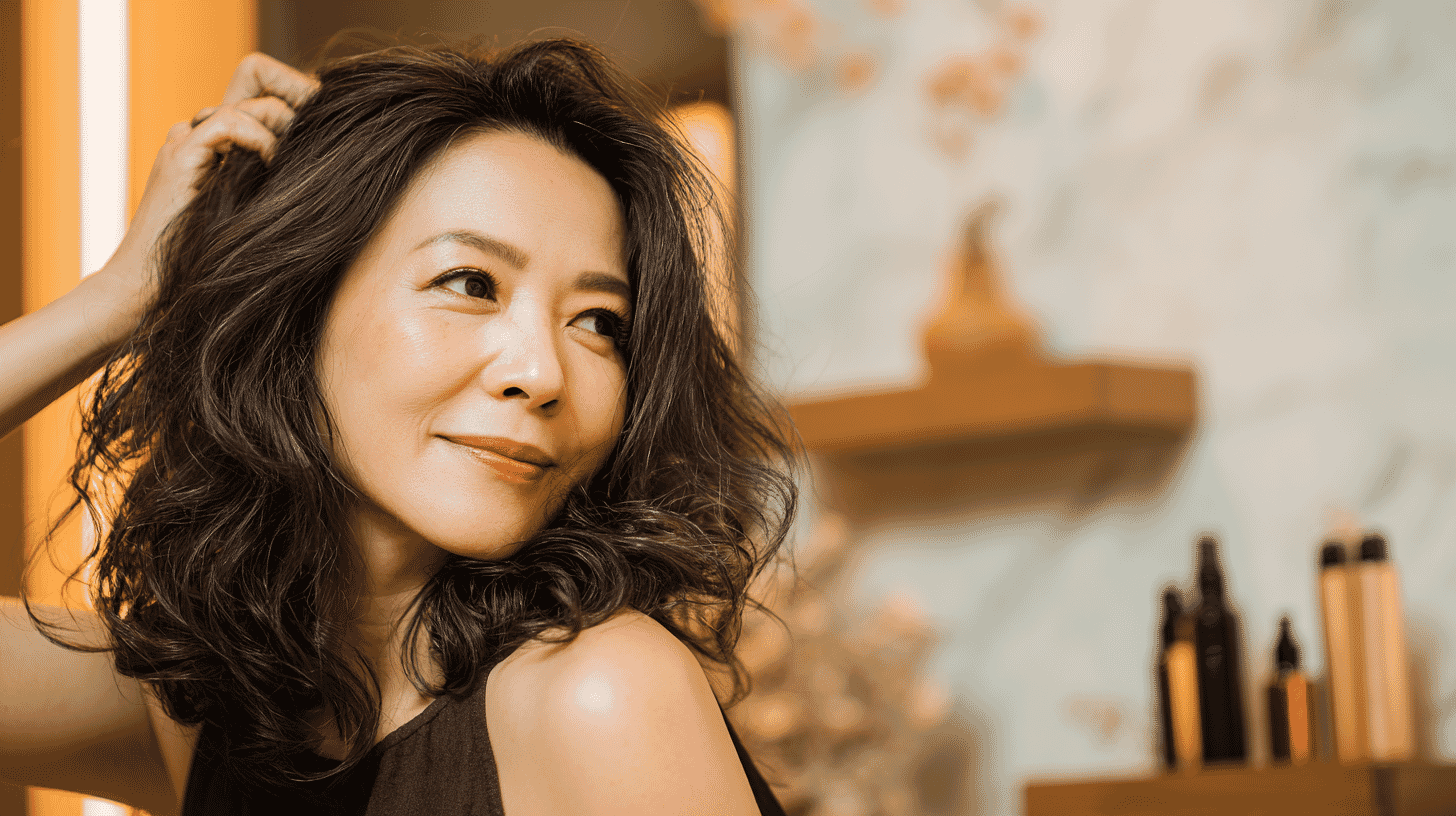
💇‍♀️ A Beauty Salon That Doesn't Cut Hair? If you're over 40, you may have noticed your hair getting curlier, more prone to frizz, or harder to manage. A revolutionary new salon concept has arrived in Osaka's Dojima district— one that focuses entirely on care rather than cutting. Here's how this innovative business model is changing the beauty game in Japan.

What Is a "No-Cut Salon"? A New Business Model Emerges

In Dojima, one of Osaka's central business districts, a salon with an unconventional concept has recently opened its doors. Its defining feature? Targeting customers over 40 with curly hair concerns, it deliberately avoids cutting as a main service, instead focusing exclusively on hair quality improvement and specialized care.

While typical salons center their menus around "cut + color" or "cut + perm" combinations, this establishment has made the bold choice to skip cutting entirely. Instead, they concentrate on internal hair repair, scalp care, and styling guidance that helps clients embrace their natural texture.

Why Target "40+ with Curly Hair"?

The Universal Challenge of Aging Hair

Around age 40, many people begin noticing significant changes in their hair texture. Those who had straight hair in their youth may develop waves or curls, while naturally curly hair often becomes more pronounced. This is attributed to hormonal changes and shifts in hair follicle shape that occur with aging.

The "Anti-Straightening" Movement

Among those who have relied on Japanese straightening treatments (known as "shukumo kyosei") for years, fatigue is setting in. The cumulative damage from repeated treatments, combined with the ongoing time and financial commitment, has led many to seek alternatives.

In recent years, Japan's beauty industry has embraced a new philosophy: rather than fighting curly hair, work with it. Specialized cutting techniques and styling approaches that make curly hair look intentionally beautiful have gained significant traction.

This new "no-cut salon" takes this trend even further, making the bold statement that cutting isn't necessary at all. For those hesitant about haircuts or simply wanting to understand their natural hair better, it offers an intriguing new option.

Key Services Offered

1. In-Depth Consultation

First-time visitors receive consultations significantly longer than typical salon appointments. This includes hair quality diagnosis, treatment history review, daily care habits assessment, and discussion of long-term hair goals. Each client receives a customized care plan tailored to their specific needs.

2. Hair Quality Improvement Treatments

The salon offers acid-heat treatments, keratin treatments, and other services that restructure hair from within. Rather than chemically straightening curly hair, the goal is to restore hair's natural health, thereby reducing frizz and unmanageability organically.

3. Home Care Education

Services extend beyond the salon chair. Clients receive detailed guidance on at-home care—from selecting appropriate shampoos and conditioners for curly hair, to proper blow-drying techniques, to effective styling product use. This ensures beautiful hair is maintained between visits.

4. Styling Lessons

One-on-one instruction teaches clients how to style their curly hair attractively. The focus is on techniques that are quick and easy enough to replicate during busy mornings, practiced hands-on during the appointment.

Japan's Beauty Industry: The Rise of Niche Specialization

This "no-cut salon" exemplifies a broader trend in Japan's beauty industry: hyper-niche specialization.

Japan has approximately 250,000 beauty salons—roughly five times the number of convenience stores—creating intense competition. To survive in this crowded market, many salons are carving out distinctive specialties. "Curly hair specialists," "hair quality improvement experts," and "40+ focused" salons represent this strategic pivot.

In Tokyo's upscale Omotesando and Ginza districts, curly hair specialists have emerged with waiting lists stretching months into the future. In Osaka, the "Curly Hair Science Lab" in Tennoji has developed its proprietary "FUSE CUT" technique, attracting clients who travel significant distances for appointments.

The Dojima "no-cut salon" represents the next evolution of this trend, and has captured attention from both within and outside the industry.

What Mature Clients Really Want: Comfort and Understanding

Salons targeting the 40+ demographic recognize that technical skill alone isn't enough—the overall experience matters tremendously. Many in this age group find the energetic atmosphere of youth-oriented salons uncomfortable. They seek calm interiors, private or semi-private spaces, and attentive service.

Additionally, many clients struggle to communicate their wishes effectively or find themselves with inconsistent results from visit to visit. To address this, an increasing number of salons have adopted one-on-one systems where a single stylist handles everything from consultation to final styling.

Future Outlook and Challenges

The "no-cut salon" concept remains novel in Japan. While it's attractive for those wanting to grow their hair out or approach cutting cautiously, those requiring regular trims would need to visit a separate salon for that service.

Furthermore, specialized hair quality improvement and care treatments tend to require longer appointment times, likely resulting in higher prices than typical salons. Nevertheless, as a destination that "takes hair concerns seriously," this concept appears poised to meet a genuine need among mature consumers.


In Japan, approaches like "curly hair care for those 40+" and "building healthy hair without straightening treatments" are gaining momentum. How does your country address hair texture changes that come with aging? Is embracing curly hair popular where you live? We'd love to hear about beauty trends in your country!

References

Reactions in Japan

A no-cut salon!? As someone in my 40s with curly hair, I'm super curious. I want to quit straightening treatments but haven't had the courage... It would be great to consult somewhere like this.

I agree 0
I disagree 0

A new salon opened in Dojima. No cutting is pretty innovative, but it might be good for people growing their hair out. I need cuts though, so I'd have to use both.

I agree 0
I disagree 0

The era of embracing curly hair has arrived. In my 20s I got so many straightening perms, but after 40 I gave up... I want to get proper care at a salon like this.

I agree 0
I disagree 0

A no-cut salon means you still need to get cuts elsewhere, right? Then how is it different from a treatment-only salon... The concept is interesting though.

I agree 0
I disagree 0

Hair quality improvement salons are increasing, but specializing in 40+ is rare. If they look at everything including aging care, I'd want to go even if it's a bit expensive.

I agree 0
I disagree 0

As a hairstylist, this is an interesting business model. Not cutting means lower turnover, but you can charge more per customer and probably increase repeat rates.

I agree 0
I disagree 0

I'm in my 50s and finally have time for my own hair after raising kids. I've been getting straightening treatments for 25 years but I'm exhausted. Having this option is a relief.

I agree 0
I disagree 0

Honestly, isn't this too niche? I wonder if this business model can work in Dojima. Considering downtown rent, they might need to attract a broader clientele.

I agree 0
I disagree 0

The styling lessons sound interesting! I struggle with my curly hair every morning, so I want to learn from a pro. Focusing on services other than cutting is new.

I agree 0
I disagree 0

I wonder how much it costs. Hair quality improvement often costs over 10,000 yen, and with long consultations it might be even more. But for people seriously struggling, it might be worth it.

I agree 0
I disagree 0

Curly hair is normally accepted overseas, but Japan has had too strong a straight hair obsession. It feels like the era of diversity has finally arrived.

I agree 0
I disagree 0

I was really struggling after suddenly getting curly hair in my 40s. It's hard to consult at salons for young people, so age-specific salons are welcome.

I agree 0
I disagree 0

I like that they teach home care. Even when the salon makes my hair beautiful, it was pointless because I couldn't recreate it at home.

I agree 0
I disagree 0

I wonder if men with curly hair are also included? I'm a man in my 40s, and I think there are quite a few men struggling with curly hair. It seems aimed at women though...

I agree 0
I disagree 0

I'm happy this kind of salon is opening in Osaka. There are many curly hair specialists in Tokyo, but Kansai had few options.

I agree 0
I disagree 0

Voices from Around the World

Sarah M.

In America, curly hair was seen negatively for a long time, but recently the 'Curly Girl Method' has become popular and there's a movement to embrace natural curls. It's interesting that Japan is seeing a similar trend.

Emma L.

In the UK, we don't really see specialist salons for older women. Focusing on 40+ is a brilliant idea. Our hair concerns are completely different from younger people's.

Marie D.

In France, we have a culture that considers natural hair beautiful. The concept of focusing on care without cutting might be close to French values. It's good that Japan is moving in this direction.

Chen Wei

Hair quality improvement salons are increasing in China too recently. But I've never heard of a 'no-cut' concept. Japan is always good at creating niche businesses.

Kim Soo-yeon

In Korea, straight hair is still mainstream, and the idea of embracing curly hair isn't very common. I hope Japan's 'anti-straightening' movement spreads to Korea too.

Priya S.

In India, many people naturally have curly or wavy hair, but many still straighten it. A specialist salon for 40+ is a good idea. Our hair changes with age too.

Anna K.

In Germany, we tend to prioritize hairstyle (cut) over hair care, but hair concerns with aging are universal. I hope services like this spread more widely.

Jennifer T.

In Australia, curly hair specialist salons are increasing. But 'no-cut' is unusual. Focusing on consultation and home care guidance might be effective for improving hair long-term.

Maria G.

In Brazil, many people have curly hair. Recently, more people are doing the 'big chop' (cutting all damaged hair) and growing out natural curls. Japan's approach is lovely.

Sofia R.

In Spain, older women have established their own style and expect the same from salons. Specializing in 40+ is a good concept that meets such needs.

Lisa N.

In the Netherlands, we tend to prefer being natural, but there aren't many curly hair specialist salons. I'm impressed by Japan's creativity in niche businesses.

Michael H.

In Canada, we have a multicultural society with various hair types. But we rarely see salons specializing in 40+. It's an interesting business model.

Yuki T.

I'm Japanese living in America. Japanese straightening techniques are popular here, but embracing curly hair is still new in Japan. It's an interesting reversal.

Fatima A.

In UAE, the humidity makes managing curly hair difficult. If there were salons like this in Japan, I think they'd be popular. Home care guidance is especially important.

Rachel P.

In South Africa, more people are enjoying Afro and curly hair naturally. I'm glad Japan is moving in the same direction. Loving your hair regardless of age is important.