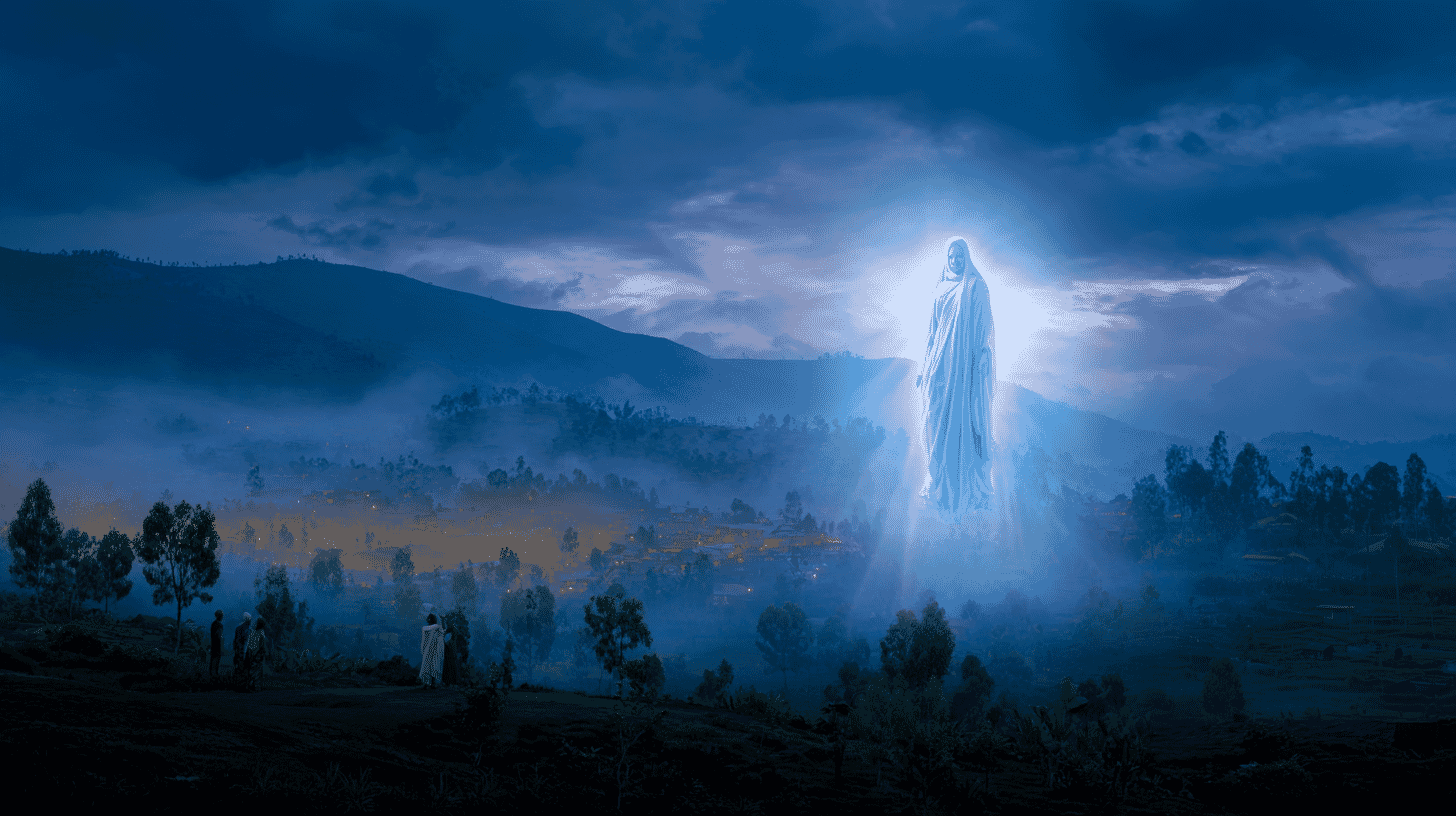
In January 2026, a small village in East Africa sparked global attention when two children claimed to have seen the Virgin Mary. Of the more than 1,500 reported Marian apparitions worldwide, only 18 have been officially recognized by the Vatican. One of those rare approved cases happened in the same country, Rwanda, about 45 years ago, at a place called Kibeho, where visions allegedly foretold the 1994 genocide. Is this new apparition the real thing?
The Incident in Musanze
On January 16, 2026, something extraordinary was reported in Gataraga Sector, Musanze District, in northern Rwanda.
Two Primary Four students, a boy and a girl, from Rwinzovu Integrated School claimed they had seen the Virgin Mary while walking home from school. According to their testimony, a figure of Mary holding the infant Jesus appeared first on an electricity pole, then near a tree. Both figures were reportedly wearing crosses.
The news spread like wildfire through social media and word of mouth. By the morning of January 17, thousands of people from across the country had descended on the site. Crowds gathered, singing hymns, praying, and some even spending the night in hope of witnessing the miracle themselves.
Some claimed to have seen a figure resembling the Virgin Mary. Others left disappointed, having seen nothing unusual.
Official Response from Authorities and the Church
Local authorities acted swiftly to manage the crowds and ensure public safety.
Musanze Mayor Nsengimana Claudien visited the site and stated: "We found more than a thousand people gathered, but there was nothing unusual observed. This story is not true. It is a rumour."
Due to safety concerns from the continued influx of crowds, the Rwanda Energy Group (REG) removed the electricity pole mentioned in the children's account.
The Catholic Church also responded promptly. Father Jean Bosco Nambaje, Parish Priest of Busogo Parish which oversees the area, called for calm and discernment among the faithful.
"Our faith is rooted in Sacred Scripture, Church teaching, and tradition, not unverified claims," he stated.
Father Nambaje emphasized that the Virgin Mary, in recognized apparitions, has never appeared to thousands of people simultaneously without delivering a clear message.
The verification of apparitions, he explained, is not determined by individuals or popular belief but follows a strict and lengthy process guided by Church doctrine.
Kibeho: Africa's Only Vatican-Approved Apparition Site
Rwanda is home to one of the rarest phenomena in Catholic history: a Vatican-approved Marian apparition site. It's called Kibeho, located in Nyaruguru District in the southern part of the country.
On November 28, 1981, 17-year-old Alphonsine Mumureke, a student at Kibeho High School, was serving food to fellow students when she reported seeing a beautiful woman who identified herself as "Nyina wa Jambo" (Mother of the Word), the Virgin Mary.
Initially, Alphonsine faced ridicule and disbelief. She was called mentally disturbed or possessed by evil spirits. But soon, two other students, Nathalie Mukamazimpaka and Marie Claire Mukangango, reported similar visions. The phenomena continued from 1981 to 1989.
The Virgin Mary reportedly asked them to repent, pray, and spread the Rosary of the Seven Sorrows. Then, on August 19, 1982, all three girls were shown a terrifying apocalyptic vision: rivers of blood, people killing each other, unburied corpses, a burning tree, and decapitated bodies.
Twelve years later, this nightmarish vision became reality. The Rwandan genocide of 1994 claimed over 800,000 lives in approximately 100 days. Kibeho itself became the site of two massacres. Marie Claire, one of the original three visionaries, was killed during the genocide along with her husband.
On June 29, 2001, after more than two decades of investigation, Bishop Augustin Misago of Gikongoro officially declared the apparitions to the three girls authentic. This remains the only Vatican-approved Marian apparition in Africa.
Today, Kibeho attracts nearly half a million pilgrims annually. An estimated 85,000 visited during the 2024 Assumption of Mary celebrations. The Rwandan government has designated Kibeho as a religious tourism hub under its Vision 2050 national development plan.
Vatican's New Guidelines for Evaluating Supernatural Phenomena
Reports of Marian apparitions continue worldwide. The Catholic Church has recorded more than 1,500 such reports throughout history, but only 18 have received official Vatican recognition.
In May 2024, the Vatican's Dicastery for the Doctrine of the Faith published new guidelines for discerning Marian apparitions and other supernatural phenomena. Cardinal Fernández explained that the document provides "clear guidelines and norms for discerning supernatural phenomena."
Under these new standards, the credibility and mental health of witnesses are carefully examined. Investigators assess whether the alleged visionaries might be seeking fame or financial gain. The recognition process typically takes decades.
Should the Church decide to investigate the Musanze incident, it would follow these newly established criteria.
Why Do Marian Apparitions Captivate People?
Why do reports of the Virgin Mary's appearance move people so deeply?
In Rwanda, where Christians make up over 80% of the population, devotion to the Virgin Mary runs especially deep. As a symbol of maternal love, sorrow, and sacrifice, Mary often feels more approachable than abstract theological doctrine.
Notably, Marian apparitions frequently occur in poor regions or conflict zones: Kibeho, Lourdes in France, Fátima in Portugal. For those suffering, the Virgin Mary's appearance represents hope.
However, the Church maintains a cautious stance. "Faith does not depend on miracles or apparitions," is the official position. Church authorities worry that unverified claims may distort genuine faith.
What Happens Next?
Calm has returned to Musanze. Church and government authorities have issued a unified message to the public: avoid speculation, prioritize safety, and await official guidance.
The Diocese of Ruhengeri is expected to review the reports and provide guidance to the faithful. However, as the Kibeho precedent shows, even if an investigation is conducted, reaching a conclusion may take many years.
Will Musanze become the next Kibeho? The answer likely won't come for decades.
In Japan, the "Our Lady of Akita" phenomenon, in which a statue of the Virgin Mary reportedly shed tears 101 times, is well known; in 1984 the local bishop of Niigata issued a pastoral letter recognising it as supernatural.
How are miraculous religious phenomena perceived in your country? How do people interpret events that science cannot explain?
References
- https://www.ktpress.rw/2026/01/alleged-virgin-mary-apparition-in-northern-rwanda-draws-crowds-reignites-church-debate/
- https://web-mu.jp/paranormal/66487/
- https://en.wikipedia.org/wiki/Our_Lady_of_Kibeho
- https://www.catholicnewsagency.com/news/248419/meet-our-lady-of-kibeho-the-only-approved-marian-apparition-in-africa
- https://www.atlasobscura.com/articles/rwanda-kibeho-marian-apparition








Global Discussion
16 comments