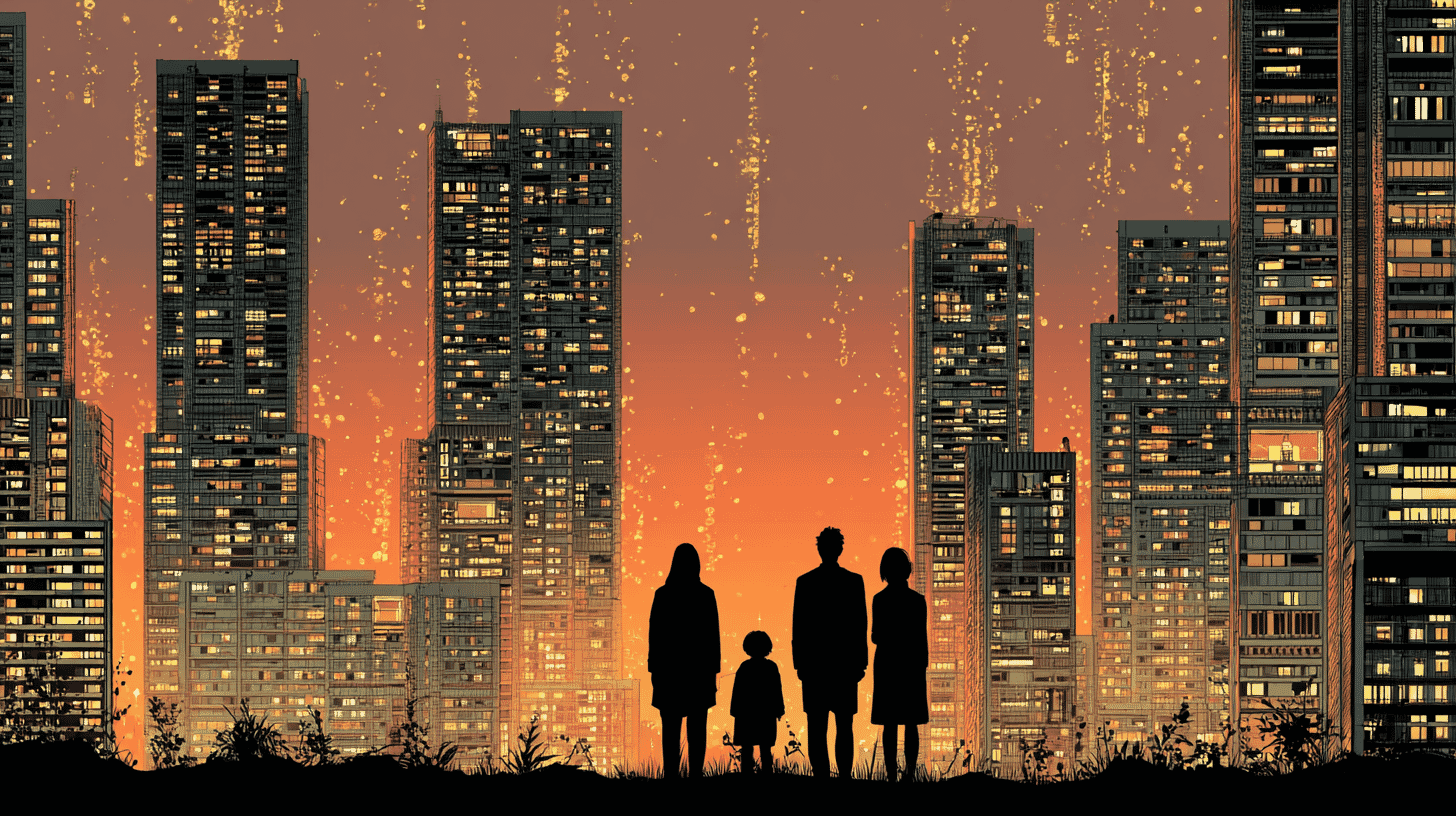
The old rule of thumb that rent should be 30% of your income has become a relic of the past in Tokyo. Family apartments in the capital now average ¥250,000 per month (about $1,700), consuming nearly 50% of disposable income. Meanwhile, 45% of young adults in their 20s express interest in rural migration, and families with children are fleeing to the suburbs at an accelerating pace. A quiet revolution in where, and whether, people can afford to live is reshaping Japan's capital.
When Half Your Paycheck Goes to Rent
Housing costs in Tokyo's 23 special wards have reached unprecedented levels.
According to data from At Home, a major real estate information service, the average asking rent for family-sized apartments (50-70 square meters) reached approximately ¥250,000 per month in 2025, a roughly 10% increase from the previous year, continuing a rapid upward trend.
What makes this especially alarming is the relationship between rent and income. When compared to the average monthly disposable income of dual-income households in Tokyo (approximately ¥620,000), rent now accounts for about 40%, and some estimates put it close to half for certain properties and households.
The conventional wisdom that "rent should stay under 30% of take-home pay" was long considered the golden rule of household budgeting. But since 2023, Tokyo's 23 wards have blown past this threshold. By 2024, the ratio had reached 34.1% and continues climbing.
Even single-person studio apartments aren't immune: average rents have exceeded ¥100,000, with some property categories recording a staggering 29% year-over-year increase.
What's Driving the Rent Explosion?
The primary culprit behind soaring rents is the historic spike in condominium prices.
The average price of a new condominium in Tokyo's 23 wards now exceeds ¥150 million (roughly $1 million), while even used units approach the ¥100 million mark. Dual-income "power couples" who might once have purchased property now find "oku-man" (hundred-million-yen units) out of reach, or hesitate to buy amid concerns that prices may have peaked.
The result: a surge in rental demand from those who "can't buy, so they rent." As higher-income households flood into the rental market, they're driving up prices across the board.
The effect is most pronounced in the central three wards (Chiyoda, Chuo, and Minato) and redeveloped Shibuya, where 2LDK apartments in Minato Ward average over ¥400,000 monthly. The gap between Minato (most expensive) and Edogawa (least expensive) is roughly ¥286,000, a 3.3x difference.
Even formerly "affordable" outer wards like Nerima and Adachi have seen their floor prices rise. Across all 23 wards, the bottom end of the market is shrinking rapidly, leaving fewer and fewer budget options.
The Danger of "Thin Ice" Household Finances
When half your disposable income goes to housing, the problem extends far beyond an inability to save.
Healthy household finances require resilience, a buffer against unexpected events like illness, job loss, childcare needs, or elderly parent care. When fixed costs are this heavy, any shock can send the entire household budget into freefall.
The result is a growing class of what might be called the "high-income poor," people whose salaries look impressive on paper but who live with no margin for error. Career changes, entrepreneurship, decisions about having children, moving closer to aging parents. All these life choices become constrained by housing costs.
Some observers note that urban living is shifting from a symbol of prosperity to something closer to confinement.
Families with Children Are Fleeing Tokyo
In response to these pressures, families in their 30s and 40s are accelerating their exodus from Tokyo's 23 wards.
According to the Ministry of Internal Affairs and Communications' population migration report, while young adults aged 15-29 continue to move into Tokyo for education and employment, those aged 30-49 (the child-raising generation) and children aged 0-14 are experiencing net outflows.
Popular destinations include the "30-minute from Tokyo" zone: Kawasaki and Yokohama in Kanagawa Prefecture, Saitama City and Kawaguchi in Saitama, and Ichikawa and Urayasu in Chiba. However, as prices in these suburban areas have also risen, families are now moving further out to the "40-50 kilometer radius" zone.
The 2024 rankings for child-age population (0-14 years) net inflow show suburban cities like Machida, Kashiwa, Hachioji, Chigasaki, Inzai, and Ebina at the top. Meanwhile, 14 of the 20 areas with the largest net outflows are in Tokyo's 23 wards.
A new population movement pattern, from inner suburbs to outer suburbs, is emerging as families give up on central Tokyo housing and accept longer commutes in exchange for better value and child-rearing environments.
Nearly Half of Young Adults Consider Rural Migration
Among younger generations, interest in a more fundamental departure from Tokyo is growing.
The Ministry of Land, Infrastructure, Transport and Tourism's 2024 Metropolitan Area White Paper found that 44.8% of Tokyo-area residents in their 20s expressed interest in moving to rural areas, significantly higher than the 35.1% average across all age groups.
A survey by Trustbank's Regional Revitalization Lab found that 45.6% of young people aged 15-29 "long to live in rural areas." Top reasons included "attracted to slow rural lifestyles" (49.0%), "wanting to escape urban hustle" (32.9%), and "seeking a fresh start" (29.5%).
Popular migration destinations are led by Hokkaido, followed by Gunma, Shizuoka, Tochigi, and Nagano prefectures. The North Kanto region has seen particularly notable growth in popularity.
However, the biggest barrier to actual migration remains "work and income." Whether suitable jobs with acceptable salaries exist in rural areas is the decisive factor for most potential movers.
How Remote Work Changed the Equation
The spread of remote work since the COVID-19 pandemic has been a key driver of interest in rural migration.
Once it became normal for many workers to do their jobs from anywhere, the fundamental question arose: why pay Tokyo prices if you don't have to be there? For those in fully remote positions, living in a lower-cost rural area while earning a Tokyo salary has become a realistic option.
The government has supported this trend with subsidies of up to ¥1 million for those who move to rural areas while continuing Tokyo-based remote work, and up to ¥3 million for those starting IT businesses in regional areas.
That said, remote work isn't possible in all industries. For many whose jobs require physical presence, living in or near Tokyo remains a necessity. Whether rural migration is even an option varies dramatically by profession and sector.
The Paradox: Tokyo's Gravitational Pull Remains
Curiously, despite all this interest in leaving Tokyo, the capital region (Tokyo, Saitama, Chiba, and Kanagawa) continues to experience net population inflow.
The 2024 population migration report showed net inflows to the Tokyo metropolitan area exceeding 130,000 people. A decade after the government launched its "regional revitalization" initiative, Tokyo's concentration continues unabated.
Particularly striking is the flow of women to Tokyo. Of the 40 prefectures experiencing net outflows, 32 saw more women than men leaving. Young people, especially young women, continue leaving rural areas for Tokyo upon entering higher education or the workforce.
Analysis points to the relative lack of attractive jobs in rural areas, gender-based pay gaps, and persistent traditional gender role expectations as contributing factors. Creating regions that people actively choose requires not just migration support policies but fundamental reform of local workplace cultures.
Housing Is a Global Urban Crisis
Tokyo's housing cost surge is part of a worldwide phenomenon.
New York's average rent runs about ¥550,000 monthly ($3,783), and cities like Hong Kong and Singapore often exceed Tokyo's price levels. London, Sydney, Vancouver, and Seoul: major cities around the world are simultaneously experiencing the phenomenon of younger generations being priced out of housing markets.
What distinguishes Japan is the relative weakness of tenant protections and the scarcity of social housing. Many European countries have rent control systems and social housing programs that allow even lower-income residents to live in city centers. Japan's safety net in this regard is comparatively underdeveloped.
Moreover, in a country facing population decline and aging, accelerating concentration in Tokyo risks hastening the disappearance of rural communities and poses structural challenges to national sustainability.
Rethinking What It Means to "Live"
The reality that rent in Tokyo's 23 wards is approaching 50% of disposable income is more than just a statistical milestone.
It represents a fundamental question about life choices: where to live, how to work, how to spend one's life. It forces us to reconsider the relationship between cities and regions, intergenerational inequality, and the essential purpose of housing.
Families fleeing to suburbs, young people dreaming of rural life, yet unstoppable concentration in Tokyo: these intertwined phenomena may signal that Japanese society is in the midst of a profound reassessment of what it means to "live" somewhere.
Japan is experiencing simultaneous trends of urban housing cost surges and growing interest in rural migration. Does your country face similar dynamics? What's the situation where you live?
References
- https://biz-journal.jp/economy/post_393147.html
- https://www.nikkei.com/article/DGXZQOUA074S60X00C26A1000000/
- https://toushi.homes.co.jp/column/research/regional_market/market38/
- https://www.nikkan-gendai.com/articles/view/life/356646
- https://www.trustbank.co.jp/newsroom/newsrelease/press841/
- https://www.jiji.com/jc/article?k=2025013100933







Global Discussion
16 comments