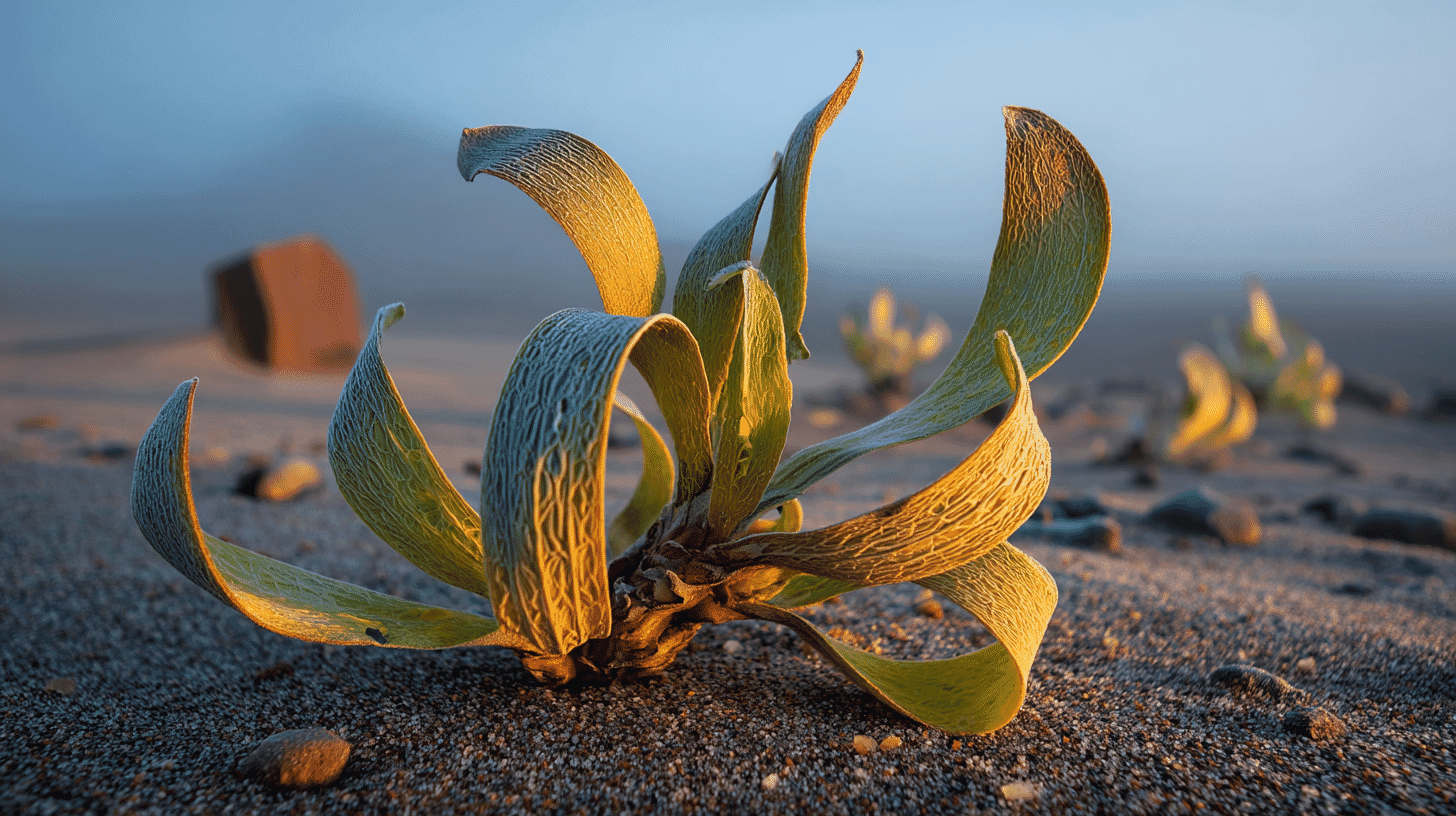
Japan's Tsukuba Botanical Garden, operated by the National Museum of Nature and Science, has pulled off the artificial pollination of Welwitschia mirabilis, known in Japan as "Kisoutengai" (meaning "beyond imagination"). Seeds were collected in December 2025, and Yomiuri Shimbun and other outlets reported the result on January 12, 2026. A plant placed in the greenhouse in 1992 flowered for the first time after 33 years, setting the whole thing up.
Welwitschia grows only in Africa's Namib Desert. The species as a whole has not been evaluated on the IUCN Red List, but it is protected by law where it grows, and climate change is expected to shrink its range. Often called a "living fossil," this plant has fascinated scientists for over 160 years due to its extraordinary biology. The successful pollination represents a significant step forward in the conservation and research of this rare species.
What is Welwitschia?
Basic Information
Welwitschia mirabilis is a gymnosperm belonging to the family Welwitschiaceae. It holds the unique distinction of being a "one family, one genus, one species" plant, there are no other living relatives in its taxonomic family.
The plant was first discovered by Austrian botanist Friedrich Welwitsch in 1859 in the Namib Desert of Angola. When he first encountered it, he reportedly knelt down on the burning sand and simply stared in disbelief. The Japanese name "Kisoutengai" (奇想天外), meaning "beyond all imagination," perfectly captures the plant's bizarre appearance. It is the national flower of Namibia and even appears on the country's coat of arms.
Extraordinary Biology
The most remarkable feature of Welwitschia is that it produces only two leaves throughout its entire lifetime. After germination, the plant develops two cotyledons followed by two true leaves, and never produces any more. These two leaves continue growing from their base throughout the plant's life, extending at a rate of approximately 13.5 centimeters per year.
In the wild, specimens have been documented with leaves reaching 1.8 meters in width and over 6 meters in length. As the leaves grow, the tips gradually die and the leaves split lengthwise due to wind and desiccation, sometimes giving the appearance of multiple leaves.
Carbon-14 dating has confirmed individuals over 2,000 years old, with some estimates suggesting that certain specimens may be as old as 3,000 years.
Adaptation to Extreme Conditions
The Namib Desert, where Welwitschia grows naturally, is one of the world's oldest deserts. It features extremely harsh conditions with annual rainfall of only 25-100 millimeters, and periods of over 150 days without any rain.
Welwitschia has no water-storing tissue of the kind cacti rely on. It survives by other means.
Deep Root System: The main taproot extends over 3 meters deep, accessing groundwater reserves far beneath the desert surface.
Fog Harvesting: The Namib Desert experiences frequent fog when the cold Benguela Current meets hot desert air. Welwitschia leaves have stomata on both surfaces and a thick cuticle layer that efficiently absorbs atmospheric moisture.
CAM Photosynthesis: The plant uses Crassulacean Acid Metabolism (CAM), absorbing carbon dioxide at night while keeping stomata closed during the day. This is extremely rare among gymnosperms.
Challenging Reproduction
Welwitschia is dioecious, meaning male and female reproductive structures occur on separate plants. It takes approximately 25 years for a plant to reach reproductive maturity. Pollination is primarily achieved through wind and insects, particularly bugs from the family Pyrrhocoridae.
Female plants produce 10,000 to 20,000 winged seeds annually, but most become infected with Aspergillus fungus and die. Seeds require at least 12.5 millimeters of rainfall and 3-21 days of moisture to germinate. Such conditions occur in the Namib Desert perhaps once every 50 years, resulting in extremely low natural reproduction rates.
The Successful Pollination at Tsukuba
Background
Tsukuba Botanical Garden planted Welwitschia specimens in 1992 and has maintained them in the Savanna Greenhouse. While a male plant has flowered nearly every year, the female plant had never bloomed, until now.
In July 2025, after 33 years of cultivation, the plant finally flowered. The shape of the strobilus (cone-like reproductive structure) confirmed it was a female plant. This was the first female flowering at the facility.
The Pollination Process
Fortunately, male and female plants were positioned close together. Staff member Hiromi Kobayashi and her colleagues used tweezers to carefully transfer tiny pollen grains, just about 1 millimeter in size, from the male to the female plant every few days.
In natural conditions, wind and insects handle pollination, but in the controlled greenhouse environment, human intervention was necessary. With no precedent to follow, the team worked through uncertainty, unsure whether their efforts would succeed.
Seed Discovery
Past the middle of December 2025, the female plant began dropping seeds. Each was enclosed in a wing-like structure for wind dispersal and measured roughly 3 centimeters including the wing: proof that the artificial pollination had worked.
Speaking to reporters, Kobayashi said she had been anxious about whether the pollination had taken, given that there was no precedent to go on, and that she was very happy with the outcome.
Future Plans
The collected seeds will be used for propagation experiments at the garden and will also be shared with other research institutions.
Update: Garden Director Tomohisa Yukawa invited visitors, saying "It's extremely rare to see seeds. We're exhibiting them alongside the plant, so please come visit," and the seed-bearing female plant remained on display for some time. The garden has since sown the collected seeds and is waiting to see whether they germinate. (Added August 2026)
Conservation Significance and Future Challenges
Climate Change Threats
Recent research has raised serious concerns about climate change impacts on Welwitschia habitats. A 2021 study by Bombi and colleagues in the Journal of Arid Environments surveyed 1,330 plants in 12 stands in northern Namibia's Kunene region and projected that climate change would cut habitat quality by about 69 percent. Applying IUCN criteria to those populations, it assessed them as Endangered (EN). Other parts of the range lack the data for a similar assessment, and the species as a whole remains unevaluated on the IUCN Red List.
Importance of Ex-situ Conservation
Given these threats, the successful pollination at a Japanese botanical garden holds significant meaning for ex-situ conservation (conservation activities outside natural habitats). Establishing seed production and breeding techniques could contribute to protecting and potentially restoring wild populations in the future.
Where to See Welwitschia in Japan
Currently, the main facilities in Japan where visitors can observe Welwitschia include:
- Tsukuba Botanical Garden, National Museum of Nature and Science (Tsukuba, Ibaraki)
- Sakuya Konohana Kan (Osaka)
- Higashiyama Zoo and Botanical Gardens (Nagoya, Aichi)
- Fukuoka City Botanical Garden (Fukuoka)
- Yamashina Botanical Museum (Kyoto)
How does your country approach the conservation of "living fossils" like this one? Tell us about breeding programs at your botanical gardens, or how climate change and rare plants are being discussed where you are.
References
- https://news.yahoo.co.jp/articles/210dbab7d52444a2ad37b0ff7ef8a6a07d9fdcae
- https://tbg.kahaku.go.jp/
- https://en.wikipedia.org/wiki/Welwitschia
- https://www.nibb.ac.jp/plantdic/blog/?p=1095
- https://pza.sanbi.org/welwitschia-mirabilis
- https://www.kew.org/plants/welwitschia-mirabilis
- https://www.sciencedirect.com/science/article/abs/pii/S0140196321000951
- https://www.kew.org/plants/welwitschia-mirabilis







Global Discussion
15 comments