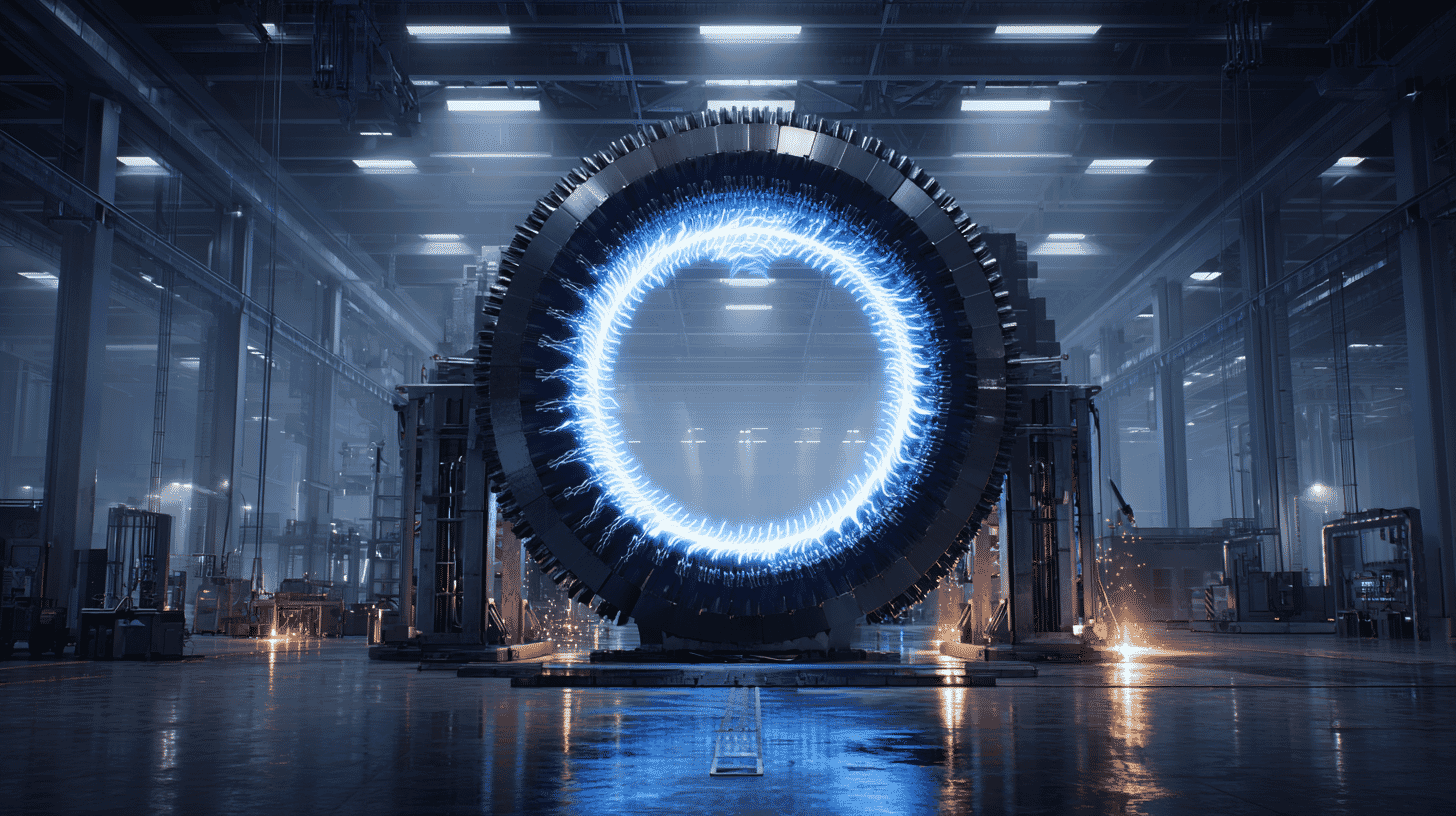
A Japanese startup and a 90-year-old manufacturer have joined forces on the grand dream of building a "sun on Earth" through fusion power. A one-of-a-kind machine, six meters tall and weighing 12 tons, could prove key to producing the energy of the future.
A Startup and a Legacy Manufacturer Team Up to Build the World's Only Fusion Coil Machine
On February 5, 2026, nuclear fusion startup Helical Fusion (headquartered in Chuo, Tokyo) and Sugino Machine, a precision machinery manufacturer founded in 1936 in Namerikawa, Toyama Prefecture, announced the completion of a specialized device for manufacturing high-temperature superconducting (HTS) coils, a core component of fusion reactors.
This one-of-a-kind machine stands approximately 6 meters (20 feet) tall, weighs 12 tons, and is designed to wind HTS cables into the complex spiral shapes needed for Helical Fusion's unique reactor design. The project began in 2023, with Sugino Machine's factory in Toyama Prefecture serving as the manufacturing site. The machine represents a fusion of Helical Fusion's innovative concepts and Sugino Machine's nine decades of precision engineering expertise.
What Is Fusion Energy?, Harnessing the Power of the Sun
Nuclear fusion is the process of merging light atomic nuclei, such as hydrogen, to form heavier elements, releasing enormous amounts of energy in the process. This is exactly how the sun generates its energy, which is why fusion power is often described as "creating a sun on Earth."
Fusion energy offers transformative advantages over conventional power sources. Its fuel, deuterium, derived from ordinary seawater, is virtually inexhaustible. The process produces zero CO₂ emissions, making it an ultimate solution for climate change. Unlike nuclear fission (used in today's nuclear power plants), fusion generates almost no long-lived radioactive waste. And unlike fission reactors, fusion carries virtually no risk of meltdown.
The catch? Achieving fusion requires heating fuel to over 100 million degrees Celsius to create a state of matter called plasma. Keeping this incredibly hot plasma stable and contained has been the central challenge for fusion scientists worldwide for decades.
The Helical Approach, Japan's 70 Years of Homegrown Fusion Science
There are several approaches to containing plasma for fusion. The most well-known is the "tokamak" design, a doughnut-shaped configuration used by ITER (International Thermonuclear Experimental Reactor), currently under construction in France with international cooperation.
Helical Fusion takes a different path. Their "helical" (heliotron) approach uses spiral-shaped coils to create a magnetic "cage" that traps plasma. This technology has been refined over more than 70 years at Japan's National Institute for Fusion Science (NIFS) in Toki, Gifu Prefecture, making it a distinctly Japanese contribution to fusion science.
The helical approach has a critical advantage: it doesn't require driving an electric current through the plasma itself. This enables steady-state operation, running 24 hours a day, 365 days a year, making it uniquely suited for commercial power generation. Helical Fusion claims their design can satisfy all three requirements for a commercially viable fusion power plant: net electricity output, steady-state operation, and maintainability.
Why High-Temperature Superconducting Coils Matter
In a fusion reactor, ultra-hot plasma must be suspended in mid-air using powerful magnetic fields to prevent it from touching the reactor walls. Superconducting coils generate these magnetic fields.
Conventional fusion devices like ITER use "low-temperature superconducting" materials (niobium-tin), which require cooling to around minus 269°C (about 4 kelvin) using expensive liquid helium. Helical Fusion instead uses "high-temperature superconducting" (HTS) technology, which can produce stronger magnetic fields in a more compact form. This allows the reactor to be significantly smaller, dramatically reducing construction and operating costs.
However, manufacturing HTS coils is extraordinarily difficult. Only a handful of companies worldwide have demonstrated this at scale, among them Helical Fusion, America's Commonwealth Fusion Systems (CFS), and the UK's Tokamak Energy. Adding to the challenge, the helical design requires winding coils into complex spiral shapes, a manufacturing hurdle that goes beyond what tokamak-type reactors demand.
What This New Machine Does, Paving the Way for "Helix HARUKA"
The newly completed coil manufacturing machine is purpose-built to precisely wind HTS cables into the spiral configurations needed for Helical Fusion's reactor. It leverages Sugino Machine's expertise in controlling large-scale machinery with high precision.
The coils produced by this machine will be installed in "Helix HARUKA," Helical Fusion's integrated demonstration device planned for completion around 2030. Helix HARUKA will generate and sustain actual plasma, serving as the proving ground before the commercial demonstration reactor "Helix KANATA," which aims to achieve the world's first practical fusion power generation.
The machine will be transported to the Helix HARUKA demonstration site, where coil assembly was expected to begin in mid-2026.
Helical Fusion's Journey So Far
Helical Fusion was founded in 2021, building on decades of research at NIFS. Led by CEO Takaya Taguchi, the team brings together rare expertise in full reactor design and component technology development.
Key milestones include the establishment of a dedicated joint research space at NIFS in March 2024, a Series A funding round of approximately 2.3 billion yen (about $15 million) in 2025, and selection for the Ministry of Economy, Trade and Industry's "J-Startup" program. The Ministry of Education has also provided roughly $13 million in grants for HTS technology development.
In October 2025, Helical Fusion announced a world first: successfully conducting an energization test of a large-scale HTS coil under conditions simulating the magnetic environment inside an actual fusion reactor. At minus 258°C, the coil carried a stable current of 40,000 amperes. CEO Taguchi said the achievement had put Japan at the forefront of the race toward practical fusion power.
Japan's Government Backs the Fusion Vision
The Japanese government is firmly behind fusion energy development. In June 2025, the "Fusion Energy Innovation Strategy" was revised to actively promote diverse approaches, tokamak, helical, and laser fusion, and to position Japan as a leader in building the global fusion supply chain.
For Japan, a nation with limited natural energy resources that imports the vast majority of its fossil fuels, fusion represents the ultimate energy security technology. With fuel derived from seawater, fusion could fundamentally free Japan from energy import dependence, a strategic imperative that gives the country powerful motivation to lead in this field.
The Global Fusion Race, Where Japan Stands
The global fusion race is accelerating. In the US, CFS has received investments of several billion yen from a consortium of 12 Japanese companies including Mitsui and Mitsubishi, and is building its experimental reactor "SPARC." The UK's Tokamak Energy continues developing its own HTS technology. Germany's Max Planck Institute operates "Wendelstein 7-X," the world's most advanced stellarator, a design closely related to the helical approach.
With over 50 fusion projects underway worldwide, Helical Fusion differentiates itself through Japan's unique helical technology and its claim that it can meet all three commercial viability requirements using technologies available today.
Japan's Manufacturing Heritage Powers the Fusion Future
What stands out in this announcement is how Japan's "monozukuri" (craftsmanship and manufacturing) tradition is supporting cutting-edge fusion technology. Beyond Sugino Machine, the ecosystem includes Fujikura supplying HTS wire, Ryoki Kingatsu Kogyo in Aichi developing coil cases, and Mitsui Kinzoku collaborating on blanket technology. Japan's deep industrial base is proving essential to making fusion a reality.
Sugino Machine CEO Gaku Sugino commented: "While this is no easy challenge given that fusion is unprecedented technology, we will tackle each obstacle with determination, drawing on 90 years of engineering expertise and fresh ideas."
Achieving commercial fusion power still requires overcoming numerous technical hurdles and investments on the order of hundreds of billions of yen. But the partnership between a bold startup and Japan's traditional manufacturing excellence represents a new model for how deep-tech innovation can emerge from Japan's unique industrial ecosystem.
Will the 2030s see Helix HARUKA light its artificial sun? Will Helix KANATA deliver the world's first practical fusion electricity? Japan is watching with great anticipation.
How far has fusion energy research progressed in your country?
References
- https://news.yahoo.co.jp/articles/735b47ea363ea37938659d8c6330ce3186f276ae
- https://www.nikkei.com/article/DGXZQOUC054190V00C26A2000000/
- https://prtimes.jp/main/html/rd/p/000000148.000070070.html
- https://global.helicalfusion.com/post/helical-fusion-completes-a-new-coil-manufacturing-machine-for-its-integrated-demonstration-device-in
- https://newswitch.jp/p/47369
- https://interestingengineering.com/energy/japan-fusion-startup-completes-coil-manufacturing








Global Discussion
15 comments