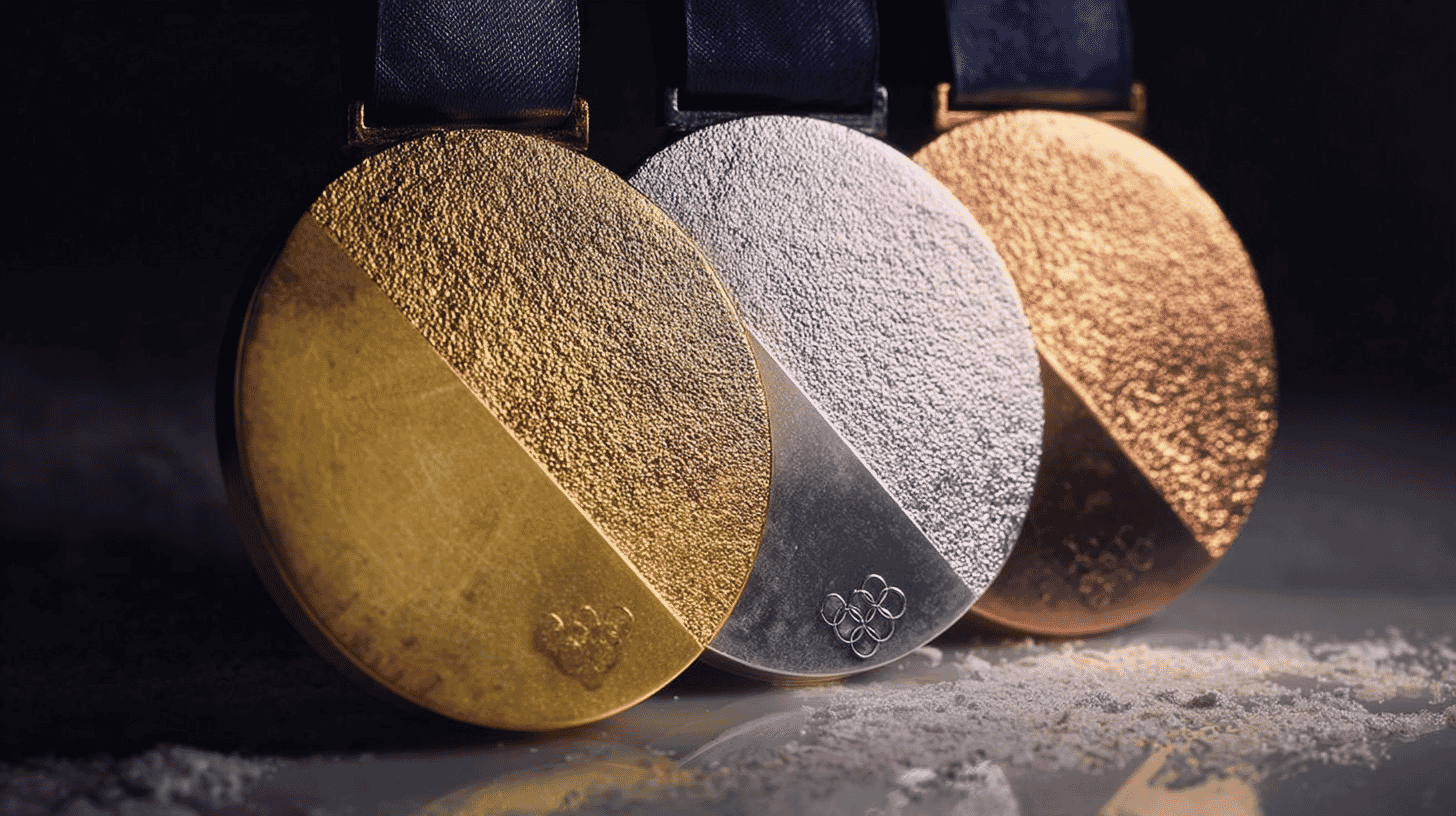
🏅 Every Olympics, the medal design becomes a topic of conversation. But the 2026 Milano Cortina Winter Games medals have sparked something more — a full-blown debate. "Why is there a line down the middle?" "Is that a chocolate coin?" "It's gorgeous!" Here's the story behind the single line dividing the world's opinions.
The Story Behind the "One Line"
The official medals for the 2026 Milano Cortina Winter Olympics were unveiled on July 15, 2025, at the historic Palazzo Balbi in Venice, Italy. Designed by a team led by Raffaella Paniè, the Brand, Identity and Look of the Games Director, and crafted by Italy's state mint (Istituto Poligrafico e Zecca dello Stato, or IPZS), the medals immediately caught the world's attention — though not everyone agreed on whether that attention was favorable.
The standout feature is a single diagonal line that divides the medal into two halves. One half has a granular, matte texture, while the other is mirror-polished. The Olympic rings sit at the junction of these two surfaces, and the reverse side features the event name and the Milano Cortina 2026 emblem.
The two-halves concept carries layered symbolism. It represents the union of Milan and Cortina d'Ampezzo — the first Olympics officially co-hosted by two cities. It symbolizes the bond between athletes and their support systems: coaches, teammates, families, and fans. And it draws from the Italian avant-garde art movement, expressing the idea of unity through constant motion and transformation.
"We conceived a medal that represents purity and a return to essence," explained Paniè. "We celebrate the strength found in difference: two unique halves that join through the Olympic and Paralympic symbols to deliver a bold and unified message."
Specs and Sustainability — Recycled Metal, Renewable Energy
Each gold medal weighs approximately 500 grams (about 1.1 pounds). Per Olympic Charter requirements, the base is sterling silver with at least 6 grams of pure gold plating. If made of solid gold at today's market price (roughly $110 per gram), each gold medal would be worth around $55,000.
What sets these medals apart is their environmental commitment. The metal comes from recycled manufacturing waste, all production energy is sourced from renewables, and the protective finish is eco-friendly, non-toxic, and fully recyclable.
In total, 1,146 medals were produced: 735 for the Olympics (245 each of gold, silver, and bronze) and 411 for the Paralympics (137 each).
A World Divided — "Beautiful" vs. "Boring"
The debate ignited when Jackie Redmond, a caster on TNT Sports' "NHL on TNT," posted images of the medals on X (formerly Twitter) with the caption "Beautiful, right!?"
Reactions flooded in, split almost evenly:
Admirers praised the medal's Italian elegance — "The silver one is gorgeous," "Really cool design!," and "Less is more, very Italian." Critics questioned the central line — "Why is it split in half?", "Kind of plain, but... maybe that's okay?", and the now-viral "Is there chocolate inside?"
Multiple comments specifically targeted the diagonal line, asking "Why is there a line in the middle?" The minimalist approach proved divisive because the design's meaning isn't immediately self-explanatory. Unlike Paris 2024's medals with visible Eiffel Tower iron pieces or Tokyo 2020's medals made from recycled electronics, Milano's concept requires context to fully appreciate.
Notably, some commenters invoked the 2010 Vancouver medals as the gold standard for Winter Olympics medal design, suggesting that Milano's ultra-simple approach faces stiff competition in the court of public opinion.
How Japan Is Reacting
In Japan, opinions are just as varied. Overall, the Milano Cortina Games' visual identity has been received warmly — the food-themed sport pictograms featuring pasta, cheese, and coffee have been hugely popular on Japanese social media. "This is so Italian, so Milan — absolutely gorgeous!" is a common refrain.
However, when it comes specifically to the medal design, some Japanese fans feel the concept doesn't quite land at first glance. Japan's design-conscious audience tends to favor medals with immediately recognizable storytelling — Tokyo 2020's recycled electronics medals and Paris 2024's Eiffel Tower-embedded medals both resonated strongly with Japanese fans because the story was visible in the object itself.
"I appreciate the philosophy behind it, but you need to read the explanation to understand," one Japanese commentator noted. Others took a wait-and-see approach: "I bet it looks completely different in person," and "What matters is how the athletes react when they receive them."
What overshadows the design debate in Japan is excitement about the team's medal prospects. Japan won a record-breaking 18 medals at the 2022 Beijing Games and is targeting even more this time. Regardless of what the medals look like, the hunger is to bring home as many as possible.
Medal Design Through History — Where Milano Fits
Looking at recent Winter Olympics medals reveals an evolving design philosophy. PyeongChang 2018 featured striking three-dimensional edges inspired by Korean alphabet characters. Beijing 2022 drew from ancient Chinese jade bi discs with concentric ring patterns. Paris 2024 (Summer) broke new ground by physically embedding iron from the original Eiffel Tower.
In this context, Milano Cortina's medals represent a deliberate departure — Italian minimalism taken to its purest form. Rather than adding layers of ornament, the design team stripped everything back to essential lines and contrasting textures. It's the "Less is more" philosophy that the fashion capital of the world might naturally gravitate toward.
Whether you love it or not, the design has succeeded at one undeniable thing: getting the world talking. And perhaps that's the most Italian move of all — provocation through elegance.
What's the most memorable Olympic medal design you can recall from any Games? Does Milano's minimalist approach resonate with you, or do you prefer medals with more visible storytelling? We'd love to hear how this looks through the lens of your culture!
References
- https://news.yahoo.co.jp/articles/9a62cf652f29f63e49967cfca6728c61546c982b
- https://www.olympics.com/en/milano-cortina-2026/brand/medals
- https://www.olympics.com/en/milano-cortina-2026/news/milano-cortina-2026-reveals-medals-olympic-paralympic-winter-games/
- https://www.fashionsnap.com/article/milano-cortina-olympics-2026/
- https://artsfuse.org/323906/design-review-the-look-of-the-2026-milano-cortina-winter-olympic-games/
- https://nationaljeweler.com/articles/14108-2026-winter-olympic-medal-design-symbolizes-unity

- https://www.nbcnewyork.com/olympics/2026-milan-cortina/history-winter-olympic-medals-milan-cortina/6446830/
Reactions in Japan
My first reaction to the Milano medal was 'too simple?' But once I heard it represents two cities merging, it clicked. Italian design always makes sense after you hear the story.
Personally the Paris medals with actual Eiffel Tower iron were peak design. This looks plain by comparison. But maybe I'll feel differently when I see athletes wearing them.
As a designer, 'beauty through subtraction' is incredibly hard. It takes more courage to remove than to add. This feels like a very Italian challenge.
Someone overseas said it looks like a chocolate coin and I can't unsee it now lol. The gold color really does give off that vibe.
I was impressed Tokyo medals were made from recycled electronics, and Milano using recycled metal with 100% renewable energy is amazing too. I hope this trend continues.
Honestly I care more about Japan's medal count than the design. Hope we beat Beijing's 18! Counting on team figure skating and moguls.
The sport pictograms use pasta and cheese motifs and they're adorable, but then the medals are suddenly ultra-minimal. That contrast is so Italian. Love the boldness.
Olympic medals are remembered alongside athletes' tears and smiles. The design perception will change. Who actually remembers what Yuzuru Hanyu's PyeongChang gold looked like?
Combining granular and mirror-polished textures is a product design nerd's dream. Photos don't do it justice — the real thing probably looks incredible.
They should've put pasta motifs on the medals too — that would've gone viral. The sport pictogram designs are so good they're overshadowing the medals.
I hear Vancouver 2010 medals are considered the GOAT overseas. They were cool with that 3D effect. But every era should have its own design challenge.
Showed it to my grandma and she asked 'Is it cracked? Is it defective?' Might be a bit hard for regular people to get the concept.
I work in metal processing, and achieving two distinct textures on one medal with precision is technically very advanced. Hat's off to the Italian mint's craftsmanship.
From an athlete's perspective, different textures on front and back would be interesting to wear. Might photograph well for social media — fitting for the Instagram era.
It's rare for Olympic medals to be this polarizing. But that means people are paying attention. Divided opinions prove the design is alive.
Seeing Japan's athletes wave Italian flags during the opening ceremony was touching. Respecting each other's countries matters more than any medal design debate.
As a Canadian, Vancouver 2010 medals are still the GOAT in my book. But Milano's are beautiful in a different way — a bold subtraction that suits a fashion capital.
It's inevitable they'll be compared to Paris' Eiffel Tower medals. But I respect Italy going all-in on 'less is more.' As a French person there's some rivalry, but I admire the boldness.
I see echoes of German Bauhaus philosophy here — expressing function and beauty with minimal elements. This is the kind of design you need to see in person to truly appreciate.
Honestly it looked like a chocolate coin at first. But learning it's 100% recycled metal made with renewable energy changed my mind. It's about substance, not just looks.
As a Korean, I was proud of PyeongChang's Hangul 3D design. But Milano's approach is interesting too. I love how each Games becomes a showcase for different cultural identities.
I'm Italian and my first reaction was lukewarm. But seeing footage from the Venice unveiling completely changed my view. The texture contrast doesn't come through in photos at all.
As a graphic designer, I appreciate the attempt to express 'unity in motion' through contrasting textures. But for social media impact, I wish there was one more iconic visual element.
Norway tops the all-time Winter Olympics medal count, so our athletes will probably wear plenty of these. Reserve judgment until you see them on actual podiums.
Coming from Mexico's colorful design culture, this ultra-minimal medal feels refreshing. The absence of decoration IS the statement — that's fascinating.
London 2012 medals were divisive at the time but are now considered classic. Design opinions change over time. In 10 years, Milano's could easily be remembered fondly.
Winter Olympics culture isn't big in India yet, so this medal design debate is refreshing. But 'two halves becoming one' resonates with India as a nation of diversity.
From Nigeria, the Winter Olympics still feels distant. But the sustainability commitment in these medals is noteworthy. A global sports celebration addressing environmental issues is great to see.
I actually love that line. Intentionally 'breaking' a perfect circle reminds me of wabi-sabi — finding beauty in imperfection. There's something profound about it.
As an Argentine with strong Italian heritage, I feel a connection. It's refined, very Milano. But compared to the World Cup trophy, the impact is... modest.
I'm rooting for Polish ski jumpers and can't wait to see them wearing these medals. The simplicity means the ribbon colors will really pop in photos.
From Australia — Mariah Carey at the opening ceremony is getting way more social media buzz than the medal design. Once competition starts, the conversation will shift naturally.