🔐 In the age of AI, can you prove you're human?

World ID, launched by ChatGPT creator Sam Altman, is now expanding across Japan. Healthcare giant MEDIROM is building verification infrastructure at 3,000 locations nationwide. A privacy-preserving digital ID obtained by simply scanning your iris— what possibilities does this technology hold?

Why "Proof of Human" Matters in the AI Era

The rapid evolution of generative AI has made it extremely difficult to distinguish between humans and AI online. Deepfake impersonation, bot-manipulated reviews, and the spread of misinformation are eroding the foundation of trust in digital spaces.

To address these challenges, OpenAI CEO Sam Altman and physicist Alex Blania launched "World" in 2019—a project to build global infrastructure for proving "humanness" online.

At the core of this project is World ID, a revolutionary digital identity system that uses iris authentication to prove you are a unique human being—without requiring any personal information like your name or address.

MEDIROM to Deploy World ID Across 3,000 Locations in Japan

On January 23, 2026, MEDIROM Healthcare Technologies Inc. (NASDAQ: MRM) signed a Master Service Agreement with Tools for Humanity and World Foundation, securing the rights to expand World ID throughout Japan.

MEDIROM has established a dedicated division called "MEDIROM World Proof of Human" and plans to deploy verification terminals across approximately 3,000 locations through two channels.

Expansion within the Re.Ra.Ku Group Currently, over 150 wellness centers operated by the MEDIROM Group, primarily under the "Re.Ra.Ku" brand, have Orb terminals installed. The company plans to expand to franchise locations, targeting approximately 300 stores across the entire Re.Ra.Ku Group.

Partner Network Deployment MEDIROM is collaborating with member stores of the Japan Relaxation Industry Association and other retail and service providers to expand to approximately 3,000 locations. Negotiations are currently underway with 370 third-party locations.

How Iris Authentication Works and Privacy Protection

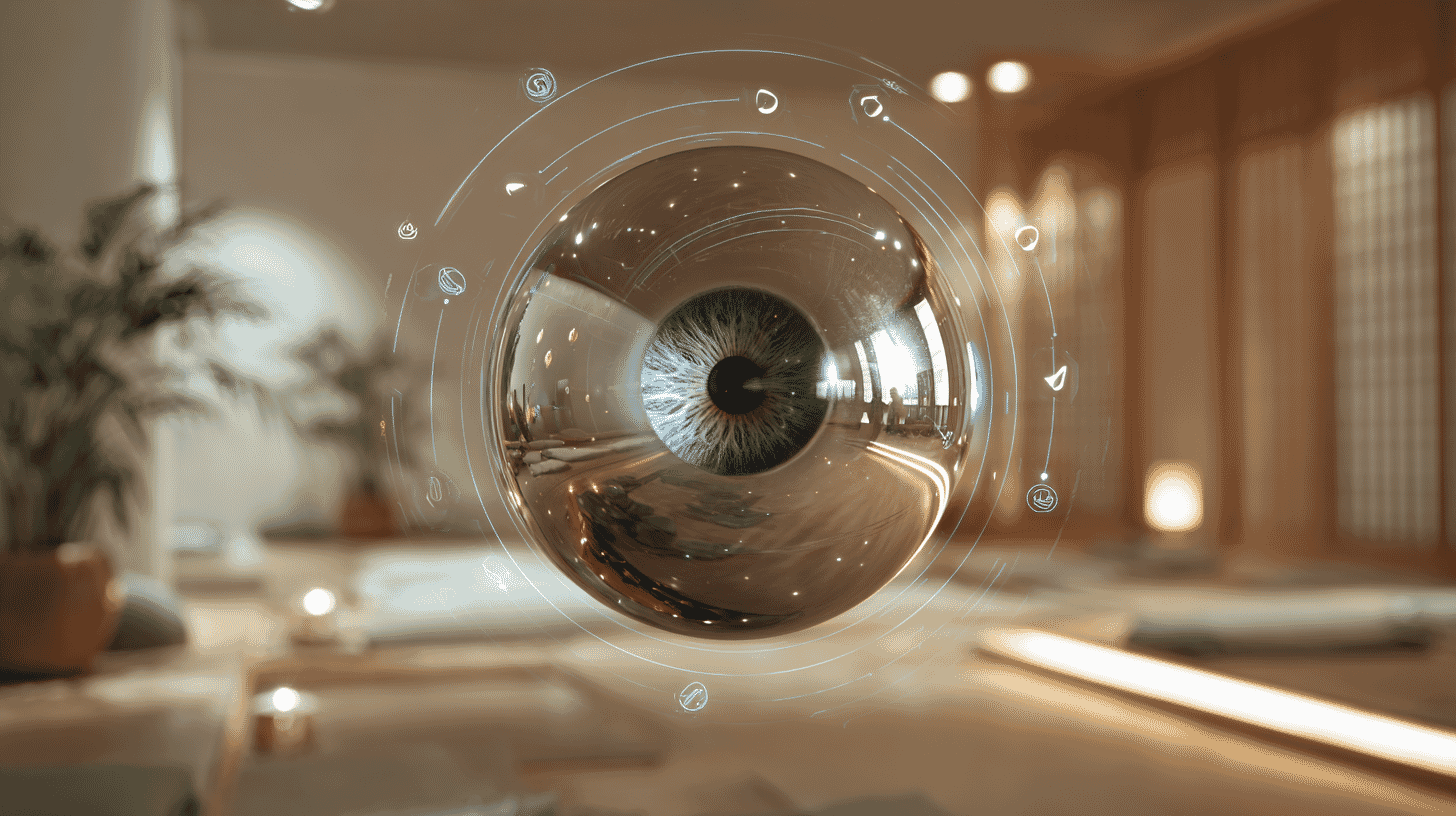
World ID verification uses a spherical device called "Orb." Equipped with high-precision cameras and AI, the Orb scans your iris and completes verification in seconds.

What's remarkable is the thorough privacy-by-design approach.

Captured iris information is encrypted in a non-decryptable format and completely deleted from the Orb immediately after scanning. The encrypted iris code is then split into fragments through Anonymized Multi-Party Computation (AMPC) and distributed across multiple independent organizations, including universities and research institutions.

When using World ID, zero-knowledge proof technology allows you to prove you are human without revealing any personal information. This means even service providers cannot track user activity.

Use Cases in Japan and Future Outlook

World ID adoption is steadily growing in Japan. Tinder Japan has implemented World ID for age and identity verification. Social networking service "Yay!" and restaurant review app "SARAH" have also begun using it for authentication.

The demand for bot countermeasures and fake account prevention continues to rise, especially in gaming and social media. MEDIROM President and CEO Kouji Eguchi stated, "As generative AI rapidly permeates society, this new social infrastructure for 'proving one's humanness' will become an indispensable foundation for the future digital society."

Tomoe Makino, General Manager of Japan at Tools for Humanity, expressed optimism: "By partnering with MEDIROM, which is deeply rooted in local communities nationwide, we can offer World ID in places people trust and feel comfortable."

International Regulatory Landscape and Challenges

However, World ID has faced regulatory challenges overseas. Countries including Spain, Kenya, Indonesia, the Philippines, and Colombia have launched investigations or imposed temporary suspensions over concerns about biometric data collection methods and consent processes.

Key concerns include the risks of handling iris data—which cannot be changed throughout one's lifetime—the possibility that financial incentives (cryptocurrency distribution) may distort genuine consent, and anxiety about centralized infrastructure.

In response, Tools for Humanity emphasizes that biometric images are not stored; only encrypted codes are used. Data is distributed across multiple organizations so no single entity can access it, and core components have been open-sourced with third-party audits conducted.

For Japan's rollout, more transparent operations will likely be required based on these international experiences.

Conclusion: Will This Become a New Trust Foundation for Digital Society?

The evolution of AI technology shows no signs of slowing. The need to verify whether the person you're interacting with online is actually human will only intensify.

World ID is gaining attention as a groundbreaking solution that can prove humanness while protecting privacy. With the MEDIROM partnership significantly expanding verification locations in Japan, more people will gain access to this new digital infrastructure.

However, given that biometric information is involved, careful discussion and transparency are essential. Society as a whole needs to debate how to balance technological convenience with individual privacy protection.

In Japan, the concept of "Proof of Human" is beginning to spread, but what discussions are happening in your country about digital identity verification and privacy protection in the AI era? We'd love to hear your thoughts!

References

Reactions in Japan

Got my World ID while visiting Re.Ra.Ku. The iris scan was over in a flash, much quicker than I expected. The staff was friendly and made me feel at ease. Excited to see what services will support it.

I agree 0
I disagree 0

Your iris pattern never changes throughout your life, right? If the data ever leaks, you can't change it like a password. Even with encryption claims, I'm still worried.

I agree 0
I disagree 0

In an era where AI can impersonate humans, infrastructure for 'proof of humanity' is essential. The zero-knowledge proof approach makes technical sense. Hope it spreads in Japan too.

I agree 0
I disagree 0

Isn't Worldcoin basically a business model that distributes crypto to boost registrations? Getting coins in exchange for biometric data—that's the same thing causing issues in developing countries.

I agree 0
I disagree 0

Bot accounts have been a challenge for our service too, so maybe I'll consider implementing World ID. The open API and developer-friendly approach is a plus.

I agree 0
I disagree 0

The open-sourcing is commendable. Third-party audits are in place, and technically it's sound. However, trust in the operating company is a separate issue from the technology.

I agree 0
I disagree 0

Honestly, iris scanning sounds like something from a sci-fi movie and is a bit scary. But when asked how it's different from My Number Card facial recognition... hmm.

I agree 0
I disagree 0

Being able to get World ID at my regular Re.Ra.Ku is super convenient. No need to go to a special location. Just registered quickly after my treatment.

I agree 0
I disagree 0

Even with 3,000 locations, they'll probably be concentrated in urban areas, right? Wonder when it'll come to rural regions. These things always prioritize Tokyo.

I agree 0
I disagree 0

Seeing the regulatory issues in Europe and Africa, I'm curious how Japan's Personal Information Protection Commission will rule. Hope they don't just leave it to the operators.

I agree 0
I disagree 0

If World ID can be used for anti-cheat in online games, that would be amazing. Could wipe out fraudulent accounts. Hope games support it soon.

I agree 0
I disagree 0

Even after hearing the explanation, I don't really understand... Isn't eye scanning scary? Are young people okay with this? I wish they'd explain it more simply.

I agree 0
I disagree 0

Noteworthy as a practical case of decentralized identity. The combination of zero-knowledge proofs and biometrics is technically interesting. Though full decentralization still has challenges.

I agree 0
I disagree 0

It's getting attention thanks to Sam Altman's name, but mainstream adoption is still far off. Without more compatible services, the 'reason to get it' isn't clear.

I agree 0
I disagree 0

There's a contradiction in claiming 'no personal info required' while collecting biometric data. Isn't the iris the ultimate personal information? The wording feels off.

I agree 0
I disagree 0

Voices from Around the World

Michael Thompson

World ID expansion is progressing in the US too, but Japan's 3,000-location deployment is impressive. Success in the privacy-conscious Japanese market will be an important test case for global expansion.

Elena Rodriguez

World ID was temporarily suspended in Spain due to regulatory issues. Aligning biometric data handling with GDPR is the challenge. Watching closely how Japan addresses this.

David Kim

Interest in AI bot countermeasures is growing in Korea too. Iris recognition is said to be more accurate than fingerprints, but cultural acceptance is another matter. Want to learn from Japan's adoption.

Sarah Williams

Similar technology is being investigated in the UK too. The zero-knowledge proof concept is excellent, but independent verification is needed to confirm the implementation matches promises.

Hans Mueller

German regulators have also expressed concerns about Worldcoin. However, the need for infrastructure to prove humanness in the AI era is recognized. Balance between privacy and convenience is key.

Aisha Okonkwo

Looking at issues in Kenya, deployment in developing countries should be cautious. Economic incentives may distort genuine consent. Interested in how it's deployed in developed countries like Japan.

Pierre Dubois

In France, CNIL is investigating Worldcoin. The approach of partnering with healthcare companies is interesting. Registration at trusted locations might lower psychological barriers.

Carlos Mendez

Brazil's parliament is also investigating. Being Sam Altman's project attracts attention, but we should properly evaluate the technology itself.

Lisa Chen

Singapore is advanced in digital ID but hasn't deployed iris authentication at scale yet. If Japan succeeds, there could be ripple effects across the Asia-Pacific region.

Anna Kowalski

AI-generated content is becoming a social issue in Poland. Interested in 'proof of human' systems, but EU regulation compliance is challenging. Want to learn from Japan's case.

James O'Brien

Online fraud and bot issues are worsening in Australia too. Technology that proves humanness while maintaining anonymity is attractive. However, concerns about biometric data transfers overseas remain.

Maria Santos

In the Philippines, regulators ordered World ID operations to stop. The consent process for biometric data collection was deemed insufficient. Japan seems to be preparing more thoroughly in advance.

Thomas Anderson

Canada has relatively low resistance to biometrics, but where data is stored is a key concern. The distributed storage approach is commendable.

Wei Zhang

Interesting project. Partnership with Japanese companies could increase credibility in Asian markets. The technical open-sourcing is commendable for transparency.

Isabella Romano

Deepfake issues are increasing in Italy too. Demand for 'proof of human' is definitely growing. However, the relationship with EU AI regulations needs careful consideration.