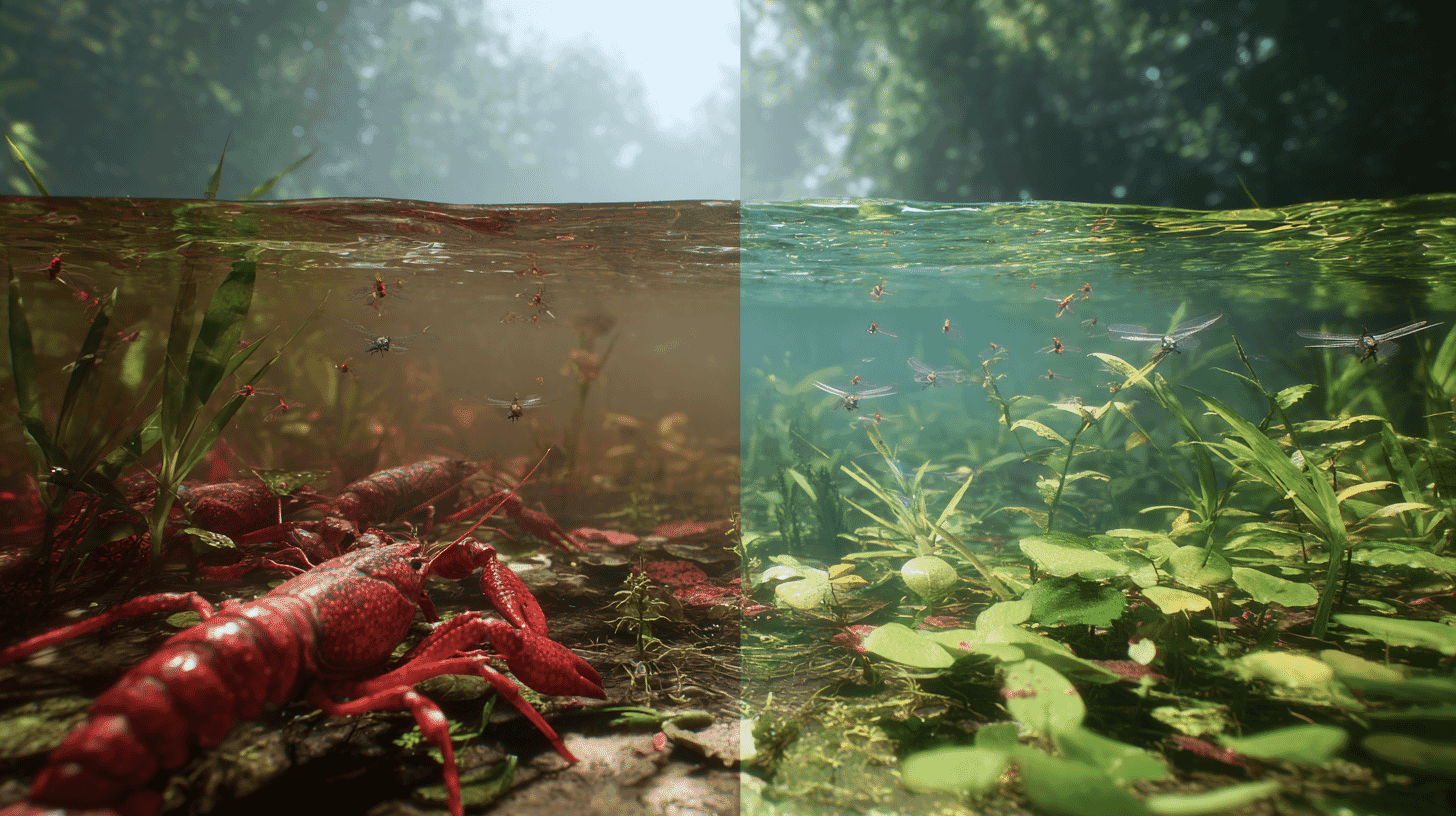
What happens when you remove 20,000 invasive crayfish from a single pond? A murky, lifeless pool of brown water transforms into a crystal-clear haven bursting with aquatic plants, dragonfly larvae, and even endangered species, all in just 12 months. Here's the story of one conservationist's battle against Japan's most stubborn invasive species, and what it tells us about the surprising resilience of nature.
A Pond on the Brink
Across Japan, countless ponds, rice paddies, and wetlands have been quietly devastated by a single culprit: the American crayfish (Procambarus clarkii). Originally brought to Japan from Louisiana in 1927 as feed for farmed bullfrogs, these hardy crustaceans escaped into the wild and have since colonized waterways in all 47 prefectures.
The damage they cause is severe. American crayfish are voracious omnivores that devour aquatic plants, chew through root systems, and prey on insects, tadpoles, and small fish. Once they gain a foothold in a pond, they systematically strip away vegetation. Without plants to filter the water and provide habitat, water quality collapses. The pond turns brown. Native species vanish. What conservationists describe as a "black hole of nutrient cycling" takes hold, the crayfish consume everything coming into the ecosystem while giving almost nothing back.
This was the state of a small rural pond that caught the attention of Komiya, a YouTuber and biodiversity conservation activist who documents his work on his channel "Komiya's Reflections on Biodiversity" (@ariake538). The pond was clouded with sediment, virtually devoid of visible life, and thoroughly overrun with American crayfish.
The Threshold Strategy
Previous efforts to control American crayfish in Japan have often relied on a technique called ike-boshi (literally "pond drying"), draining ponds completely to remove unwanted species. But crayfish are notorious survivors. They burrow into the mud and wait out the dry period, re-emerging when water returns. Traditional trapping methods also tend to fall short, because if you don't catch more crayfish than the population can reproduce, the numbers simply bounce back.
Komiya and his team adopted a different approach based on the concept of a "threshold" (ikichi). The idea is straightforward but demanding: you must capture crayfish at a rate that exceeds their reproductive capacity. Fall below that threshold, and the population recovers. Exceed it consistently, and the population starts to collapse.
To hit that target, the team deployed large numbers of traps and maintained a relentless schedule. Over the course of one year, they removed approximately 20,000 American crayfish from a single pond.
A Dramatic Transformation
The results were astonishing, even to Komiya himself.
Within the first month, large adult crayfish had largely disappeared. By spring, native amphibians began returning. Larvae of the San'in salamander (Hynobius setoi) and tadpoles were spotted in the now-clearing water. By summer, aquatic plants were spreading rapidly, and water insects such as diving beetles and water scorpions followed.
One year after the removal effort began, the pond was unrecognizable. Water that had been opaque brown was now clear enough to see the bottom. The surface was covered with lush green vegetation, including water chestnut (Trapa japonica) and stonewort algae (Chara species) that acted as natural water filters.
Even more remarkably, endangered plant species began reappearing. Surveyors confirmed the presence of Ceratopteris gaudichaudii (a small aquatic fern classified as Near Threatened) and Limnophila sessiliflora (an aquatic herb that several prefectures list as endangered). These species had likely persisted as dormant seeds in the pond's sediment, a natural "seed bank" that sprang to life once the crayfish were no longer destroying every shoot.
From "Black Hole" to Living Ecosystem
Komiya explained the transformation in ecological terms. When crayfish dominated the pond, it was a dead-end in the nutrient cycle, a place where organic matter entered but never left. The crayfish consumed fallen leaves, visiting amphibians, and virtually every living thing.
With the crayfish suppressed, the cycle reversed. Aquatic plants now convert sunlight and nutrients into biomass. Insects and tadpoles feed and grow in the pond, then leave as adults, dragonflies take to the air, frogs head into surrounding forests. Those frogs become food for snakes, birds, and mammals. The pond shifted from being a place of pure consumption to a place of biological production, feeding the wider landscape.
The Fight Isn't Over
Despite the dramatic recovery, Komiya cautions that the job isn't done. Small juvenile crayfish are still being found in the pond, and he estimates that complete eradication will take at least three years of sustained effort.
There's also the constant threat of reintroduction. The original infestation likely began when just a few crayfish were released, perhaps dumped pets or escaped specimens. From that small start, the population grew slowly before exploding. Even a handful of survivors could restart the cycle.
"There is no breakthrough method," Komiya says of the road ahead. "We just have to keep doing the work, steadily and consistently."
Surviving Climate Challenges
The first year also brought unexpected tests. The summer of 2025 saw severe drought conditions across much of Japan, and many ponds and streams dried up entirely. Komiya's project pond nearly lost all its water too, but because the team had previously dredged and deepened parts of the pond bed, pockets of water remained. Many organisms survived in these refuges.
"This year made it clear that building ecosystems resilient to climate change is essential," Komiya reflected.
Japan's Legal Framework for Invasive Species
Japan has been strengthening its legal response to the crayfish problem. In June 2023, the American crayfish was officially designated as a "Conditionally Specified Invasive Alien Species" under Japan's Invasive Alien Species Act. This is a unique regulatory category, the crayfish couldn't simply be banned outright because millions of Japanese households keep them as pets, and a blanket prohibition would likely lead to mass releases into the wild, worsening the problem.
Under the current rules, people can continue keeping pet crayfish without any permit. However, releasing them into rivers, ponds, or any natural waterway is now illegal and subject to penalties. Selling, distributing, and importing crayfish are also prohibited. The regulation reflects a pragmatic balance: acknowledging reality while closing the door on further spread.
Japan's Ministry of the Environment has also published detailed manuals and educational materials on crayfish control, recognizing that community-based removal efforts like Komiya's are essential to the national strategy.
Inspiration for Other Communities
Komiya's documentation of the project has had ripple effects beyond his own pond. By sharing detailed data on how many crayfish need to be removed before populations start declining, he has given other communities a roadmap and, crucially, hope.
"By showing in video how many crayfish you need to catch before the population starts to decline, we demonstrated that this is not an endless battle," Komiya says. "We've received messages from people saying they felt it was possible and started their own removal efforts."
His broader goal now extends beyond a single pond. He is working to remove invasive species from surrounding ponds as well, aiming for regional ecosystem recovery and eventual certification under Japan's "Nature Symbiosis Sites" (officially, the Ministry of the Environment's "30by30" initiative, which aims to conserve 30% of land and sea by 2030).
What Does Your Country Do About Invasive Species?
Japan's American crayfish story is both a cautionary tale and a story of hope. A species introduced nearly a century ago for an entirely different purpose has caused widespread ecological damage, but determined, strategic action by citizen-conservationists is proving that recovery is possible.
Invasive species are a global challenge. From zebra mussels in North America's Great Lakes to cane toads in Australia, every country faces its own version of this battle. What invasive species are causing problems where you live? Has your community found effective ways to fight back?


Global Discussion
14 comments