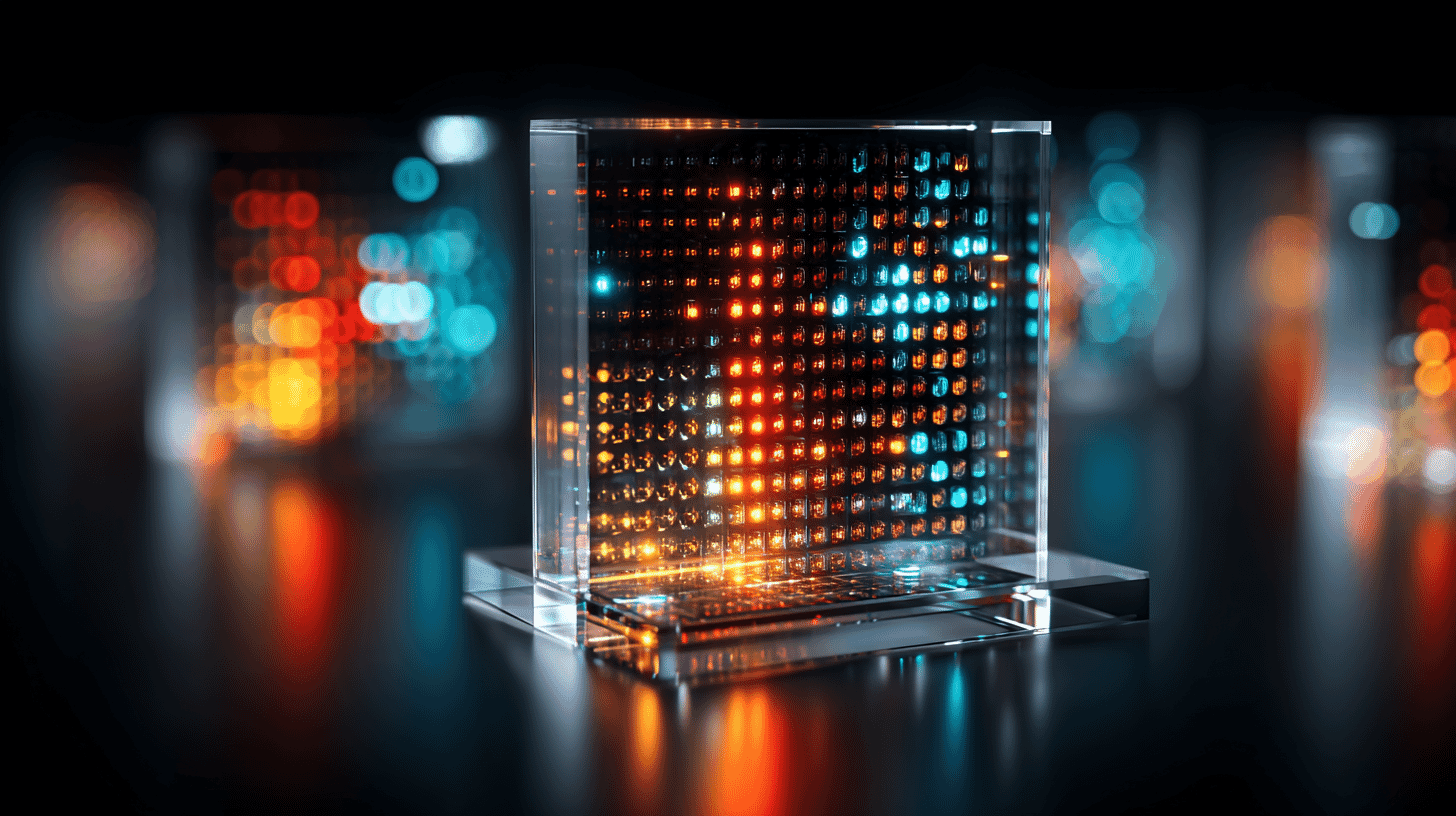
Micro-LED, widely seen as the successor to OLED, is edging into mass production. On television-sized panels the price has been the obstacle: about $110,000 for an 89-inch set. But the technology is now arriving on much smaller screens, in AR glasses and smartwatches. How are Japanese manufacturers positioning themselves?
What is Micro-LED?
Micro-LED is a display technology that arranges ultra-fine LED elements smaller than 100 micrometers (about the thickness of a human hair) across a screen, with each element lighting up independently to create images. Red, green, and blue LEDs form one pixel as a set, so even a Full HD (1920x1080) panel needs roughly 6 million elements, and a 4K panel about 24 million.
Like OLED, micro-LED is a "self-emissive" technology, but it uses inorganic materials instead of organic ones. This means no burn-in issues and a lifespan of approximately 100,000 hours. Furthermore, brightness can reach several to dozens of times that of OLED, enabling clear image display even outdoors.
Why Mass Production is Now Becoming Reality
Micro-LED has long been called the "ideal display technology," but high manufacturing costs have hindered its widespread adoption. Manufacturing a 4K display requires precisely placing approximately 24 million LED chips, and the traditional "Pick and Place" method was extremely time-consuming as chips had to be placed one by one.
The breakthrough came with advances in "mass transfer" technology. This technique enables the transfer of millions of elements at once, dramatically improving manufacturing time and costs. Canadian startup VueReal has developed a proprietary "cartridge method" that envisions direct mounting on automobile bodies by 2026.
Market research predicts the micro-LED market will grow from approximately $420 million in 2025 to $2.41 billion by 2030, representing an average annual growth rate of 41.8%.
AR Glasses: The First Battlefield
At SID Display Week 2025, held in May 2025, intense technological competition between micro-LED and OLED was on full display.
Particular attention was drawn to ultra-compact displays for AR (Augmented Reality) glasses. Micro-LED's greatest strength, its dramatically higher brightness, makes it ideal for AR glasses that need to function outdoors.
Taiwan's PlayNitride reached 5,644ppi in a 0.18-inch, 720x720 full-color panel. The optical engine volume has shrunk to just 0.4cc, about 1/20th of conventional DLP systems, bringing AR glasses resembling regular eyewear within reach.
Full-scale adoption of micro-LED in the AR glasses market is predicted to begin in 2026, intensifying the battle for dominance with OLED.
Japanese Manufacturers' Strategies
Sony Semiconductor Solutions
Sony is known as a pioneer in the micro-LED field. In 2016, it was the first in the world to commercialize the "Crystal LED Display System" for professional use, which has been adopted in Hollywood for virtual background systems in film production.
At SID Display Week 2025 in May, Sony reported a 0.26-inch micro-LED display prototype at 5,644ppi (Session 38.4). Building on its established OLEDoS (OLED on Silicon) technology, Sony is now fully accelerating development in the micro-LED sector. Sony's strength lies in combining display technology with image sensing technology, aiming to deliver comprehensive value through real-time 3D sensing and polarization sensors.
Sharp
Sharp is developing monolithic micro-LED displays for AR headsets at its Fukuyama Semiconductor facility in Hiroshima Prefecture. The company achieved the world's first full-color display at 1,053ppi in a 0.38-inch size and has been working toward mass production.
Using proprietary "LSW" technology, Sharp prevents light leakage from quantum dot color conversion layers, achieving high-purity red and green colors. By adopting the monolithic method that allows simultaneous element bonding, the company aims to deliver highly reliable products.
Equipment and Materials Manufacturers' Contributions
Japan's strength extends beyond finished product manufacturers. Japanese companies are playing a leading role in manufacturing equipment essential for mass transfer technology.
TDK has developed a total solution including laser removal equipment, alignment machines, and mounting machines. Toray Engineering also offers a lineup from inspection equipment to bonding equipment and quantum dot coating equipment. Toray has successfully developed materials for laser transfer, and Shin-Etsu Chemical is advancing the development of transfer components, increasing the presence of Japanese companies throughout the supply chain.
Global Competition Landscape
Globally, development is accelerating among Korea's Samsung and LG Display, Taiwan's AU Optronics and Innolux, and China's BOE.
Apple spent years and billions of dollars on micro-LED, aiming to put it in the Apple Watch Ultra first. But cost and yield problems led it to shut down in-house development in early 2024 and sharply cut the team, according to multiple reports, though it may keep the technology alive for AR uses. The retreat of the player once expected to lead the market underscored just how high the mass-production bar remains. Samsung, meanwhile, continues to develop micro-LED for smartwatches and large TVs, and its moves are expected to help shape the market.
At SID Display Week 2025, Taiwan's AUO unveiled a 42-inch micro-LED module, described as "the world's largest single-piece display." This demonstrated that manufacturing large displays as a single panel without tiling is becoming possible.
Micro-LED Possibilities and Challenges
Expected Applications
Micro-LED applications span a wide range.
Beyond AR glasses and VR headsets, smartwatches are expected to leverage high brightness and low power consumption for improved outdoor visibility. For automotive displays, attention is focused on HUDs (Head-Up Displays) that remain visible even in sunlight.
Micro-LED is also well-suited for transparent displays. Because emitting elements can be made smaller, light passes through more easily, enabling integration into shop windows and building glass.
Even more interesting is the integration of displays and sensors. Research is underway on utilizing micro-LED as an integrated platform that can "see, measure, and respond" by incorporating sensors and cameras between the microscopic elements.
Remaining Challenges
The biggest challenge remains cost. Samsung's 89-inch 2024 model, the micro-LED set you can actually buy for a living room, lists at about $110,000 in the United States, far beyond the reach of ordinary consumers.
Additionally, manufacturing a single 4K display reportedly takes about 5 days, requiring improvements in production efficiency. Technological innovations continue toward mass production, including improving yield rates, further advances in transfer technology, and material cost reductions.
Japan's Challenges and Outlook
Following LCD and then OLED, Japan has the bitter experience of leading in R&D while falling behind Korean and Chinese competitors in the mass production race. Avoiding the same fate with micro-LED has become a crucial theme that will determine the future of Japan's display industry.
On the other hand, companies like Fujifilm, Japan Display Inc. (JDI), and Semiconductor Energy Laboratory (SEL) are developing a new approach: hybrid technology combining OLED and micro-LED. This has the potential to overcome the limitations of conventional FMM (Fine Metal Mask) and achieve ultra-high-definition displays at low cost, attracting attention as a unique Japanese technology.
Update (as of August 2026): The smartwatch use case this article flagged has since arrived. In September 2025 Garmin launched the fēnix 8 Pro - MicroLED, the first commercially available smartwatch with a micro-LED screen. The 1.4-inch, 326ppi panel is made by Taiwan's AUO. It sells for $1,999.99 and runs up to 10 days in smartwatch mode, well short of the 27 days on the OLED version of the same watch.
What micro-LED changes is how we look at screens at all. A smartwatch readable in blazing sun is already on sale; AR glasses and automotive head-up displays are next in line.
In Japan, technological development toward micro-LED mass production is accelerating. What discussions about display technology are happening in your country? If you have expectations for next-generation displays, share them below.







Global Discussion
15 comments