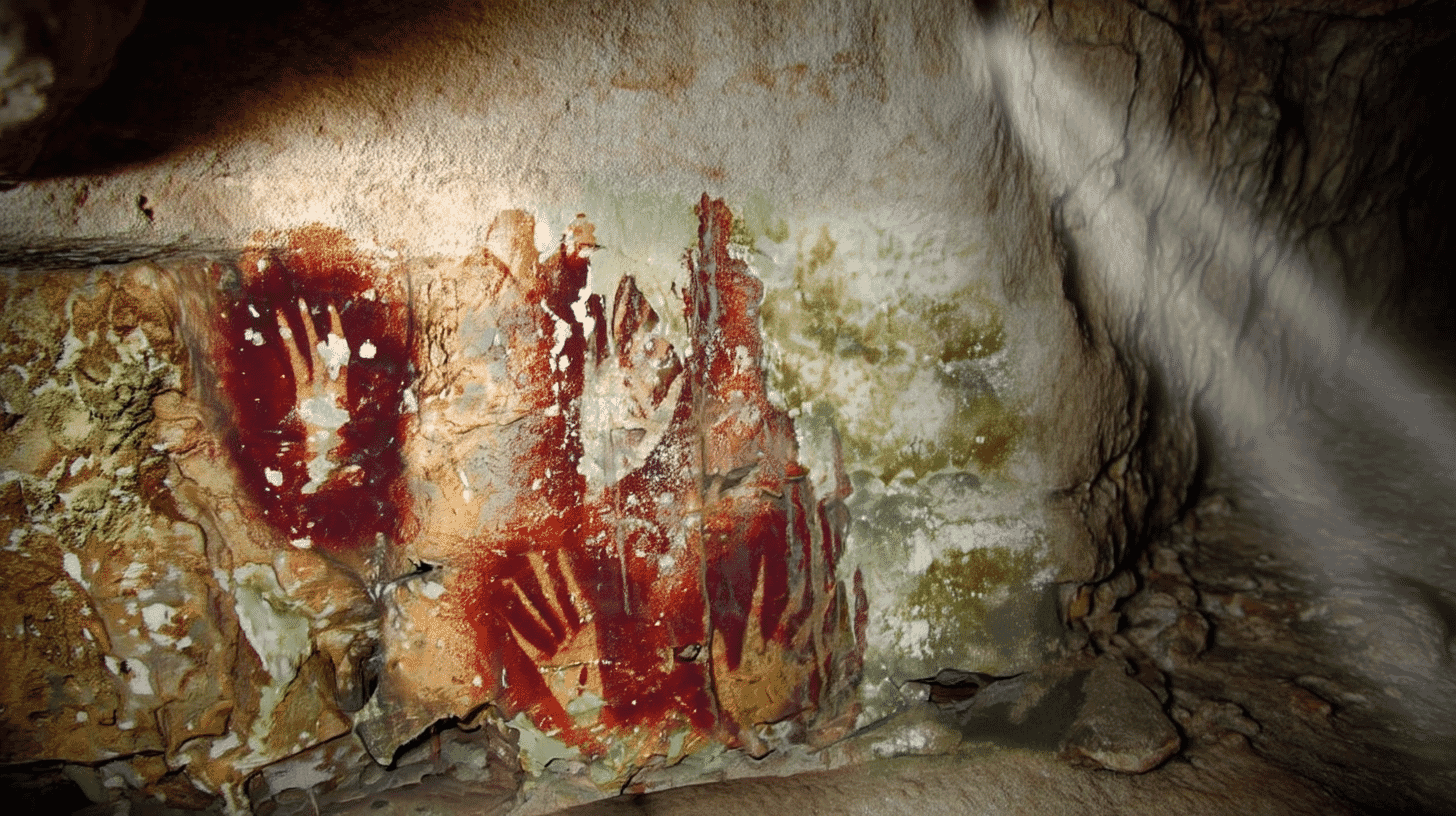
🖐️ Nearly 68,000 years ago, someone pressed their hand against a cave wall and blew red pigment over it, leaving a trace that said, "I was here." Over 40,000 years older than Lascaux, this is humanity's oldest known artwork—and it wasn't found in Europe, but in a small Indonesian island cave. The discovery is rewriting the story of human artistic evolution and illuminating the ancient paths our ancestors took to reach Australia.
The World's Oldest Cave Art: Found on Indonesia's Muna Island
On January 22, 2026, a paper published in the journal Nature sent shockwaves through the archaeological community. A hand stencil found in the Liang Metanduno cave on Muna Island, in southeastern Sulawesi, Indonesia, has been confirmed as at least 67,800 years old—making it the oldest reliably dated cave art in the world.
The stencil surpasses what was previously considered the oldest cave art: hand markings in a Spanish cave attributed to Neanderthals, by more than 1,000 years. It is also over 16,000 years older than the earliest rock art previously documented in southwestern Sulawesi's Maros-Pangkep region by the same research team.
The study was led by Adhi Agus Oktaviana of Indonesia's National Research and Innovation Agency (BRIN) and Maxime Aubert, a specialist in archaeological science at Griffith University in Australia, along with an international team of researchers.
How Uranium-Series Dating Unlocks the Age of Ancient Art
The key to this breakthrough is a cutting-edge technique called laser-ablation uranium-series dating (LA-U-series dating).
Cave paintings cannot be dated using conventional radiocarbon methods because the pigments are not organic materials. Instead, researchers focus on the thin layers of calcium carbonate (calcite) that naturally form over cave paintings over thousands of years. These mineral deposits contain trace amounts of uranium, which decays into thorium at a known, constant rate. By precisely measuring the ratio of uranium-234 to thorium-230, scientists can determine when the calcite layer formed.
The LA-U-series method represents a significant advancement over older solution-based uranium-series techniques. Rather than physically scraping off calcite and dissolving it for analysis, this approach uses a finely focused laser (with a spot diameter of approximately 44 micrometers) to analyze polished cross-sections of the mineral deposits non-destructively. This allows researchers to target the calcite closest to the pigment layer, dramatically improving accuracy and avoiding the systematic underestimation of ages that plagued earlier methods.
Importantly, the dates obtained through this method represent minimum ages. Since there may be a time lag between when the painting was created and when the first calcite layer formed over it, the actual age of the artwork could be even older. The 67,800-year figure is a floor, not a ceiling.
What the Hand Stencil Reveals: More Than a Simple Handprint
The Muna Island hand stencil measures approximately 14 centimeters by 10 centimeters and was created by placing a hand against the cave wall and blowing red pigment—likely ochre—over it. While the stencil has faded considerably and its preservation is deteriorating, researchers noted a remarkable detail: the fingertips of one hand were deliberately modified to appear pointed, like animal claws.
This technique of reshaping fingertips is unique to Sulawesi, found nowhere else in the prehistoric record. According to Adam Brumm, an archaeologist at Griffith University, the artists may have been trying to transform the human handprint into something else entirely—perhaps an animal or a mythical being. This suggests that these early humans already possessed the cognitive sophistication to use their imagination to alter reality in creative ways.
Combined with the team's 2024 discovery of a 51,200-year-old narrative cave painting in Sulawesi (depicting human-like figures interacting with a wild pig), the Muna find strengthens the case that a sustained, sophisticated artistic culture existed in Indonesia during the Late Pleistocene epoch.
Overturning the "Europe First" Theory of Art
For much of the 20th century, the prevailing view in archaeology was that advanced artistic expression first emerged when humans arrived in Europe. The famous cave paintings of Lascaux in France (roughly 20,000 years old) and Altamira in Spain were long considered humanity's earliest creative masterpieces.
The series of discoveries in Sulawesi since 2014 has systematically dismantled this Eurocentric framework. Figurative art dating back over 40,000 years, narrative scenes from more than 51,000 years ago, and now a hand stencil from approximately 68,000 years ago—all found in Indonesia, all far older than Europe's celebrated cave paintings.
These findings suggest one of two possibilities: either artistic expression originated independently in multiple regions, including Southeast Asia, or—perhaps more likely—humans who left Africa already carried the capacity for symbolic thought and creative expression with them. The "cognitive revolution" that produced art may have occurred before the great migration out of Africa, rather than in Europe as traditionally assumed.
Illuminating the Path to Australia
The discovery carries profound implications for another great archaeological puzzle: how early humans first reached Australia.
Modern humans (Homo sapiens) are believed to have arrived in Australia—then connected to Papua New Guinea as part of the landmass called Sahul—approximately 65,000 years ago. But the route they took has been hotly debated.
The "northern route" hypothesis proposes that people traveled from Borneo through the islands of eastern Indonesia, including Sulawesi, then crossed to Papua New Guinea by boat and walked into Sahul. The "southern route" hypothesis suggests a path through Java, Bali, the Lesser Sunda Islands, and Timor, followed by a sea crossing to northwestern Australia.
Finding 67,800-year-old art on Muna Island—located off the southeastern coast of Sulawesi—provides the first direct evidence that modern humans were present on these Indonesian islands at that time. According to Aubert, the discovery "probably supports the hypothesis of arriving in Australia via Papua New Guinea around 65,000 years ago via the northern route," though the southern route cannot be entirely ruled out.
The research team believes the artists were likely closely related to the ancestors of Australia's Aboriginal peoples—making this hand stencil a tangible connection between Indonesia's prehistoric cave painters and one of the world's oldest continuous cultures.
Sulawesi's Caves: An Exploration Still in Its Infancy
The current study surveyed 44 cave sites in southeastern Sulawesi, dating 11 rock art motifs including seven hand stencils. Fourteen of these sites were previously unknown to archaeologists.
Liang Metanduno itself contains over 400 paintings beyond the ancient hand stencil, including images of people on horseback, birds, and other figures estimated to be approximately 3,500 to 4,000 years old. This means the same cave was used as a canvas repeatedly over at least 35,000 years.
Sulawesi's karst landscape contains countless limestone caves, and rock art has been documented at 242 sites so far. Many of these remain uninvestigated with modern dating techniques. The potential for discovering even older art is very real.
The Race Against Deterioration
Despite their immense cultural significance, many of these cave paintings face serious threats. The Muna hand stencil itself is visibly fading, and researchers are concerned about its long-term preservation. Industrial activity has already destroyed some caves in the region, and climate change is altering the delicate microenvironments within the caverns that have protected the art for tens of thousands of years.
The research team hopes that the global attention brought by this discovery will boost conservation efforts. How we choose to protect a 68,000-year-old message from our ancestors may itself become a defining chapter in humanity's cultural legacy.
This discovery has sparked widespread fascination in Japan, with many people expressing awe that artistic expression existed over 60,000 years ago and noting how it overturns Eurocentric assumptions about the origins of art. What are the perspectives in your country on the origins of human creativity? Does your homeland have ancient rock art or cave paintings of its own? We'd love to hear your thoughts on what "art" meant to our earliest ancestors—and what it means to you today.
References
- https://www.nature.com/articles/s41586-025-09968-y
- https://www.cnn.co.jp/fringe/35243014.html
- https://www.afpbb.com/articles/-/3619030
- https://www.nationalgeographic.com/history/article/worlds-oldest-rock-art-indonesia-hand-stencil
- https://www.aljazeera.com/news/2026/1/22/worlds-oldest-cave-art-discovered-in-indonesias-muna-island

Reactions in Japan
68,000 years ago... at a time when almost nobody lived on the Japanese archipelago, someone in an Indonesian cave was making hand stencils. And they even had the concept of 'design,' reshaping their fingertips. It's mind-boggling but also somehow relatable. Humans were creators from the very beginning.
The evolution of uranium-series dating is incredible. With laser ablation, they can now target areas just 44 micrometers from the pigment layer. Older methods tended to underestimate ages, but this technique corrected that at once. This is literally technology rewriting history.
I was taught in art history class that art originated in Europe, as if it were obvious. Turns out it's completely wrong. Southeast Asia had art over 40,000 years before Lascaux. Maybe it's time to rewrite the textbooks.
Pay attention to the 'at least 67,800 years ago' part. There's a time lag before the calcite layer forms, so the actual age could be even older. If it exceeds 70,000 years, it would've been made shortly after Homo sapiens left Africa, potentially impacting our timeline for the Out of Africa migration itself.
I'm definitely using this in my class next year. We can't teach that 'human intellectual development flowered in Europe' anymore. I want my students to think about how Indonesian caves might've been an 'artistic relay station' between Africa's starting point and Australia's destination.
Muna Island sounds amazing, but apparently only one propeller plane goes there per day. That remote feel is part of the charm though. The challenge will be balancing conservation with tourism before commercialization damages the art.
The pointed fingertips are the most shocking part. It's not just a handprint—they had the imagination to transform their own body into 'something else' 68,000 years ago. Combined with the therianthrope paintings, the ancient Sulawesi people clearly had an incredibly rich inner world.
The article casually mentions that the dating of Spain's cave art attributed to Neanderthals 'has been controversial.' That alone is a massive issue. If the Neanderthal attribution holds, it means art wasn't exclusive to modern humans.
Handprints exist in every culture worldwide. Japanese Jomon pottery has hand marks too, and we still take kids' handprints for kindergarten mementos. Across 68,000 years, we're creatures that simply want to leave a mark saying 'I was here.' It's deeply moving.
I want NHK to do a 2-hour special on this. I'd love to see how the team reached this cave, what equipment they used for laser dating, and the local scenery. Sulawesi has 242 caves with art, so there must be so much more to discover.
I think we should be a bit more cautious about the dating. British researchers have previously pointed out issues with uranium-series methods, and complex calcite growth histories can cause age discrepancies. Laser ablation is an improvement, but independent verification is still needed.
I've lived in Indonesia for 5 years and never heard of Muna Island. Even Sulawesi is obscure, let alone its offshore islands. But this really highlights Indonesia's deep historical potential. Indonesia is so much more than Yogyakarta and Bali.
Every time my 2-year-old scribbles on the wall with crayons I get frustrated, but knowing humans were drawing on cave walls 68,000 years ago somehow makes it forgivable. Drawing on walls is just human instinct, I guess.
In an era where generative AI produces 'art' in seconds, the fact that it took humanity tens of thousands of years to leave its first handprint is deeply poignant. That stencil was art born from pure impulse, with no prompt required.
I'm worried about conservation. Some Indonesian cave paintings have been damaged by industrial activity, and the Muna stencil is reportedly fading. UNESCO World Heritage listing should be expedited. I wonder if Japanese preservation technology could contribute somehow.
I feel like this cave painting is asking us to define 'what is art?' Is a hand stencil art, a symbol, or a ritual? At minimum, the act of leaving a trace on a wall conveys a desire to inscribe one's existence onto something transcendent—and that's exactly the same impulse underlying modern art.
As an archaeologist who collaborated with Aubert's team on Sulawesi cave art research in 2019, this finding is surprising yet entirely consistent with the trajectory. LA-U-series is far more accurate than solution-based methods, and I expect many cave paintings worldwide to see their ages revised upward. The critical next step is making this technique accessible to more research teams.
As a Frenchman, the pride in Lascaux as 'humanity's oldest art' started crumbling a decade ago, but 68,000 years? That's in a completely different league. Still, Lascaux's artistic sophistication is a separate conversation. 'Oldest' and 'greatest' don't always overlap.
India's Bhimbetka rock shelters have paintings from about 30,000 years ago, nowhere near Indonesia's 68,000. But Indian rock art has its own unique beauty. I hope this discovery elevates interest in all of Asia's prehistoric art. The era of Europe monopolizing attention should be over.
It's fascinating how the 'oldest cave art' title keeps getting rewritten every few years. 40,000 years in 2014, 51,200 in 2024, now 67,800. Next up, 80,000? You can really feel how dating technology is accelerating archaeology.
The attribution of Maltravieso cave hand stencils in Spain to Neanderthals has always been debated. Now that a modern human stencil in Indonesia has been confirmed as even older, the question of 'who were the first artists' has become even more complex. Archaeology truly is endless.
Africa has abstract markings from 73,000 years ago (the Blombos Cave crosshatching), but those differ from figurative hand stencils. Did the cognitive ability born in Africa blossom into figurative art in Southeast Asia? Or are there undiscovered figurative paintings in Africa too? As an African researcher, I certainly hope for the latter.
Aboriginal Australians are said to have the world's oldest continuous culture at 65,000 years. If this cave art's creators are ancestrally related, it traces Indigenous Australian culture back to Indonesian cave paintings. I'm curious how Aboriginal communities will receive this news.
Germany's Hohlenstein-Stadel Lion Man, at 40,000 years old, remains the world's oldest known three-dimensional sculpture. The Indonesian find is a 2D stencil. Media says 'oldest art in the world,' but we need to be precise about what category of 'oldest' we're talking about.
As an Indonesian, I'm truly proud. These incredible historical treasures have been sleeping in Sulawesi and surrounding islands, yet they lack sufficient recognition even domestically. The Muna caves were only known to locals. The government needs to allocate more funding for research and preservation.
I'm a Silicon Valley engineer, and I'm most fascinated by the technical side of LA-U-series. A laser coupled with mass spectrometry at 44μm resolution—that's conceptually similar to semiconductor inspection tools. Cross-disciplinary tech advancing archaeology is incredibly cool.
Brazil's Serra da Capivara National Park also has rock art dating back tens of thousands of years. But even the '25,000 years ago' date has been questioned by parts of the academic community. If Indonesia's new dating method is applied to South American rock art, it could change history.
South Korea's Bangudae Petroglyphs in Ulsan are about 7,000 years old and important as Asian prehistoric art. But compared to 68,000 years, it's a whole different magnitude. I genuinely admire Southeast Asia's richness in prehistoric art. I hope this sparks greater archaeological interest in Korea too.
Saudi Arabia's AlUla has rock art over 10,000 years old, recently UNESCO-listed. Middle Eastern rock art is gaining attention, but Indonesia's 68,000-year discovery shows that art is a universal human impulse. Rather than competing for 'oldest,' we should focus on the commonality across regions.
Russia's Kapova Cave has paintings from 36,000 years ago. The dismantling of Eurocentrism is academically healthy, but I do wonder if such discoveries might become overly politicized in postcolonial discourse. I hope the scientific discussion remains rigorous and apolitical.
Nigeria has prehistoric rock art too, but research is barely progressing. Looking at Indonesia's findings, I feel there may be undiscovered ancient art sleeping in African caves. The problem is lack of research funding and trained specialists. Bridging the archaeological gap between developed and developing nations is the real challenge.
Sweden's Tanum petroglyphs are UNESCO-listed but relatively young at about 3,000 years. A 68,000-year-old handprint reminds us how deep art's history really goes. What's fascinating is that this stencil is both a proof of existence—'I was here'—and the seed of fiction, with fingertips reshaped into claws. Art was born somewhere between reality and imagination.