
Pottery from 16,000 years ago. Lacquerwork from 9,000 years ago. Giant pillars placed at precisely 4.2-meter intervals. Japan's Jomon people, long dismissed as "primitive hunter-gatherers," possessed technologies that stun modern scientists. Here is how DNA analysis, laser scanning, and cutting-edge science are decoding ancient Japan's astonishing lost technologies.
Rewriting the Textbooks: Jomon Japan Was Anything But Primitive
When most people think of ancient Japan, they picture a misty, mythological past far removed from technological achievement. School textbooks have long summarized the Jomon period (roughly 14,000–300 BCE) as an era of simple hunter-gatherers living in pit dwellings. But a wave of archaeological discoveries, supercharged by modern scientific analysis, is shattering that image entirely.
The world's oldest pottery. Lacquerware rivaling today's traditional crafts. Massive structures built with precision engineering. An ironmaking method that produces purer steel than modern blast furnaces. Ancient Japan's archaeological sites are packed with traces of what can only be called "lost technologies."
This article weaves together archaeological finds and cutting-edge scientific analysis to reveal the remarkable technical achievements of ancient Japan.
The World's Oldest Pottery: A 16,000-Year-Old Revolution
If asked where the world's oldest pottery was made, most people would guess Mesopotamia or Egypt. The answer is Japan. Pottery fragments from the Odai Yamamoto site in Aomori Prefecture have been radiocarbon-dated to approximately 16,500 years ago, predating the earliest known pottery from any other civilization.
What makes this finding even more remarkable is that these ancient vessels already show evidence of cooking. Residue analysis of soot and charred deposits revealed that people were heating animal and fish fats in pottery, processing them into portable food supplies and fuel. This wasn't just container-making, it was chemical engineering in its earliest form.
By the Middle Jomon period (roughly 3,000–2,000 BCE), pottery had evolved into high art. The spectacular "flame-style pottery" (kaen-gata doki) from the Shinano River region of Niigata Prefecture features dramatic, flame-like sculptural forms that have earned National Treasure status. These vessels transcended mere utility, embodying a sophisticated spiritual culture.
9,000-Year-Old Lacquer Technology: Chemical Knowledge That Amazed the World
Perhaps no ancient Japanese technology better illustrates the gap between perception and reality than lacquerwork. Refining urushi (lacquer) sap into a durable, beautiful coating requires an extraordinary chain of knowledge: harvesting sap from toxic urushi trees, purifying it, blending mineral pigments, and applying multiple layers with carefully controlled drying conditions. Each step involves what is essentially applied chemistry.
Fragments of lacquered combs from the Kamiutsuro Nakaya site in Toyama Prefecture and the Mibiki site in Ishikawa Prefecture date to approximately 7,500–7,200 years ago, making them among the world's oldest lacquerware. The use of lacquer itself is thought to go back about 9,000 years: lacquered artifacts from that period have been excavated at the Kakinoshima site in Hakodate, Hokkaido, and a lacquer tree branch about 12,600 years old has been found at the Torihama Shell Mound in Fukui Prefecture.
Since each urushi tree yields only a small amount of sap, stable lacquer production required planned cultivation of many trees. At the Sannai-Maruyama site in Aomori and the Shimoyakebe site in Tokyo, archaeologists have found numerous urushi trees bearing sap-harvesting scars, proving that Jomon people operated what amounted to managed lacquer-tree plantations.
When researchers reconstructed the roughly 3,000-year-old vermillion lacquerware from the Korekawa Nakai site in Hachinodate, Aomori, they found it comparable in quality to modern high-end Japanese tableware. The continuity between ancient craftsmanship and today's living traditions is nothing short of astonishing.
Sannai-Maruyama's Six Pillars: Precision Engineering from 5,500 Years Ago
The Sannai-Maruyama site in Aomori (approximately 5,900–4,200 years ago) revolutionized understanding of the Jomon period when major excavations began in 1992. The long-held view that Jomon people lived in small, mobile bands of 30–40 individuals collapsed overnight.
The most startling discovery was the "Large Pillar Building" (oogata hottatebashira tatemono). Six post holes, each approximately 2 meters in diameter and 2 meters deep, were found arranged in two precise rows, spaced exactly 4.2 meters apart. Inside the holes, chestnut wood pillars roughly 1 meter in diameter had survived, preserved because the builders had charred the surfaces and bases to prevent rot.
Three aspects of this find are extraordinary.
First, the perfectly uniform 4.2-meter spacing across all six holes proves the existence of standardized measurement units, likely ropes or measuring rods, and a sophisticated surveying technique. This was precision construction planning, not guesswork.
Second, growing chestnut trees to a diameter of 1 meter requires 200–250 years. With an average lifespan of about 50 years, Jomon people were managing chestnut forests across four to five generations. DNA analysis confirmed that the chestnuts found at the site were cultivated, not wild, evidence of deliberate agricultural planning spanning centuries.
Third, the sheer scale of construction implies organizational capacity far beyond what was previously attributed to Jomon communities. The largest pit dwelling at the site measures 32 meters long by 10 meters wide. Researchers estimate a peak population of around 500 residents, living in a settlement with planned zones for dwellings, cemeteries, meeting spaces, and workshops, essentially a proto-urban plan.
Tatara Ironmaking: Ancient Steel That Surpasses Modern Methods
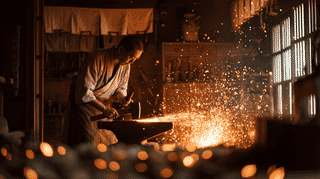
From the late Kofun period (6th century CE) onward, Japan developed a unique ironmaking method called Tatara. Using iron sand as raw material and charcoal as fuel in clay furnaces, this technique produced iron of extraordinary purity, a quality that modern blast furnaces struggle to match.
The science behind Tatara is remarkably sophisticated. Fine-grained iron sand, when fed into a charcoal fire, undergoes rapid reduction and carburization. Because the process operates at relatively low temperatures compared to modern steelmaking, harmful impurities like phosphorus and sulfur have minimal opportunity to infiltrate the iron. The result is exceptionally clean metal.
The technology reached its peak in the Edo period, particularly after the invention of the tenbin-fuigo (balance bellows) in the late 17th century. This seesaw-like device allowed continuous air supply to the furnace during operations lasting approximately 70 hours. Teams of three, called banko, worked in rotation, one pumping while two rested. The Japanese phrase "kawaribanco" (taking turns) reportedly originates from this practice.
Tatara's signature product, tamahagane (jewel steel), remains essential for Japanese sword-making. Operations continue today at the Nittoho Tatara in Okuizumo, Shimane Prefecture, though only a few times per year. Yet the complete science of Tatara remains partially mysterious, techniques passed down through oral tradition and the chemical reactions occurring within single-use clay furnaces that were destroyed after each run are still subjects of active metallurgical research.
One famous example of Tatara steel's supremacy: the nails of Horyuji Temple, which have held the 1,400-year-old wooden structure together without significant corrosion. Modern industrial steel rusts within decades, while the ultra-pure "wa-tetsu" (Japanese iron) demonstrates corrosion resistance that modern materials science is still working to understand.
Kofun Engineering: Japan's Answer to the Pyramids
Between the late 3rd and early 8th centuries, more than 200,000 burial mounds (kofun) were constructed across the Japanese archipelago. The largest, the Daisen Kofun in Sakai, Osaka (traditionally attributed to Emperor Nintoku), stretches 486 meters in length, making it one of the largest tombs ever built by any civilization.
Construction firm Obayashi Corporation calculated that building the Daisen Kofun with ancient tools would require approximately 6.8 million person-days of labor over 15 years and 8 months. At peak construction, 2,000 workers operated daily, with food preparation and tool manufacturing bringing the on-site population to around 6,000.
The tools available were rudimentary, iron-tipped spades, hoes, and bamboo carrying baskets. Yet shaping approximately 1.4 million cubic meters of earth into the precisely designed keyhole shape required surveying, soil pressure calculations, and drainage management, a complex web of civil engineering knowledge.
In recent years, LiDAR (Light Detection and Ranging) technology has enabled detailed 3D mapping of imperial tombs that remain off-limits to ground-level investigation. These aerial surveys have revealed previously unknown structural features and potential burial chambers, opening a new chapter in understanding how these monumental constructions were engineered.
Modern Science Opens a New Chapter on Ancient Japan
DNA analysis, radiocarbon dating, X-ray fluorescence, and LiDAR remote sensing, technologies unimaginable to previous generations of archaeologists, are now providing empirical answers to questions that were once matters of pure speculation.
DNA testing of chestnuts from Sannai-Maruyama proved they were cultivated species. Compositional analysis of pigments in Jomon lacquerware is now pinpointing the geographic origins of red ochre (iron oxide) and mercury vermillion used by ancient artisans. Trace element analysis of ancient iron artifacts can identify the specific iron-sand deposits from which they were smelted.
What these findings collectively demonstrate is that ancient Japanese technology was not the product of accident or mystery, but of accumulated empirical knowledge and logical thinking passed down across generations. And some of these techniques survive today in living traditions, traditional lacquerware, Japanese sword forging, and artisanal woodworking carry direct lineages from the Jomon and Kofun periods.
Meanwhile, only about 40% of the Sannai-Maruyama site has been excavated, and countless sites nationwide remain unexplored. As analytical technology accelerates, paradigm-shifting discoveries are virtually guaranteed.
In Japan, ancient "lost technologies" are gradually revealing themselves through dialogue with modern science. Does your country have ancient technologies that remain unexplained?
References
- https://jomon-japan.jp/learn/jomon-culture
- https://sannaimaruyama.pref.aomori.jp/about/iseki/
- https://tetsunomichi.gr.jp/history-and-tradition/tatara-outline/part-1/
- https://www.obayashi.co.jp/kikan_obayashi/detail/digest_kikan_20_idea.html
- https://www.gov-online.go.jp/eng/publicity/book/hlj/html/202205/202205_04_jp.html
- https://web-mu.jp/






Global Discussion
16 comments