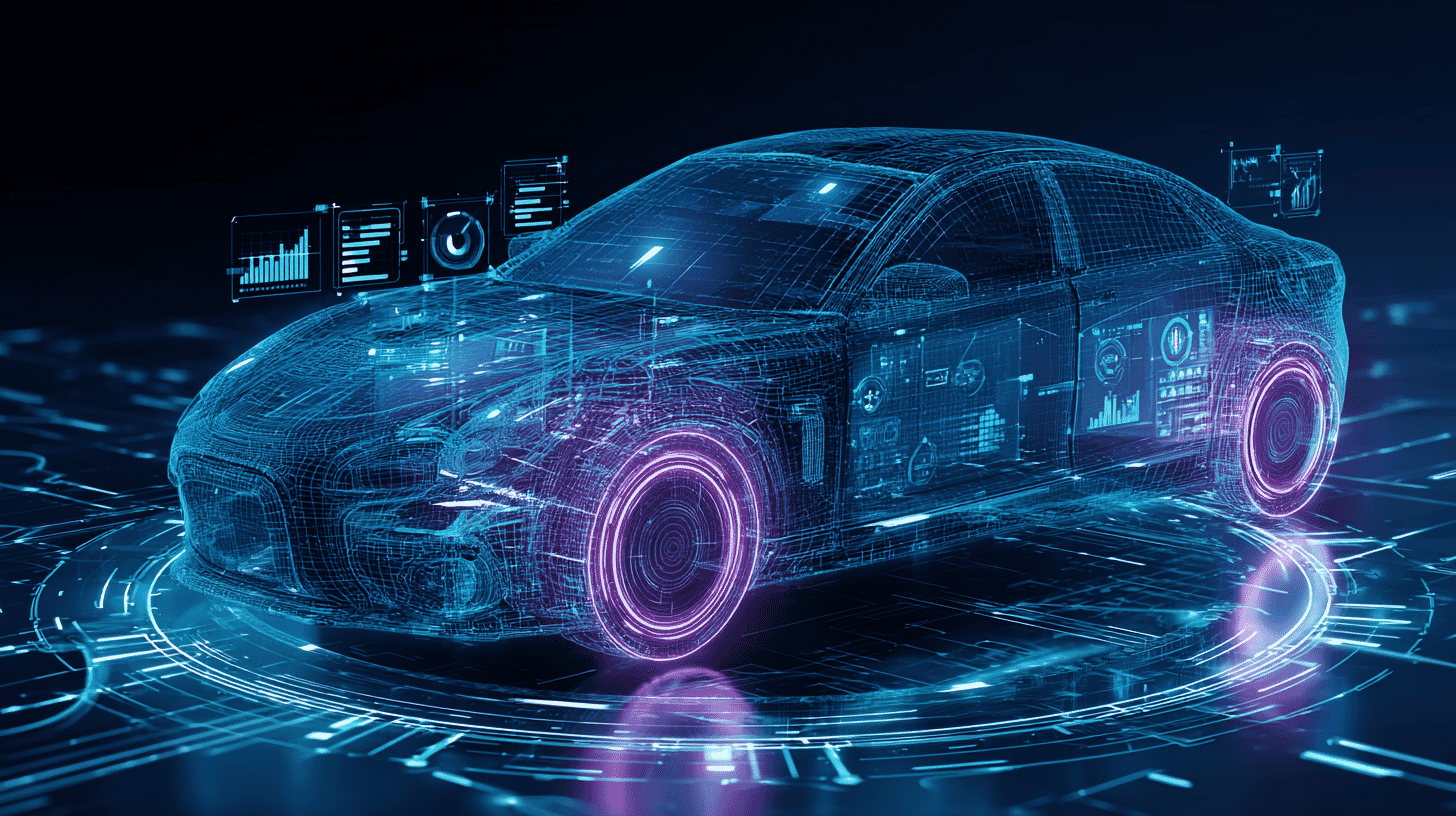
What if you could test a car's entire communication system without ever building the car? That's exactly what French automotive supplier Valeo and Japanese measurement specialist Anritsu are making possible. Their new collaboration creates a fully virtual "digital twin" testing environment for next-generation Software Defined Vehicles, allowing engineers to simulate everything from 5G connections to vehicle-to-vehicle communication entirely in the cloud. The two companies said the joint demo would debut at MWC 2026 in Barcelona in March 2026.
What Are Software Defined Vehicles, and Why Do They Matter?
Think of your smartphone. When you bought it, it had certain features, but over time, software updates added new capabilities, improved performance, and fixed bugs. Now imagine your car working the same way.
That's the core idea behind Software Defined Vehicles (SDVs). Instead of a car's features being permanently fixed at the factory, SDVs can be continuously updated and improved through software, just like your phone. New safety features, better navigation, enhanced entertainment systems, and even improved driving performance can all be delivered wirelessly after you've already bought the car.
This represents a fundamental shift in the auto industry. Traditional cars are defined by their hardware, the engine, the chassis, the physical components. SDVs flip this model: the software becomes the primary driver of a vehicle's capabilities and value.
Major automakers worldwide are racing to develop SDV platforms. Toyota, Honda, Volkswagen, BMW, and Tesla are all investing heavily, because SDVs promise not just better cars, but entirely new business models, think subscription services for premium features, pay-per-use autonomous driving, and personalized in-car experiences.
The Testing Challenge: Too Many Variables, Not Enough Time
Here's the problem. As cars become more software-driven and connected, the number of things that need testing explodes exponentially.
A modern connected car needs to communicate reliably across different cellular networks (4G, 5G), in different countries with different network operators, under varying signal conditions, while driving through tunnels, dense urban areas, rural highways, and everywhere in between. It needs to talk to other vehicles (V2V), to road infrastructure (V2I), and to cloud servers simultaneously.
Traditional testing requires building physical prototypes, setting up expensive test benches, and driving real cars through real-world scenarios. This is enormously time-consuming and costly. With the auto industry now adopting rapid software development cycles (CI/CD, Continuous Integration/Continuous Delivery), the old approach simply can't keep up.
As Gilles Mabire, CTO of Valeo's Brain Division, put it: development complexity is increasing while demands for shorter development cycles and lower costs are becoming ever more stringent.
The Solution: A Digital Twin in the Cloud
This is where the Valeo-Anritsu collaboration comes in. Together, they've created a virtualized testing solution that brings the real world into the cloud.
Anritsu's contribution is the virtual network simulation. As a leader in communications test and measurement, headquartered in Atsugi, Kanagawa Prefecture, with a history dating back to 1895, Anritsu has deep expertise in wireless testing. They've built a software-based "In-the-Loop Simulator" that can recreate real-world cellular network conditions virtually. This includes simulating multiple network operators simultaneously (Inter-MNO), various signal propagation conditions, and even vehicle-to-everything (V2X) communication scenarios.
Valeo's contribution is the virtual vehicle side. The French tech company (with approximately $23 billion in annual revenue and over 106,000 employees across 28 countries) provides virtualized hardware and ECU (Electronic Control Unit) simulation. Their telematics unit, the car's communication brain, runs as software in the cloud rather than on physical hardware.
When combined, engineers get a complete digital twin: a virtual car connected to virtual cellular networks, all running in the cloud. They can test how the car's communication systems behave under thousands of different scenarios without ever touching a physical vehicle or test track.
Koji Ogawa, General Manager of Anritsu's IoT Test Solutions Division, explained the significance: achieving reliable connectivity services requires software implementation that accounts for edge cases occurring in real-world conditions. Anritsu addresses this through a one-stop toolchain covering everything from field driving tests to lab-based software simulation.
Why This Partnership Makes Sense
The collaboration between a French automotive tier-1 supplier and a Japanese measurement company might seem unusual, but it reflects the increasingly cross-disciplinary nature of modern automotive development.
Valeo understands what automakers need from their vehicles. Anritsu understands how wireless communications work and how to test them. Neither company alone could create a comprehensive virtual testing environment, but together, they cover the complete chain from vehicle systems to network infrastructure.
This is also part of a broader trend in the Japanese automotive supply chain. Companies like Anritsu, traditionally focused on telecommunications testing, are increasingly pivoting toward automotive applications as vehicles become communication devices on wheels. Anritsu already collaborates with dSPACE on connected car simulation and has developed full-vehicle OTA (Over-The-Air) testing environments for major Japanese automakers.
The Bigger Picture: Japan's SDV Strategy
This collaboration sits within a larger context of Japan's automotive industry transformation. The Japanese government, through its Ministry of Economy, Trade and Industry (METI), has established an SDV/Data Collaboration Working Group to accelerate the shift toward software-defined vehicles.
Japanese automakers face unique pressures. While they've traditionally excelled at hardware, engines, transmissions, manufacturing quality, the SDV era demands software excellence. Companies like Tesla and Chinese EV makers have been building software-first vehicles for years. Japan's established automakers are working to close the gap, and testing infrastructure like the Valeo-Anritsu platform is a critical enabler.
Honda, for instance, has been developing its own digital twin environments for energy management and autonomous driving, using AI-driven simulation to test scenarios that would be impossible or dangerous in the real world. Toyota has invested in simulation platforms for its autonomous driving development. The common thread: virtual testing is becoming essential, not optional.
What to Expect at MWC 2026
Valeo and Anritsu said they would showcase their joint solution at Mobile World Congress 2026 in Barcelona (March 2-5), at Anritsu's booth in Hall 5, Stand D41. The demonstration will be part of Anritsu's broader showcase that includes 6G test platforms, AI-powered measurement solutions, and non-terrestrial network testing capabilities.
The Barcelona debut is significant. MWC is traditionally a telecom industry event, but the increasing convergence of automotive and communications technology means automakers and their suppliers are now major participants. A car that's always connected is, in many ways, just another device on the cellular network, and needs to be tested accordingly.
Looking Forward
The shift from physical to virtual testing isn't just about convenience or cost savings, it's about making fundamentally better cars. Virtual environments can simulate scenarios that would be impossible to test in the real world: network failures at 200 km/h, simultaneous connections across multiple countries, edge cases that happen once in a million drives but could be catastrophic when they do.
As vehicles become more connected and more software-driven, the ability to test comprehensively and rapidly will separate the leaders from the followers. The Valeo-Anritsu collaboration represents an important piece of this puzzle, one that bridges the gap between France's automotive expertise and Japan's measurement technology prowess.
What about your country? How is the automotive industry approaching software-defined vehicles and virtual testing?
References
- https://prtimes.jp/main/html/rd/p/000000293.000109169.html
- https://www.anritsu.com/ja-jp/test-measurement/solutions/automotive
- https://www.valeo.com/en/everything-you-need-to-know-about-the-software-defined-vehicle-sdv/
- https://www.valeo.com/en/valeo-at-ces-2026-las-vegas/
- https://www.meti.go.jp/policy/mono_info_service/mono/automobile/jido_soko/sdvdata_wg/







Global Discussion
13 comments