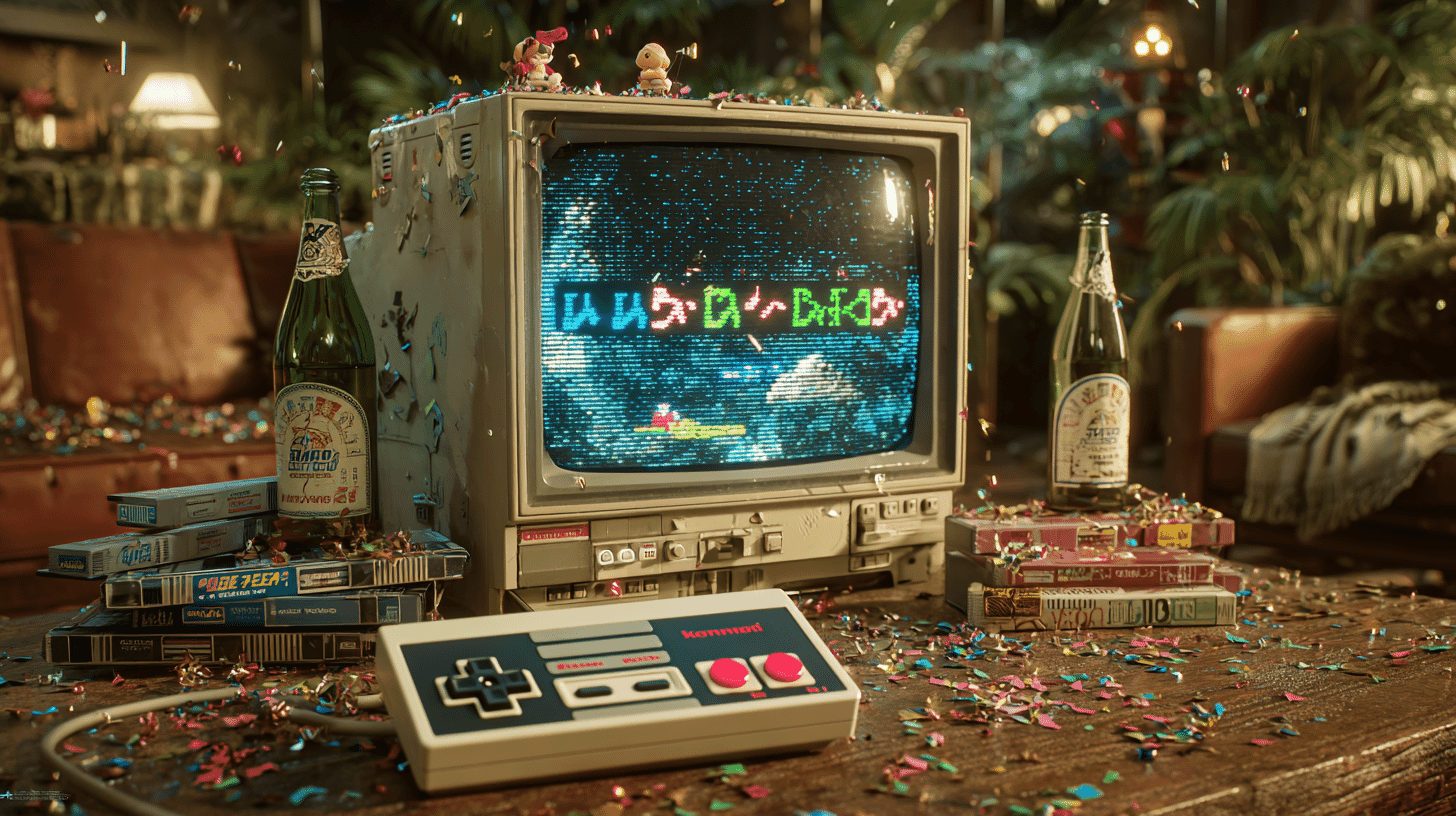
Up, Up, Down, Down, Left, Right, Left, Right, B, A. If you've ever held a controller, those ten inputs are probably burned into your memory. On April 25, 2026, the Konami Code officially turned 40, and Konami is celebrating with a special site, 98 remastered soundtrack tracks, commemorative T-shirts, and collaboration manga. But here's the part most gamers outside Japan don't know: the most famous cheat code in history was supposed to be deleted before shipping.
The Konami Code Was an Accident
On April 25, 1986, Konami released the Famicom (NES) version of Gradius in Japan. Tucked away inside the cartridge was a debug shortcut that would quietly become the most recognizable cheat code in video game history.
The person who built it was Kazuhisa Hashimoto (1958–2020), a Konami developer tasked with porting the brutally difficult arcade original to the Famicom. Unable to beat the game himself during playtesting, he wrote in a button sequence he could easily remember: ↑↑↓↓←→←→BA. Entering it while paused instantly awarded nearly every power-up. It was a purely private tool built for one person, him.
The plan was to remove the code before shipping. He forgot. The final release went out with the cheat intact, players stumbled onto it, word spread, and Konami leaned in. What started as a debug shortcut became a house tradition, embedded in dozens of the company's subsequent titles.
Hashimoto passed away in February 2020 at age 61. His death was covered by gaming press worldwide, a rare honor for a programmer, and a measure of how much his accidental legacy meant to a generation of players.
Why the World Learned It From Contra, Not Gradius
In Japan, Konami Code lore centers on Gradius. In the English-speaking world, the story pivots on a different game: Contra (1988).
The NES version of Contra, featuring those Rambo-inspired commandos dodging alien bullet storms, was notoriously punishing. Entering the Konami Code at the title screen granted 30 lives, which for many players was the difference between finishing the game and throwing the controller at the wall. That single quality-of-life gift burned the sequence into an entire generation of North American kids.
This is why, in the US, the Konami Code is often called the "Contra Code" or "30 Lives Code." The fact that it originated in Gradius two years earlier is something gaming history nerds bring up; for the average American gamer who grew up in the late 80s, Contra is where the code lives. Regional memory shapes which game gets credited.
Guinness Records, Wreck-It Ralph, and the Pop Culture Ascension
In 2010, Guinness World Records recognized the Konami Code as the most famous cheat code in video game history. But by that point, the sequence had long since escaped the boundaries of gaming.
A partial list of its cultural appearances:
- Disney's Wreck-It Ralph (2012): King Candy enters the code on a giant NES controller to unlock a hidden passage into Sugar Rush's programming.
- Family Guy Season 11: Peter tells his family to enter the code after breaking the communication system.
- Archer Season 5: Krieger's hex launch code turned out to be, per Reddit decryption, the Konami Code in disguise.
- Juice WRLD's 2020 track "Stay High": lyrics include "Up Down Left Right A B cheat codes."
- Anime Love, Chunibyo & Other Delusions: protagonist Rikka Takanashi inputs the code at a vending machine and wins a free drink in the first episode.
On the web, the code has served as an Easter egg on Facebook, ESPN, Reddit, the Bank of Canada, Chromebook Pixel, and Unreal Engine 5's Valley of the Ancient demo. On Facebook, entering the code once triggered a lens flare on every click. On Chromebook Pixel, it made the lid's LED strip blink. On the Bank of Canada site, it unlocked a hidden tribute to the space-themed Canadian $5 bill featuring Chris Hadfield.
This is what makes the Konami Code genuinely special: it's not just a gaming artifact, it's a shared language among developers. Every time a new website ships with the sequence wired in, it's a programmer tipping their hat across generations.
The r/gaming Mythology
Reddit's r/gaming, one of the largest gaming communities online, treats the Konami Code as running folklore. A few patterns repeat:
"My dad/older brother taught me this." For American kids in the 80s and 90s, the code was a rite of passage, passed down like a secret handshake. Threads built around nostalgia for the exact moment someone first saw it work on Contra regularly reach the front page decades later.
"This site has it hidden." Every major site launch kicks off a ritual hunt, someone will try the code, and if it works, the discovery gets a dedicated thread. Developers know this and keep baking it in. The cat-and-mouse has been running for roughly two decades.
"I can recite this faster than my social security number." Muscle memory posts. People genuinely cannot forget the sequence. It's been neurologically wired in.
What Konami Is Doing for the 40th
Konami Digital Entertainment launched multiple anniversary initiatives timed to the April 25 milestone.
1. Six albums, 98 tracks, now streaming. The full original soundtracks of Gradius (FC), Salamander (FC), Gradius II (FC), Gradius III (SNES), Nemesis (Game Boy), and Nemesis II (Game Boy) dropped on Spotify, Apple Music, Amazon Music, YouTube Music, Deezer, TIDAL, and more. For chiptune enthusiasts, this is a major archival release, Gradius III and the Nemesis pair come from the 2011 "Gradius Ultimate Collection" masters, while Gradius, Salamander, and Gradius II come from Konami's 2023 "Music from Konami Antiques, Family Computer" remaster project.
2. Anniversary T-shirts via Amazon Merch on Demand. Designs feature the ↑↑↓↓←→←→BA command and the Gradius 40th logo, available as print-on-demand apparel. Konami also expanded into phone cases for the same aesthetic.
3. Commemorative manga. Manga artist Shōdai Hattori, known for meme-friendly parody style, created two commemorative strips posted to X: "Nami-chan Special Edition: FC Gradius 40th" and a crossover with the classic "Nippen no Mikochan" penmanship advertising mascot.
4. Code implementation in PROJECT ZIRCON. Konami's in-development title PROJECT ZIRCON will include the Konami Code in its trial version, a self-referential wink that lets a brand-new game in 2026 accept the exact same input that worked in 1986.
Why 40 Years Matters
2026 is a milestone year for Japanese gaming. Dragon Quest also hits its 40th in April, with a commemorative exhibition. Properties from the mid-80s, the foundational era when Japan's games industry transitioned from arcades to home consoles, are now entering the same celebratory cycle that film and music went through decades ago.
But the Konami Code is a strange case even inside this trend. It isn't a game, a character, or a franchise. It's ten inputs, an information fragment, that has somehow remained commercially and culturally viable for four decades. Very few cultural artifacts work this way. Maybe HAL from 2001: A Space Odyssey. Maybe "Exterminate" from Doctor Who. That's roughly the class of icon we're talking about.
A sequence of button presses became a brand. A debug shortcut became history. And it all started because one Konami programmer in 1985 couldn't beat his own port of Gradius.
Here in Japan, That's How It Is: What About Where You're From?
For Japanese gamers in their 40s and beyond, the Konami Code is a foundational Famicom-era memory. For American millennials, it's the 30-lives lifeline from Contra. For Gen Z, it's a meme they half-know from TikToks and movies.
When did you first encounter this sequence, and in which game? In your country, does the code live more strongly as Gradius or as Contra folklore? And if you've never tried it on a random website, go do it right now, there's a good chance forty-year-old magic is still wired in under the hood somewhere.
References
- https://www.famitsu.com/article/202604/72987
- https://en.wikipedia.org/wiki/Konami_Code
- https://en.wikipedia.org/wiki/Kazuhisa_Hashimoto
- https://theretronetwork.com/konami-code/
- https://comicbook.com/gaming/feature/40-years-ago-this-code-made-gaming-history/
- https://zircon.konami.net/collab/40_UUDDLRLRBA.html






Global Discussion
13 comments