🎤 She conquered the world without ever showing her face. Now Ado has written and composed her own song, revealed a real photograph of herself, and authorized an autobiography that tells the story she's kept hidden for years. One song. One book. One massive turning point.
What Is a "Vivarium," and Why Did Ado Choose This Title?
On February 18, 2026, Japanese singer Ado released a new digital single called "Vivarium." A vivarium is a small, enclosed environment designed to replicate natural habitats for living creatures, think of a terrarium or an aquarium, but as a metaphor for something deeply personal.
Before her major debut, Ado recorded her songs inside the closet of her bedroom. That tiny, dark space was where she poured her emotions into music, dreaming of reaching listeners beyond those walls. That closet was her vivarium, a miniature garden where her artistic ecosystem took root and grew.
A Self-Written Song: Why Now?
Throughout her career, Ado's songs have been written by some of Japan's most celebrated creators. "Usseewa" (loosely translated as "Shut Up") was penned by syudou; "Shinjidai" (New Era), the massive hit from ONE PIECE FILM RED, was composed by Yasutaka Nakata; and "Sho" (Show) came from Giga and TeddyLoid. Ado's role has been to channel these compositions through her extraordinary vocal ability, an approach rooted in Japan's "utaite" culture, where singers build careers by covering and performing others' work online.
"Vivarium" breaks this pattern entirely. This time, Ado wrote both the lyrics and the melody herself, conceived as a companion piece to her autobiography. The arrangement was handled by Takafumi "CO-K" Kokei, who serves as bandmaster at her live performances. Ado described the track as a song aimed at herself, shut inside that closet.
Her label frames the song as a cry of self-doubt and loneliness, and a search for light, channelled into vocaloid rock, the style at the core of her catalogue rather than a break from it.
Her First Real Photograph: The Back of a Figure in a Closet
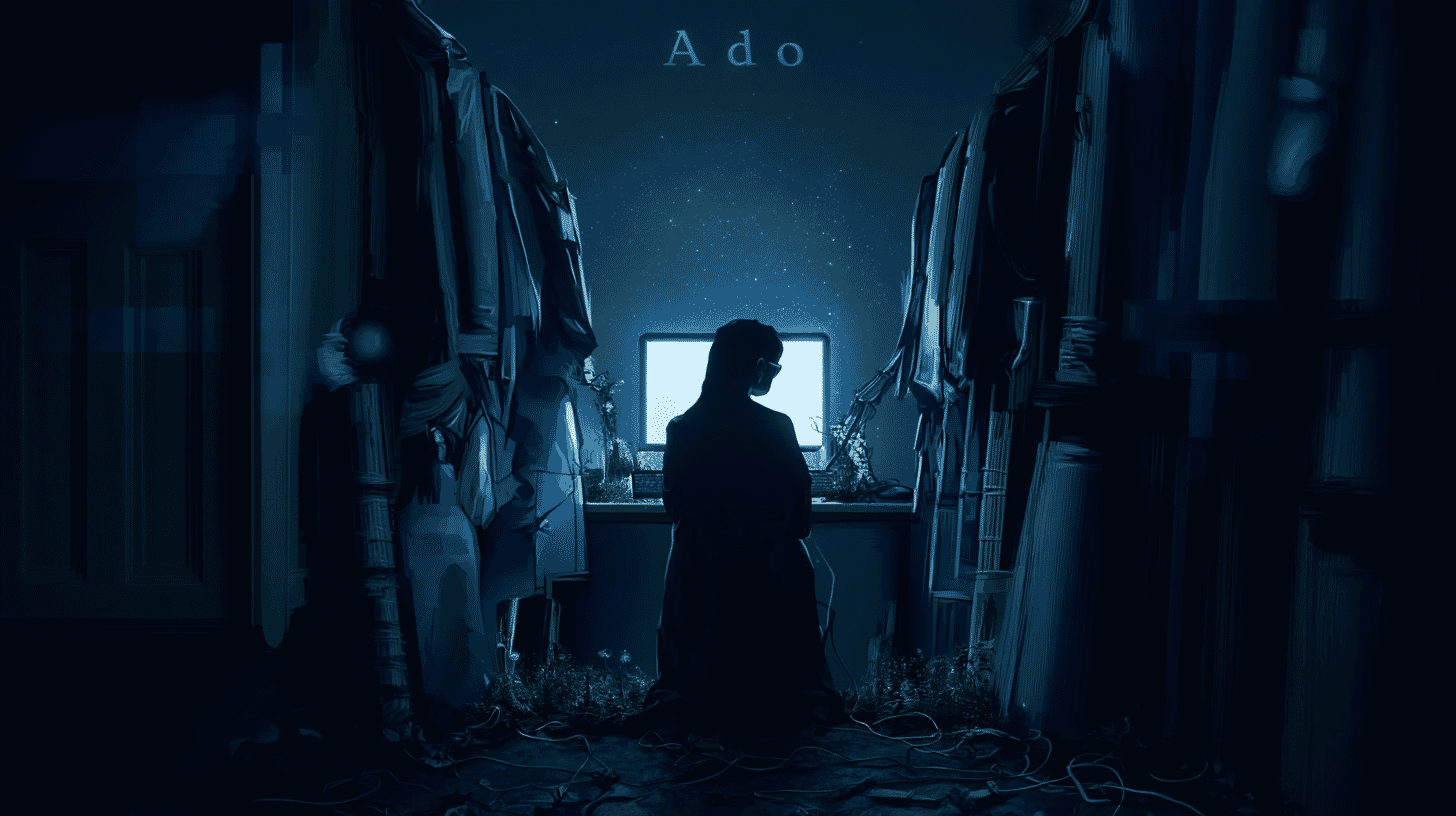
The cover artwork for "Vivarium" is a first in Ado's career. The image shows her from behind in a dark closet, her outline picked out by the glow of a computer screen. No real photograph of Ado had appeared on any of her releases before this one.
Since her debut in 2020, Ado has strictly maintained her anonymity. At live concerts, including London's O2 Arena and Japan's National Stadium, she performs behind screens and in silhouette, so audiences never see her face. This mystique has been central to her identity. Unlike masked performers such as Daft Punk or Marshmello, Ado doesn't wear a costume; she simply stays in the shadows.
Even in this cover photo, she shows only her back. But for an artist who has kept every physical detail hidden from the public, even this much feels like a seismic shift. Fans reacted with astonishment, calling it "a sign of incredible resolve" and marveling at the beauty of her profile silhouette.
The Autobiography: Vivarium: Ado and Me
Alongside the single, KADOKAWA will publish Vivarium: Ado to Watashi (Vivarium: Ado and Me) on February 26, a 336-page autobiographical novel based on three years of interviews. The author is Narumi Komatsu, a bestselling Japanese writer known for biographical works on pop star Ayumi Hamasaki (M: There Was Someone I Loved) and the band GReeeeN.
The book reveals chapters of Ado's life that have never been made public: her childhood, her years as a truant student (in Japan, school refusal or "futoko" affects hundreds of thousands of students), her discovery of Vocaloid music (songs created using voice-synthesis software like Hatsune Miku), her journey into the utaite community, and her fateful meeting with Takuya Chigira, CEO of her management agency Cloud Nine.
Ado herself commented: "I'm happy that I can finally tell this story. Why I encountered Vocaloid, why I wanted to become a singer, why I hate myself... things I've never revealed as Ado are all packed into this Vivarium."
No English-language edition has been announced at the time of writing.
From "Usseewa" to the World Stage: Ado's Journey So Far
For readers encountering Ado for the first time, here's the trajectory that brought a closet singer to global arenas:
2020: At age 17, Ado released her major debut single "Usseewa", a raw, rebellious anthem that captured the frustrations of Japanese youth. The song's YouTube music video has been viewed over 300 million times and became a cultural phenomenon in Japan, with the word "usseewa" (a rude way of saying "shut up") entering everyday vocabulary.
2021–2022: A string of hits followed, including "Odo" (Dance) and "Gira Gira." Ado became one of Japan's most-streamed artists, all without ever showing her face.
2022: The turning point for global recognition came when Ado voiced the singing role of "Uta" in ONE PIECE FILM RED. The theme song "Shinjidai" (New Era) topped charts worldwide and introduced Ado to millions of international anime fans.
2024: Ado embarked on her first world tour, "Wish," playing eight cities in Europe and North America. Her London date was at the 3,100-capacity Troxy. She also became the first female solo artist to headline Japan's National Stadium.
2025: Her second world tour, "Hibana," scaled up to arenas across more than 30 cities, selling out London's O2 Arena in June. Her first dome tour, "Yodaka," followed at home.
2026: With "Vivarium," Ado transitions from being an interpreter of others' music to an artist who tells her own story in her own words, a new phase that fans and critics are calling a pivotal evolution.
What This Means: A Turning Point in Anonymity
Update, July 2026: Ado's first live-action music video, for "Vivarium," premiered on February 28, directed by Kyotaro Hayashi and assembled from roughly 300 cuts. On July 4 and 5 she played the largest shows of her career, two nights at Nissan Stadium billed as Ado STADIUM LIVE 2026 "Ao."
This doesn't mean she's about to start doing TV interviews or unmasked concerts. But the willingness to share her personal history through a novel, put her own emotions into lyrics, and allow a real image of herself on a cover suggests a 23-year-old artist who is ready to be understood on her own terms.
The girl who once sang alone inside a closet now fills arenas around the world. With "Vivarium," she's inviting listeners inside that closet for the first time, to see the world as she saw it.
Does your country have artists who maintain anonymity or a mysterious public persona? What do you think about performing without showing your face, does it add to the art, or do you prefer knowing the person behind the voice? We'd love to hear how this concept resonates where you're from.
References
- https://realsound.jp/2026/02/post-2311319.html
- https://natalie.mu/music/news/660149
- https://www.universal-music.co.jp/ado/vivarium-2602/
- https://electricbloomwebzine.com/2026/02/ado-vivarium-photographic-cover-artwork.html
- https://onlyhit.us/en/news/ado-to-release-autobiographical-novel-and-new-song-vivarium









Global Discussion
15 comments